The Story
Plant Bio
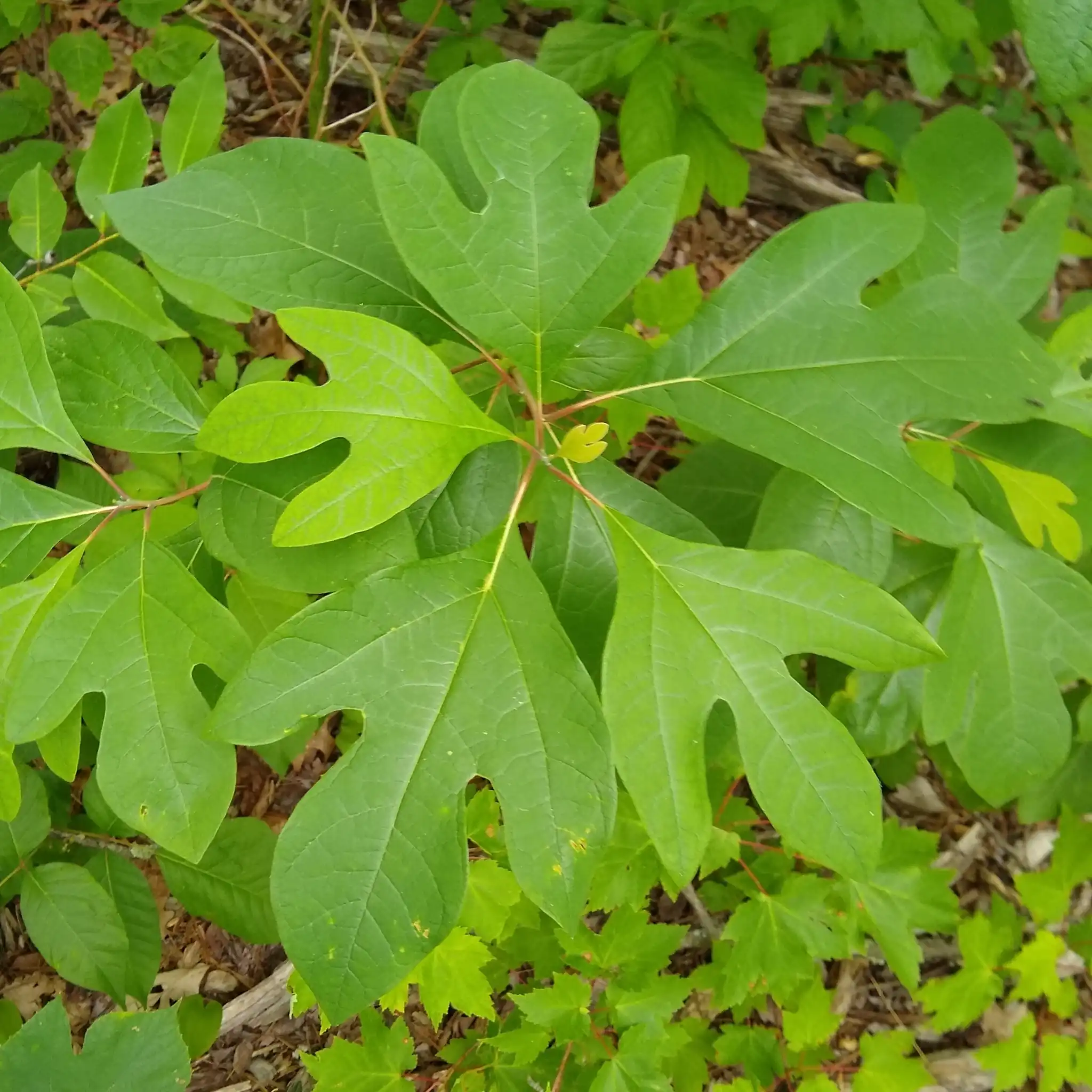
Sassafras albidum is a deciduous tree native to eastern North America, distinctive for having three unique leaf shapes (unlobed, mitten-shaped, and three-lobed) on the same tree. All parts of the plant are aromatic.
This species is celebrated for its spectacular fall foliage, a brilliant medley of yellow, orange, scarlet, and purple. It is also the primary host plant for the beautiful spicebush swallowtail butterfly.
Uses & Benefits:
Essentials
At a Glance
Plant Type
Tree
Height
480"
Width
360"
Light
Full Sun, Partial Sun
Zones
4, 5, 6, 7, 8, 9
Water
Dry to medium
Humidity
Average
Lifespan
Medium-lived tree
Native To
Eastern North America
Toxicity
Safrole in roots/bark is a mild carcinogen; not for consumption
Bloom period
Mid-spring – Late spring
In flower about 2 months of the year
Marketplace
Where to Buy
Shipping costs Year-round shipping Free shipping
Planting
How to Grow
- Choose a sunny site with acidic, sandy or loamy, well-drained soil.
- Dig a hole just deep enough for the root ball and twice as wide.
- Handle the root ball gently to avoid disturbing the sensitive roots.
- Place the tree in the hole, ensuring it's at the same depth it was in the pot.
- Backfill with native soil and water in well.
- Mulch lightly to conserve moisture.
Pro Tip
Plant a small, container-grown specimen as it develops a deep taproot quickly, making larger, field-dug trees very difficult to transplant successfully.
Keep It Thriving
Care Guide
Do
- Provide full sun for the best fall color.
- Allow space for it to spread by suckers if a naturalized grove is desired.
- Embrace its unique, often irregular growth habit.
- Protect young trees from deer browsing.
Don't
- Do not attempt to transplant mature sassafras trees from the wild.
- Avoid planting in heavy clay or alkaline soils.
- Don't overwater; it is quite drought tolerant once established.
- Avoid planting where its root suckers will be a nuisance.
Seasonal Care Calendar
| Task | Jan | Feb | Mar | Apr | May | Jun | Jul | Aug | Sep | Oct | Nov | Dec |
|---|---|---|---|---|---|---|---|---|---|---|---|---|
| Plant | ||||||||||||
| Prune |
Watch Out For
Pests & Diseases
Common Pests
Common Diseases
In the Garden
Landscape Uses & Companions
Landscape Uses
Multiply
Propagation Methods
Good to Know
Common Questions
Sassafras questions
What zones can Sassafras grow in?
Sassafras is hardy in USDA Zones 4–9. Inside that range it survives winter in the ground; outside it, grow it as an annual or a container plant you protect.
Is Sassafras deer resistant?
Yes — Sassafras is rated deer-resistant. Deer typically pass it over, though extreme hunger can override any plant's defenses.
When does Sassafras bloom?
Sassafras typically blooms in mid-spring through late spring. Exact timing shifts a week or two with your zone — Sow's bloom calendar maps it to your garden.
Does Sassafras need full sun?
Sassafras does best in full sun to part shade. In hot climates, afternoon shade keeps blooms fresher longer.
Is Sassafras drought tolerant?
Yes — once established (usually after the first full season), Sassafras handles dry spells with minimal watering. Water deeply its first year to build the root system that makes that possible.
Keep exploring
Explore the genus
Grow Sassafras with confidence
See it in a design of your actual yard, get zone-matched care reminders, and track it season by season in your garden journal.