The Story
Plant Bio
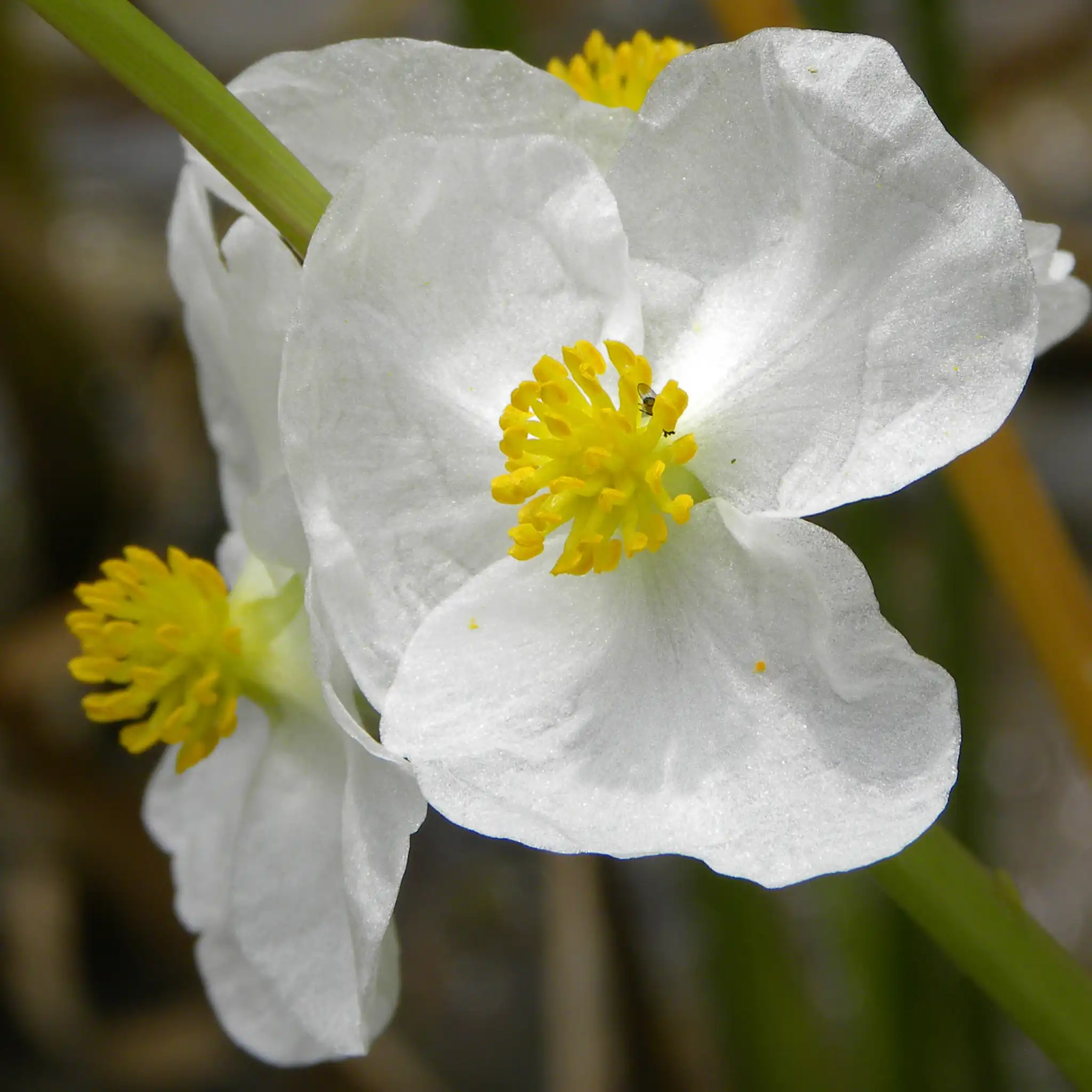
Sagittaria latifolia is an emergent aquatic perennial recognized by its striking arrowhead-shaped leaves. It produces stalks of attractive white, three-petaled flowers in summer and forms edible tubers.
The plant's starchy tubers, known as duck potatoes or wapato, are a valuable food source for waterfowl and were historically harvested by Native Americans.
Uses & Benefits:
Essentials
At a Glance
Plant Type
Aquatic
Height
36"
Width
24"
Light
Full Sun, Partial Sun
Zones
4, 5, 6, 7, 8, 9, 10
Water
High (aquatic)
Humidity
High
Lifespan
Herbaceous perennial
Native To
North and South America
Toxicity
Tubers are edible when cooked; other parts may cause upset.
Bloom period
Mid-summer – Late summer
In flower about 2 months of the year
Planting
How to Grow
- Choose a sunny spot in shallow water or saturated mud
- Plant tubers 2-4 inches deep in the substrate
- Space tubers about one foot apart to allow for spread
- Use pots with heavy loam soil to anchor them
- Submerge pots so the water level is 2-6 inches above the crown
- Provide no supplemental fertilizer in natural ponds
Pro Tip
Plant tubers in containers to prevent them from spreading too widely in natural-bottom ponds.
Keep It Thriving
Care Guide
Do
- Ensure the plant is in shallow water (up to 12 inches deep).
- Allow it to colonize to help filter water and provide habitat.
- Harvest tubers in the fall for an interesting edible crop.
Don't
- Do not plant in deep water, as it is an emergent perennial.
- Avoid planting in fast-moving water.
- Do not eat tubers raw; they must be cooked.
Seasonal Care Calendar
| Task | Jan | Feb | Mar | Apr | May | Jun | Jul | Aug | Sep | Oct | Nov | Dec |
|---|---|---|---|---|---|---|---|---|---|---|---|---|
| Harvest | ||||||||||||
| Plant | ||||||||||||
| Spring Cleanup |
Watch Out For
Pests & Diseases
Common Pests
Common Diseases
In the Garden
Landscape Uses & Companions
Landscape Uses
Multiply
Propagation Methods
Good to Know
Common Questions
Broadleaf Arrowhead questions
What zones can Broadleaf Arrowhead grow in?
Broadleaf Arrowhead is hardy in USDA Zones 4–10. Inside that range it survives winter in the ground; outside it, grow it as an annual or a container plant you protect.
Is Broadleaf Arrowhead deer resistant?
Yes — Broadleaf Arrowhead is rated deer-resistant. Deer typically pass it over, though extreme hunger can override any plant's defenses.
When does Broadleaf Arrowhead bloom?
Broadleaf Arrowhead typically blooms in mid-summer through late summer. Exact timing shifts a week or two with your zone — Sow's bloom calendar maps it to your garden.
Does Broadleaf Arrowhead need full sun?
Broadleaf Arrowhead does best in full sun to part shade. In hot climates, afternoon shade keeps blooms fresher longer.
Keep exploring
Explore the genus
Grow Broadleaf Arrowhead with confidence
See it in a design of your actual yard, get zone-matched care reminders, and track it season by season in your garden journal.