The Story
Plant Bio
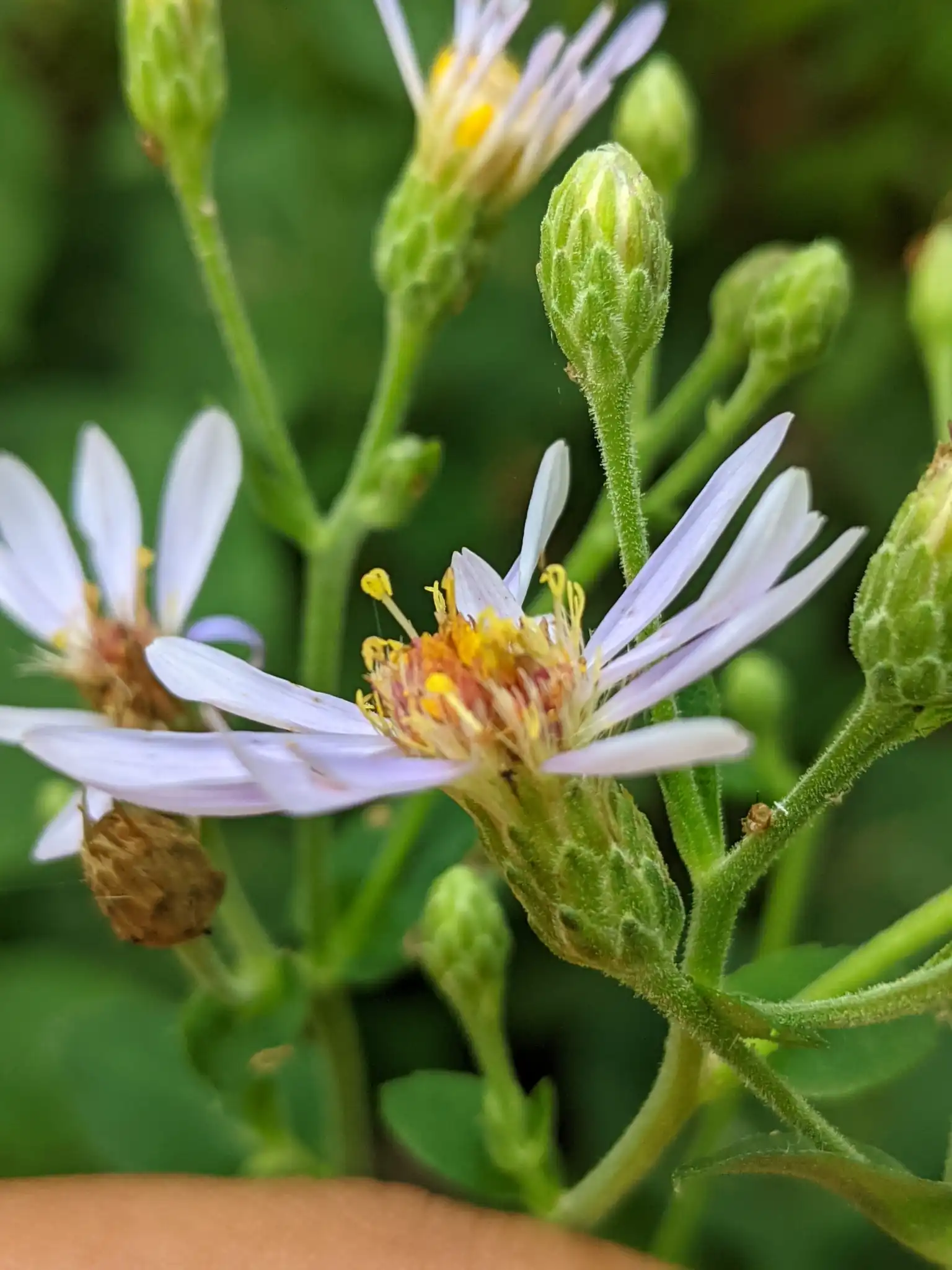
Eurybia macrophylla is a woodland perennial native to eastern North America. It forms a dense groundcover of large, heart-shaped basal leaves and sends up tall flower stalks in late summer.
This species is valued as much for its bold, weed-suppressing foliage as for its delicate, late-season flowers. It is an excellent, tough groundcover for dry shade, a notoriously difficult garden situation.
Uses & Benefits:
Essentials
At a Glance
Plant Type
Perennial
Height
30"
Width
30"
Light
Partial Sun, Shade
Zones
4, 5, 6, 7, 8
Water
Low to moderate
Humidity
Adaptable
Lifespan
Long-lived perennial
Native To
Eastern North America
Toxicity
Non-toxic
Bloom period
Late summer – Mid-fall
In flower about 3 months of the year
Planting
How to Grow
- Choose a location in partial sun to full shade.
- It is adaptable to various soils but prefers average, well-drained loam.
- Dig a hole and plant at the same depth it was in the container.
- Water well after planting to settle the soil.
- It spreads by rhizomes to form a groundcover.
- Little maintenance is required once established.
Pro Tip
Plant it where it has room to spread via rhizomes, as it will form a large, dense colony over time, especially in moist soil.
Keep It Thriving
Care Guide
Do
- Allow it to spread to form a dense groundcover.
- Water during prolonged drought, especially in the first year.
- Cut back flower stalks after they finish if desired.
- Divide in spring if you wish to propagate it or control its spread.
Don't
- Don't plant in a small, formal border where its spreading habit is unwanted.
- Don't plant in constantly waterlogged soil.
- Avoid overhead watering to reduce the risk of powdery mildew.
- Don't fertilize; it thrives in average to poor soil.
Seasonal Care Calendar
| Task | Jan | Feb | Mar | Apr | May | Jun | Jul | Aug | Sep | Oct | Nov | Dec |
|---|---|---|---|---|---|---|---|---|---|---|---|---|
| Divide | ||||||||||||
| Plant | ||||||||||||
| Spring Cleanup |
Watch Out For
Pests & Diseases
Common Pests
Common Diseases
In the Garden
Landscape Uses & Companions
Landscape Uses
Multiply
Propagation Methods
Good to Know
Common Questions
Big-leaved Aster questions
What zones can Big-leaved Aster grow in?
Big-leaved Aster is hardy in USDA Zones 4–8. Inside that range it survives winter in the ground; outside it, grow it as an annual or a container plant you protect.
Is Big-leaved Aster deer resistant?
Yes — Big-leaved Aster is rated deer-resistant. Deer typically pass it over, though extreme hunger can override any plant's defenses.
When does Big-leaved Aster bloom?
Big-leaved Aster typically blooms in late summer through mid-fall. Exact timing shifts a week or two with your zone — Sow's bloom calendar maps it to your garden.
Does Big-leaved Aster need full sun?
Big-leaved Aster does best in part shade.
Is Big-leaved Aster drought tolerant?
Yes — once established (usually after the first full season), Big-leaved Aster handles dry spells with minimal watering. Water deeply its first year to build the root system that makes that possible.
More Eurybia to compare
Keep exploring
Explore the genus
Hardy in your zone?
Grow Big-leaved Aster with confidence
See it in a design of your actual yard, get zone-matched care reminders, and track it season by season in your garden journal.