
The Story
Plant Bio
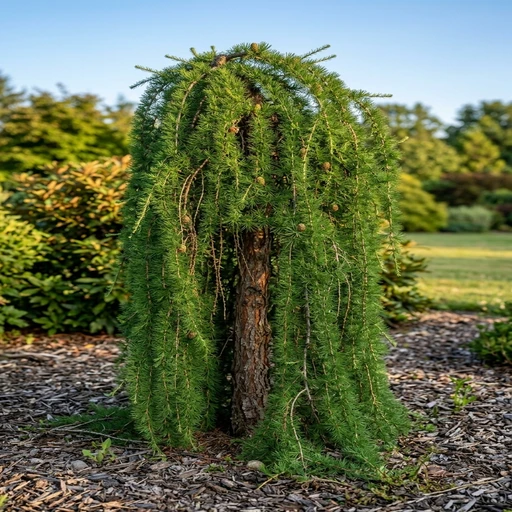
Larix laricina, commonly known as Tamarack or American Larch, is a unique deciduous conifer native to North America. It has soft, blue-green needles that turn a brilliant golden-yellow in fall before dropping.
Its most distinctive feature is being a conifer that loses its needles in winter, providing a fine-textured silhouette against the snow. It thrives in wet, boggy soils where other trees struggle.
Uses & Benefits:
Essentials
At a Glance
Plant Type
Tree
Height
720"
Width
360"
Light
Full Sun
Zones
4, 5, 6
Water
High
Humidity
High
Lifespan
Long-lived deciduous conifer
Native To
North America
Toxicity
Non-toxic
Bloom period
Early spring – Mid-spring
In flower about 2 months of the year
Planting
How to Grow
- Select a site in full sun with moist to wet, acidic soil.
- It is intolerant of shade and dry, alkaline soils.
- Dig a wide, shallow hole for the root system.
- Plant at the same depth it was growing in the container.
- Backfill with native soil and water in well to remove air pockets.
- Mulch to conserve moisture, though often unnecessary in wet sites.
Pro Tip
Do not panic in the fall when the needles turn yellow and drop; this is normal for this deciduous conifer.
Keep It Thriving
Care Guide
Do
- Provide ample sunlight; it is very shade intolerant.
- Plant in consistently moist or wet soil for best results.
- Allow plenty of room for its ultimate height and spread.
- Enjoy its unique seasonal changes, especially the fall color.
Don't
- Don't plant in shade or in dry locations.
- Avoid planting near black walnut trees, as it is sensitive to juglone.
- Don't be alarmed by fall needle drop; it is not an evergreen.
- Avoid high pH soils.
Seasonal Care Calendar
| Task | Jan | Feb | Mar | Apr | May | Jun | Jul | Aug | Sep | Oct | Nov | Dec |
|---|---|---|---|---|---|---|---|---|---|---|---|---|
| Prune |
Watch Out For
Pests & Diseases
Common Pests
Common Diseases
In the Garden
Landscape Uses & Companions
Landscape Uses
Multiply
Propagation Methods
Good to Know
Common Questions
Tamarack questions
What zones can Tamarack grow in?
Tamarack is hardy in USDA Zones 4–6. Inside that range it survives winter in the ground; outside it, grow it as an annual or a container plant you protect.
Is Tamarack deer resistant?
Not reliably. Deer may browse Tamarack, especially tender spring growth — plan on repellents or fencing where pressure is high.
When does Tamarack bloom?
Tamarack typically blooms in early spring through mid-spring. Exact timing shifts a week or two with your zone — Sow's bloom calendar maps it to your garden.
Does Tamarack need full sun?
Tamarack does best in full sun (6+ hours).
More Larix to compare
Keep exploring
Explore the genus
Hardy in your zone?
Grow Tamarack with confidence
See it in a design of your actual yard, get zone-matched care reminders, and track it season by season in your garden journal.