
The Story
Plant Bio
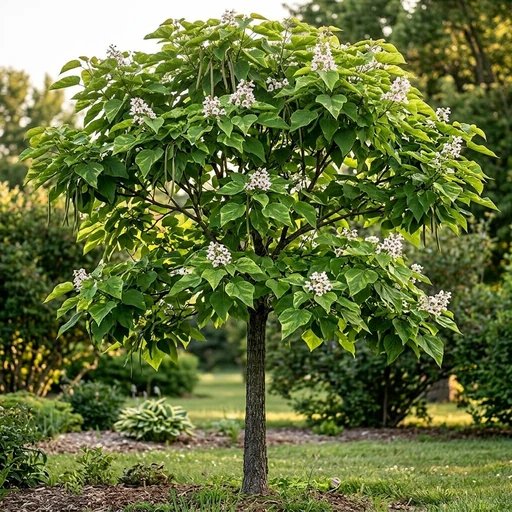
Catalpa speciosa, the Northern Catalpa, is a tough, fast-growing North American native tree. It is characterized by its huge, heart-shaped leaves, showy panicles of orchid-like white flowers, and long, bean-like seed pods that persist through winter.
'Hiawatha 2', sold as Heartland Catalpa, is a cultivar selected for a straighter, more uniform central trunk than is typical for the often-crooked species. This makes it a more reliable and predictable choice for landscape and street tree use.
Uses & Benefits:
Essentials
At a Glance
Plant Type
Tree
Height
600"
Width
360"
Light
Full Sun, Partial Sun
Zones
4, 5, 6, 7, 8
Water
Low to moderate
Humidity
Adaptable
Lifespan
Medium (around 60 years)
Native To
Midwestern United States
Toxicity
Parts of the plant can be mildly toxic if ingested.
Bloom period
Late spring – Early summer
In flower about 2 months of the year
Planting
How to Grow
- Choose a site with full sun for best flowering.
- This tree is highly adaptable to almost any soil type.
- Dig a hole twice the width of the root ball.
- Set the tree in the hole, ensuring the root flare is at ground level.
- Backfill with soil and water deeply to settle.
- Mulch to conserve moisture, but it's not essential for this tough tree.
Pro Tip
Be prepared for leaf and seed pod litter; this is a 'messy' tree best sited away from patios and walkways.
Keep It Thriving
Care Guide
Do
- Give it plenty of room to grow to its large mature size.
- Water during extreme drought, but it is generally self-sufficient once established.
- Enjoy its unique, coarse texture and bold appearance in the landscape.
- Prune young trees to encourage a single, strong leader.
Don't
- Don't plant it in a small yard or close to buildings.
- Avoid planting over areas where you don't want flower, leaf, and pod drop.
- Don't top the tree, as this will ruin its structure and lead to weak regrowth.
- Don't worry about poor soil; it will likely thrive anyway.
Seasonal Care Calendar
| Task | Jan | Feb | Mar | Apr | May | Jun | Jul | Aug | Sep | Oct | Nov | Dec |
|---|---|---|---|---|---|---|---|---|---|---|---|---|
| Plant | ||||||||||||
| Prune |
Watch Out For
Pests & Diseases
Common Pests
Common Diseases
In the Garden
Landscape Uses & Companions
Landscape Uses
Multiply
Propagation Methods
Good to Know
Common Questions
Heartland Catalpa questions
What zones can Heartland Catalpa grow in?
Heartland Catalpa is hardy in USDA Zones 4–8. Inside that range it survives winter in the ground; outside it, grow it as an annual or a container plant you protect.
Is Heartland Catalpa deer resistant?
Yes — Heartland Catalpa is rated deer-resistant. Deer typically pass it over, though extreme hunger can override any plant's defenses.
When does Heartland Catalpa bloom?
Heartland Catalpa typically blooms in late spring through early summer. Exact timing shifts a week or two with your zone — Sow's bloom calendar maps it to your garden.
Does Heartland Catalpa need full sun?
Heartland Catalpa does best in full sun to part shade. In hot climates, afternoon shade keeps blooms fresher longer.
Is Heartland Catalpa drought tolerant?
Yes — once established (usually after the first full season), Heartland Catalpa handles dry spells with minimal watering. Water deeply its first year to build the root system that makes that possible.
More Catalpa to compare
Keep exploring
Explore the genus
Hardy in your zone?
Grow Heartland Catalpa with confidence
See it in a design of your actual yard, get zone-matched care reminders, and track it season by season in your garden journal.