The Story
Plant Bio
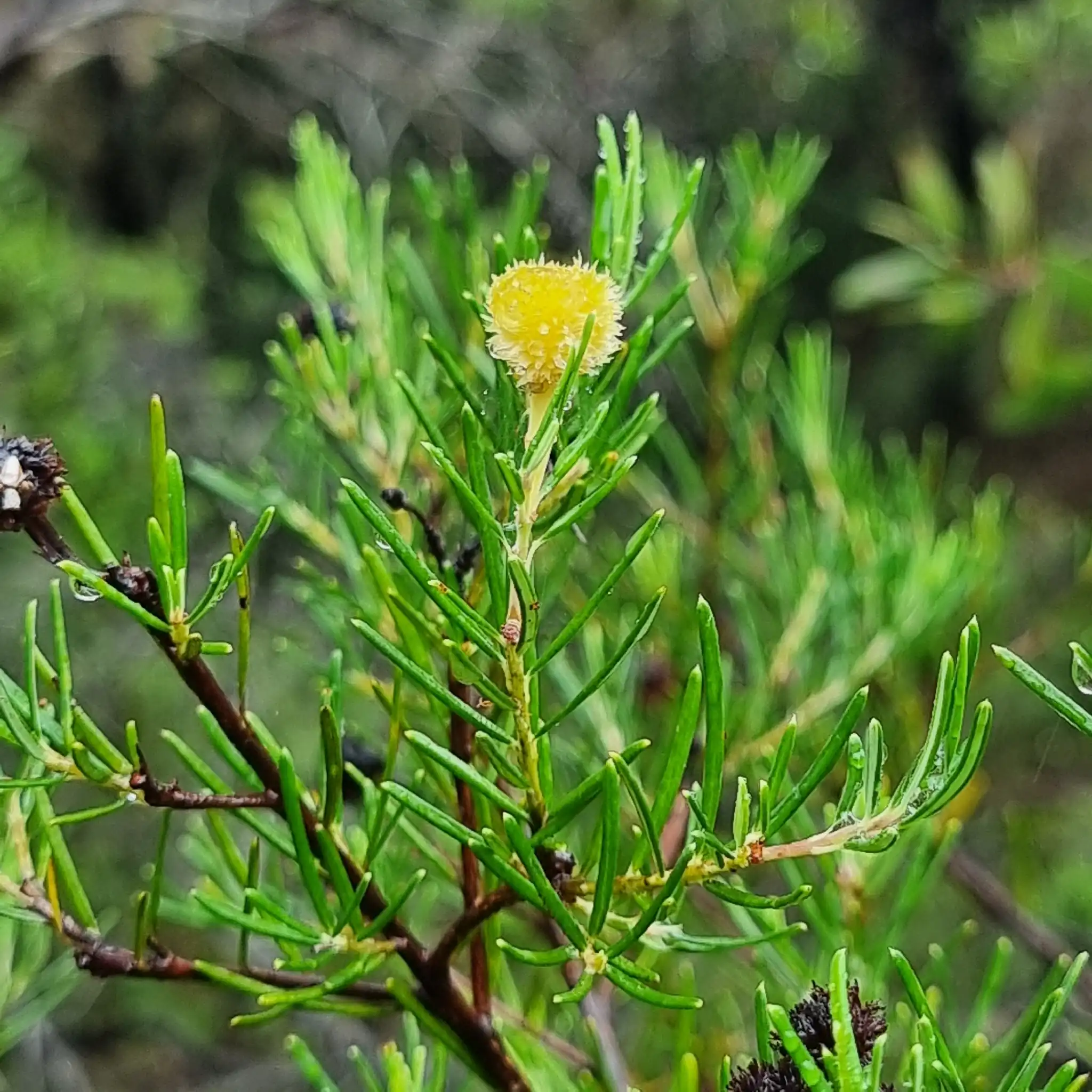
Ricinocarpos pinifolius, commonly known as wedding bush, is an erect, multi-stemmed evergreen shrub native to coastal heathlands of eastern and southern Australia. It features rigid, pine-like linear leaves with rolled margins and produces a profusion of brilliant white, five-petaled flowers with yellow centers from winter through spring.
This species is highly adapted to coastal environments, demonstrating exceptional tolerance to salt-laden winds and sandy, low-nutrient soils. The narrow, stiff foliage resembles pine needles, providing a fine-textured architectural presence even when the plant is not in bloom.
Uses & Benefits:
Essentials
At a Glance
Plant Type
Shrub
Height
118"
Width
98"
Light
Full Sun, Partial Sun
Zones
9, 10
Water
Low
Humidity
High
Lifespan
Perennial
Native To
Australia
Toxicity
Sap may cause skin irritation or mild toxicity if ingested
Bloom period
Winter – Spring
In flower about 6 months of the year
Planting
How to Grow
- Select a planting site in full sun to partial shade with sandy, exceptionally well-draining soil.
- Ensure the soil pH is acidic to neutral, ideally ranging between 5.0 and 6.5.
- Water regularly during the first growing season to establish a deep root system, then reduce watering to rely on natural rainfall.
- Apply a low-phosphorus, slow-release fertilizer formulated for native plants sparingly in spring, avoiding standard high-phosphorus commercial fertilizers.
Pro Tip
Never prune hard into old, leafless wood, as this shrub lacks dormant buds on mature stems and will fail to shoot; instead, perform light tip-pruning immediately after flowering to maintain a dense, compact form.
Keep It Thriving
Care Guide
Do
- Plant in sandy or sandstone-derived soils with exceptional drainage.
- Tip-prune lightly after flowering to encourage a bushy habit.
- Use a low-phosphorus native plant fertilizer if feeding is necessary.
Don't
- Do not prune hard into old, brown, leafless wood.
- Do not plant in heavy, poorly draining clay soils.
- Do not overwater, which triggers fatal root rot.
Seasonal Care Calendar
| Task | Jan | Feb | Mar | Apr | May | Jun | Jul | Aug | Sep | Oct | Nov | Dec |
|---|---|---|---|---|---|---|---|---|---|---|---|---|
| Fertilize | ||||||||||||
| Pest Check | ||||||||||||
| Propagate | ||||||||||||
| Prune |
Watch Out For
Pests & Diseases
Common Pests
Common Diseases
In the Garden
Landscape Uses & Companions
Landscape Uses
Multiply
Propagation Methods
Good to Know
Common Questions
Wedding Bush questions
What zones can Wedding Bush grow in?
Wedding Bush is hardy in USDA Zones 9–10. Inside that range it survives winter in the ground; outside it, grow it as an annual or a container plant you protect.
When does Wedding Bush bloom?
Wedding Bush typically blooms in winter through spring. Exact timing shifts a week or two with your zone — Sow's bloom calendar maps it to your garden.
Does Wedding Bush need full sun?
Wedding Bush does best in full sun to part shade. In hot climates, afternoon shade keeps blooms fresher longer.
Is Wedding Bush drought tolerant?
Yes — once established (usually after the first full season), Wedding Bush handles dry spells with minimal watering. Water deeply its first year to build the root system that makes that possible.
Keep exploring
Explore the genus
Hardy in your zone?
Grow Wedding Bush with confidence
See it in a design of your actual yard, get zone-matched care reminders, and track it season by season in your garden journal.