The Story
Plant Bio
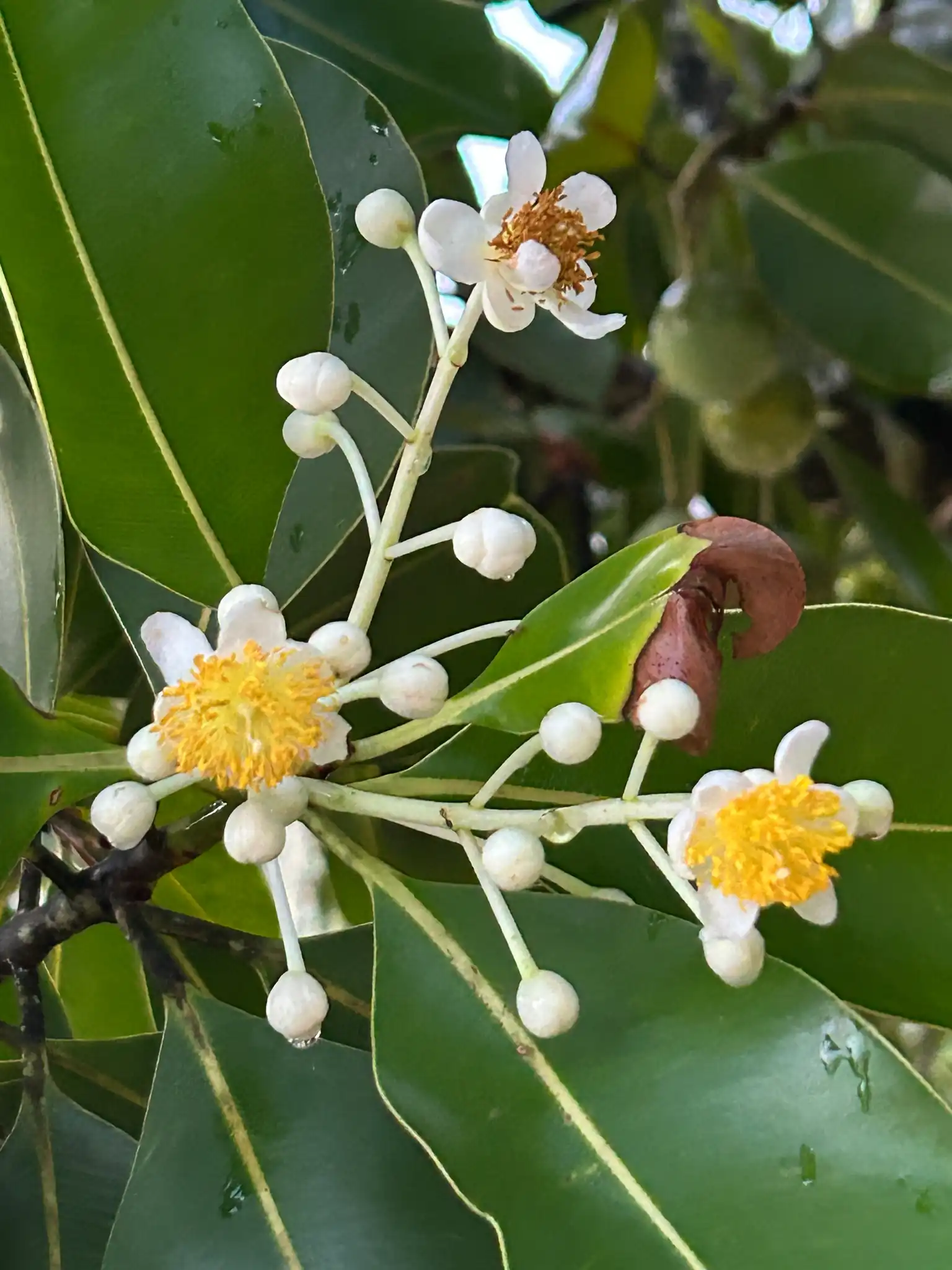
Calophyllum inophyllum, the Alexandrian laurel, is a broad-canopied, evergreen tropical tree that develops a heavy, leaning trunk and a dense, rounded crown of glossy, leathery leaves. The fragrant white flowers feature prominent yellow stamens and bloom in short clusters, giving way to large, spherical green drupes.
This species is highly valued for its exceptional tolerance to salt spray, wind, and sandy coastal soils, making it a premier shade tree for maritime environments. The thick, dark green foliage features distinctive, closely spaced parallel veins running perpendicular to the midrib, with new leaves emerging in warm pinkish-bronze tones.
Uses & Benefits:
Essentials
At a Glance
Plant Type
Tree
Height
315"
Width
315"
Light
Full Sun, Partial Sun
Zones
10
Water
Low to moderate
Humidity
High
Lifespan
Long-lived
Native To
Asia, East Africa, Madagascar, Australia, Pacific Islands
Toxicity
Toxic if ingested; skin irritant
Bloom period
Spring – Summer
In flower about 6 months of the year
Planting
How to Grow
- Plant in a full sun location with highly draining sandy, loamy, or calcareous soil.
- Water regularly during the first growing season to establish a deep, drought-tolerant root system.
- Train young trees to a single, well-spaced leader to establish a strong structural framework.
- Avoid planting in heavy clay or low-lying areas prone to standing water or waterlogging.
Pro Tip
Never shear or pollard this tree to control its size; aggressive pruning into old, leafless wood results in poor recovery and invites wood-boring pests.
Keep It Thriving
Care Guide
Do
- Provide excellent drainage to prevent root rot pathogens.
- Protect young trees from any exposure to freezing temperatures.
- Apply a balanced slow-release fertilizer sparingly to young container plants during active growth.
Don't
- Do not prune aggressively into old, bare wood.
- Do not plant in heavy, poorly drained clay soils.
- Do not ingest any part of the seeds, oil, or latex, which are toxic.
Seasonal Care Calendar
| Task | Jan | Feb | Mar | Apr | May | Jun | Jul | Aug | Sep | Oct | Nov | Dec |
|---|---|---|---|---|---|---|---|---|---|---|---|---|
| Fertilize | ||||||||||||
| Pest Check | ||||||||||||
| Prune | ||||||||||||
| Winter Prep |
Watch Out For
Pests & Diseases
Common Pests
Common Diseases
In the Garden
Landscape Uses & Companions
Landscape Uses
Companion Plants
Multiply
Propagation Methods
Good to Know
Common Questions
Alexandrian Laurel questions
What zones can Alexandrian Laurel grow in?
Alexandrian Laurel is hardy in USDA Zone 10. Inside that range it survives winter in the ground; outside it, grow it as an annual or a container plant you protect.
When does Alexandrian Laurel bloom?
Alexandrian Laurel typically blooms in spring through summer. Exact timing shifts a week or two with your zone — Sow's bloom calendar maps it to your garden.
Does Alexandrian Laurel need full sun?
Alexandrian Laurel does best in full sun to part shade. In hot climates, afternoon shade keeps blooms fresher longer.
Is Alexandrian Laurel drought tolerant?
Yes — once established (usually after the first full season), Alexandrian Laurel handles dry spells with minimal watering. Water deeply its first year to build the root system that makes that possible.
Keep exploring
Explore the genus
Hardy in your zone?
Grow Alexandrian Laurel with confidence
See it in a design of your actual yard, get zone-matched care reminders, and track it season by season in your garden journal.