The Story
Plant Bio
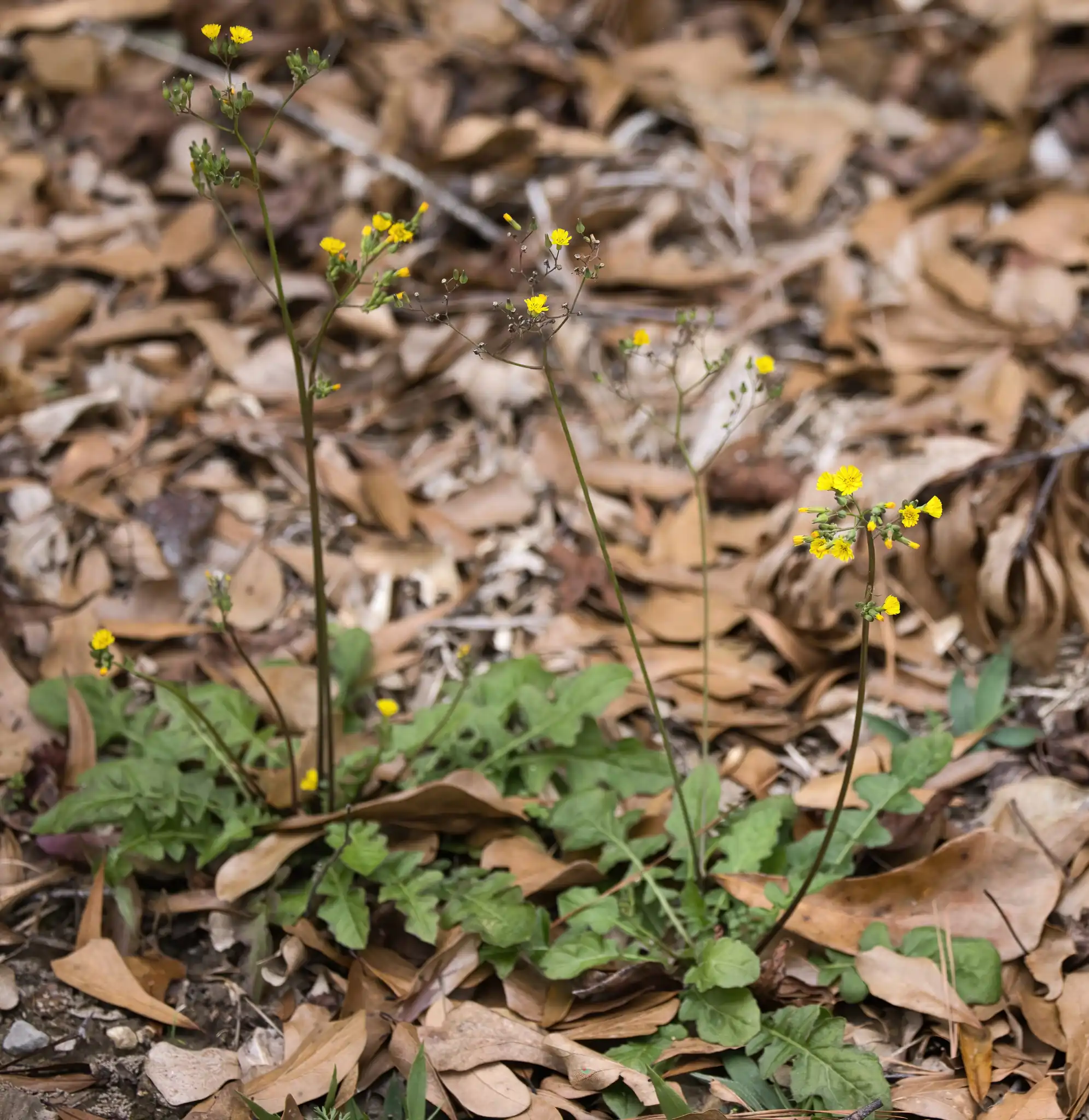
Youngia japonica is a herbaceous annual or short-lived perennial forming a flat basal rosette of deeply lobed, hairy leaves from which slender, hollow flowering stems arise. The plant exudes a milky white latex when stems or leaves are broken and produces small, yellow, dandelion-like flower heads in loose, branching clusters.
This species is distinguished by its highly invasive nature in disturbed soils and its ability to flower and set seed rapidly throughout the growing season. The tiny, wind-dispersed seeds are equipped with a white, feathery pappus that allows them to colonize container nurseries and garden beds aggressively.
Uses & Benefits:
Essentials
At a Glance
Plant Type
Annual
Height
24"
Width
12"
Light
Full Sun, Partial Sun, Shade
Zones
5, 6, 7, 8, 9, 10
Water
Low to Moderate
Humidity
High
Lifespan
Annual
Native To
Asia
Toxicity
Non-toxic
Bloom period
Spring – Summer
In flower about 6 months of the year
Planting
How to Grow
- Identify the flat basal rosettes in early spring or autumn during peak germination flushes.
- Hand-pull the entire plant, ensuring the central taproot is completely extracted from moist soil.
- Apply a thick layer of organic mulch over cleared areas to suppress seed germination by blocking light.
- Dispose of pulled plants immediately in trash bags if flower heads are present to prevent wind-dispersal of seeds.
Pro Tip
Sever the root crown below the soil line or hand-pull the entire taproot before flowering; surface mowing fails to control the plant because the remaining crown readily regenerates new shoots.
Keep It Thriving
Care Guide
Do
- Monitor garden beds continuously during spring and autumn for newly emerged rosettes.
- Extract the central taproot completely when hand-pulling to prevent regrowth.
- Apply pre-emergent controls in early spring if managing large, established infestations.
Don't
- Do not mow or cut the plant at the soil line, as the remaining root crown will quickly resprout.
- Do not compost pulled plants that have active flower heads or developing seed structures.
- Do not apply supplemental fertilizer, as this weed thrives and spreads rapidly in nutrient-rich soils.
Seasonal Care Calendar
| Task | Jan | Feb | Mar | Apr | May | Jun | Jul | Aug | Sep | Oct | Nov | Dec |
|---|---|---|---|---|---|---|---|---|---|---|---|---|
| Mulch | ||||||||||||
| Pest Check | ||||||||||||
| Prune | ||||||||||||
| Spring Cleanup |
Watch Out For
Pests & Diseases
Common Pests
Common Diseases
In the Garden
Landscape Uses & Companions
Landscape Uses
Multiply
Propagation Methods
Good to Know
Common Questions
Oriental False Hawksbeard questions
What zones can Oriental False Hawksbeard grow in?
Oriental False Hawksbeard is hardy in USDA Zones 5–10. Inside that range it survives winter in the ground; outside it, grow it as an annual or a container plant you protect.
When does Oriental False Hawksbeard bloom?
Oriental False Hawksbeard typically blooms in spring through summer. Exact timing shifts a week or two with your zone — Sow's bloom calendar maps it to your garden.
Does Oriental False Hawksbeard need full sun?
Oriental False Hawksbeard does best in full sun to part shade. In hot climates, afternoon shade keeps blooms fresher longer.
Keep exploring
Explore the genus
Grow Oriental False Hawksbeard with confidence
See it in a design of your actual yard, get zone-matched care reminders, and track it season by season in your garden journal.