The Story
Plant Bio
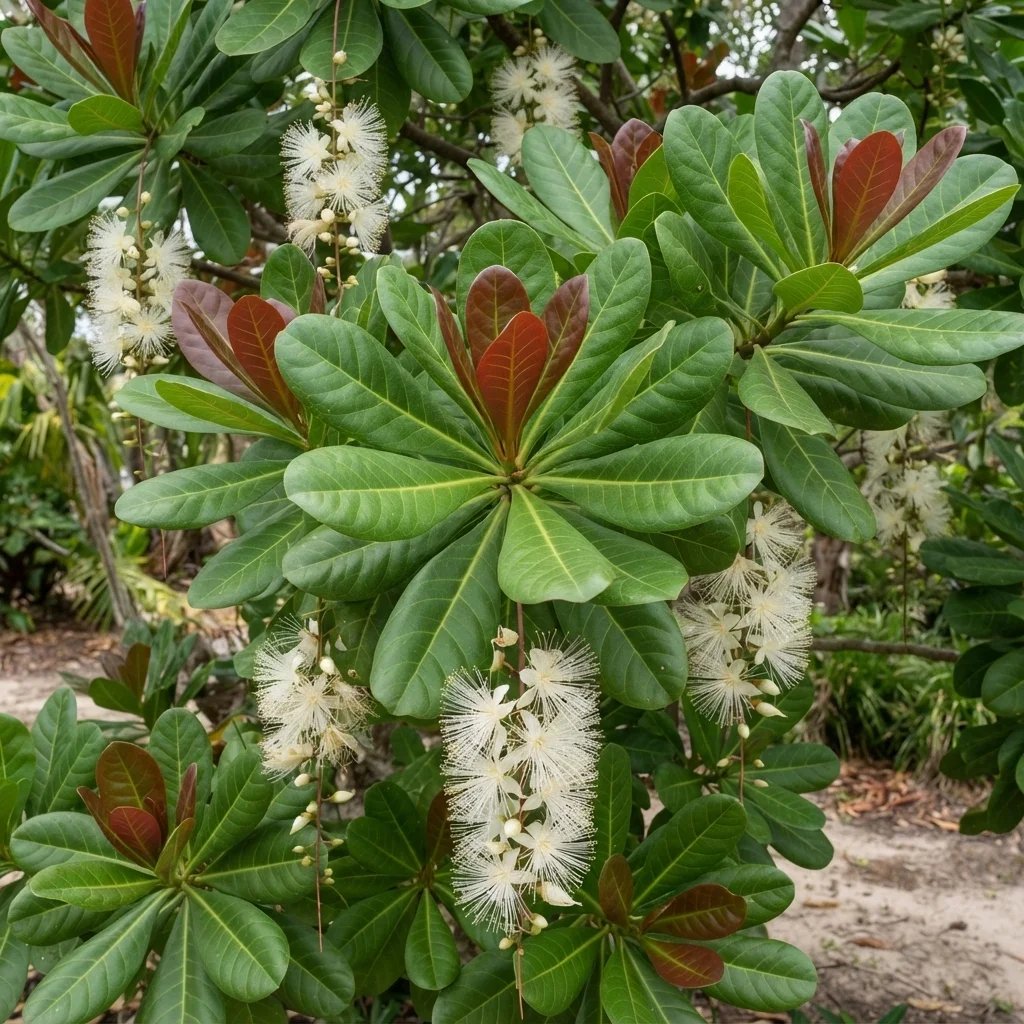
Barringtonia asiatica, commonly known as the fish poison tree, is a massive evergreen coastal tree native to the sandy shores of the Indian and Pacific Oceans. It develops a short, swollen trunk supporting a dense, rounded canopy of large, leathery leaves clustered at the branch tips.
The species is distinguished by its spectacular, night-blooming flowers that feature a dense, brush-like cluster of long white stamens tipped with pink. These are followed by large, buoyant, box-shaped fruits that drift on ocean currents to colonize new beaches.
Uses & Benefits:
Essentials
At a Glance
Plant Type
Tree
Height
787"
Width
630"
Light
Full Sun, Partial Sun
Zones
10
Water
Moderate
Humidity
High
Lifespan
Long-lived
Native To
Indian and Western Pacific Oceans
Toxicity
Highly toxic if ingested; sap is a skin irritant
Bloom period
Spring – Summer
In flower about 6 months of the year
Planting
How to Grow
- Select a planting site in full sun with deep, sandy or organic-rich soil that mimics a coastal beach environment.
- Dig a hole twice the width of the root ball and plant at the same depth as the container, backfilling with native soil.
- Water deeply and regularly during the first year to establish a deep, resilient root system.
- Apply a thick layer of organic mulch around the base to retain moisture and suppress weeds, keeping the mulch away from the trunk.
Pro Tip
Plant this tree well away from walkways, driveways, and structures to prevent the heavy, box-shaped fruits and large falling leaves from causing physical damage or creating a safety hazard.
Keep It Thriving
Care Guide
Do
- Provide plenty of space for the canopy to spread naturally without crowding.
- Water regularly during dry spells to maintain optimal growth and foliage density.
- Protect young trees from any exposure to cold drafts or temperatures near freezing.
Don't
- Do not prune aggressively into old, leafless wood, as re-sprouting from old wood is poor.
- Do not plant near parking lots or sidewalks where falling heavy fruits can cause damage.
- Do not allow livestock or pets to chew on the toxic bark, leaves, or seeds.
Seasonal Care Calendar
| Task | Jan | Feb | Mar | Apr | May | Jun | Jul | Aug | Sep | Oct | Nov | Dec |
|---|---|---|---|---|---|---|---|---|---|---|---|---|
| Fertilize | ||||||||||||
| Pest Check | ||||||||||||
| Propagate | ||||||||||||
| Prune |
Watch Out For
Pests & Diseases
Common Pests
Common Diseases
In the Garden
Landscape Uses & Companions
Landscape Uses
Companion Plants
Multiply
Propagation Methods
Good to Know
Common Questions
Fish Poison Tree questions
What zones can Fish Poison Tree grow in?
Fish Poison Tree is hardy in USDA Zone 10. Inside that range it survives winter in the ground; outside it, grow it as an annual or a container plant you protect.
Is Fish Poison Tree deer resistant?
Yes — Fish Poison Tree is rated deer-resistant. Deer typically pass it over, though extreme hunger can override any plant's defenses.
When does Fish Poison Tree bloom?
Fish Poison Tree typically blooms in spring through summer. Exact timing shifts a week or two with your zone — Sow's bloom calendar maps it to your garden.
Does Fish Poison Tree need full sun?
Fish Poison Tree does best in full sun to part shade. In hot climates, afternoon shade keeps blooms fresher longer.
Is Fish Poison Tree drought tolerant?
Yes — once established (usually after the first full season), Fish Poison Tree handles dry spells with minimal watering. Water deeply its first year to build the root system that makes that possible.
Keep exploring
Explore the genus
Hardy in your zone?
Grow Fish Poison Tree with confidence
See it in a design of your actual yard, get zone-matched care reminders, and track it season by season in your garden journal.