The Story
Plant Bio
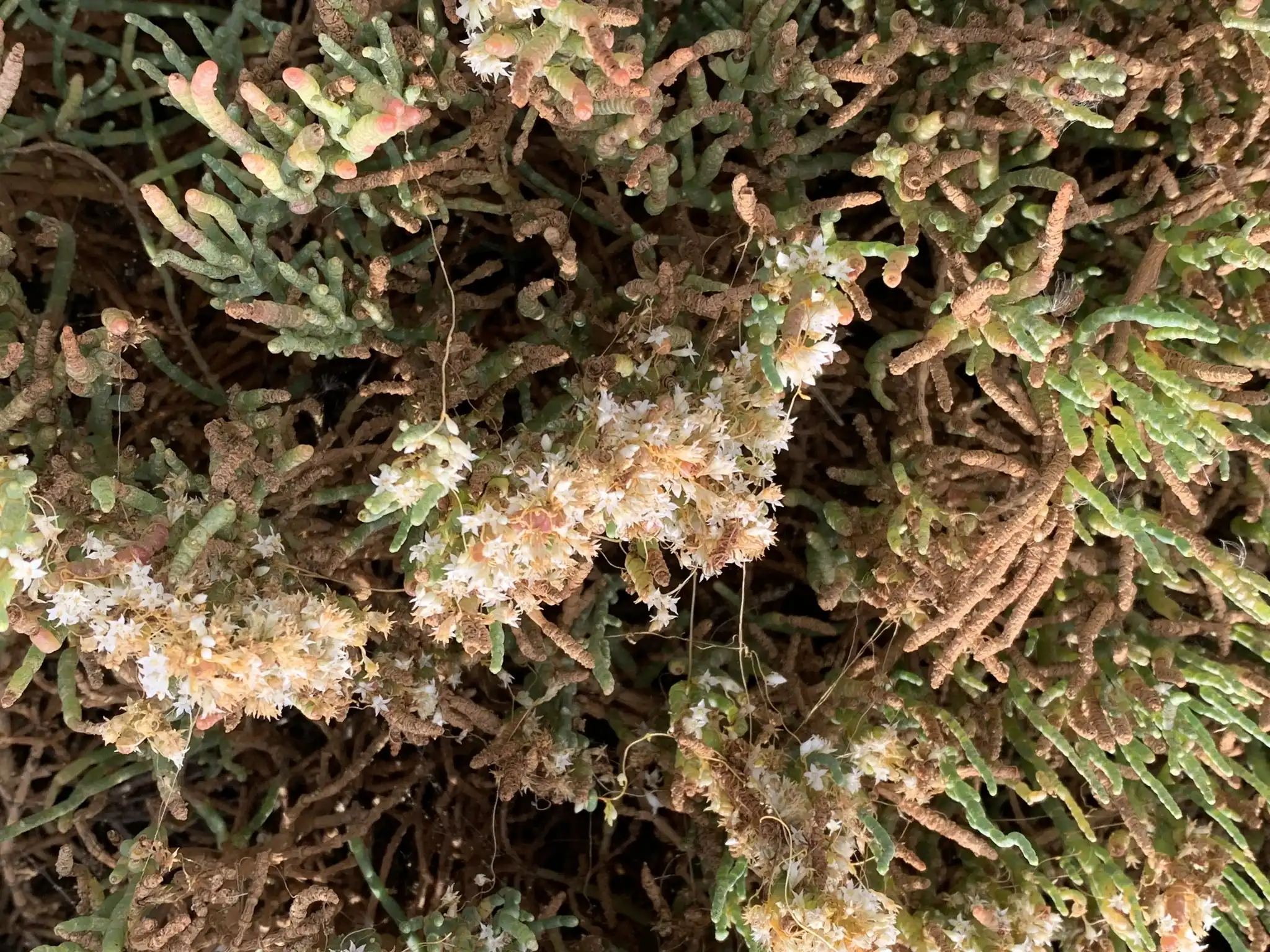
Cuscuta salina is a parasitic annual vine native to the salt marshes and alkaline flats of western North America. Lacking chlorophyll, roots, and functional leaves, it survives entirely by wrapping its thread-like orange stems around host plants to extract moisture and nutrients.
This species is distinguished by its strict adaptation to saline environments, where it forms dense, tangled golden mats over halophytic hosts like pickleweed. In summer, it produces clusters of tiny, white, bell-shaped flowers that support native coastal pollinators.
Uses & Benefits:
Essentials
At a Glance
Plant Type
Vine
Height
12"
Width
48"
Light
Full Sun
Zones
5, 6, 7, 8, 9, 10
Water
High
Humidity
High
Lifespan
Annual
Native To
Western North America
Toxicity
Non-toxic
Bloom period
Late spring – Early fall
In flower about 5 months of the year
Planting
How to Grow
- Select a sunny, wet site containing established populations of native host plants like pickleweed or fleshy jaumea.
- Sow seeds directly at the base of the host plants during early spring when soil moisture is high.
- Ensure the area remains seasonally saturated or subject to natural tidal action to support host health.
- Allow the germinating tendrils to naturally find and twine around the host stems without physical intervention.
Pro Tip
Establishment requires sowing seeds directly adjacent to an active host plant such as Salicornia; without immediate physical contact to a host stem within days of germination, the seedling will perish.
Keep It Thriving
Care Guide
Do
- Maintain a healthy stand of host plants to ensure the parasite has a viable nutrient source.
- Provide full sun exposure to mimic natural open salt marsh conditions.
- Allow the plant to complete its annual lifecycle and drop seed naturally for the following year.
Don't
- Do not apply fertilizers, as the plant derives all its nutrition directly from its host.
- Do not plant near agricultural crops or ornamental gardens due to the risk of spreading to non-target species.
- Do not attempt to transplant established vines without their host plants, as they lack roots to survive.
Seasonal Care Calendar
| Task | Jan | Feb | Mar | Apr | May | Jun | Jul | Aug | Sep | Oct | Nov | Dec |
|---|---|---|---|---|---|---|---|---|---|---|---|---|
| Harvest | ||||||||||||
| Pest Check | ||||||||||||
| Plant | ||||||||||||
| Propagate | ||||||||||||
| Winter Prep |
Watch Out For
Pests & Diseases
Common Pests
Common Diseases
In the Garden
Landscape Uses & Companions
Landscape Uses
Companion Plants
Multiply
Propagation Methods
Good to Know
Common Questions
Saltmarsh Dodder questions
What zones can Saltmarsh Dodder grow in?
Saltmarsh Dodder is hardy in USDA Zones 5–10. Inside that range it survives winter in the ground; outside it, grow it as an annual or a container plant you protect.
When does Saltmarsh Dodder bloom?
Saltmarsh Dodder typically blooms in late spring through early fall. Exact timing shifts a week or two with your zone — Sow's bloom calendar maps it to your garden.
Does Saltmarsh Dodder need full sun?
Saltmarsh Dodder does best in full sun (6+ hours).
Keep exploring
Explore the genus
Grow Saltmarsh Dodder with confidence
See it in a design of your actual yard, get zone-matched care reminders, and track it season by season in your garden journal.