The Story
Plant Bio
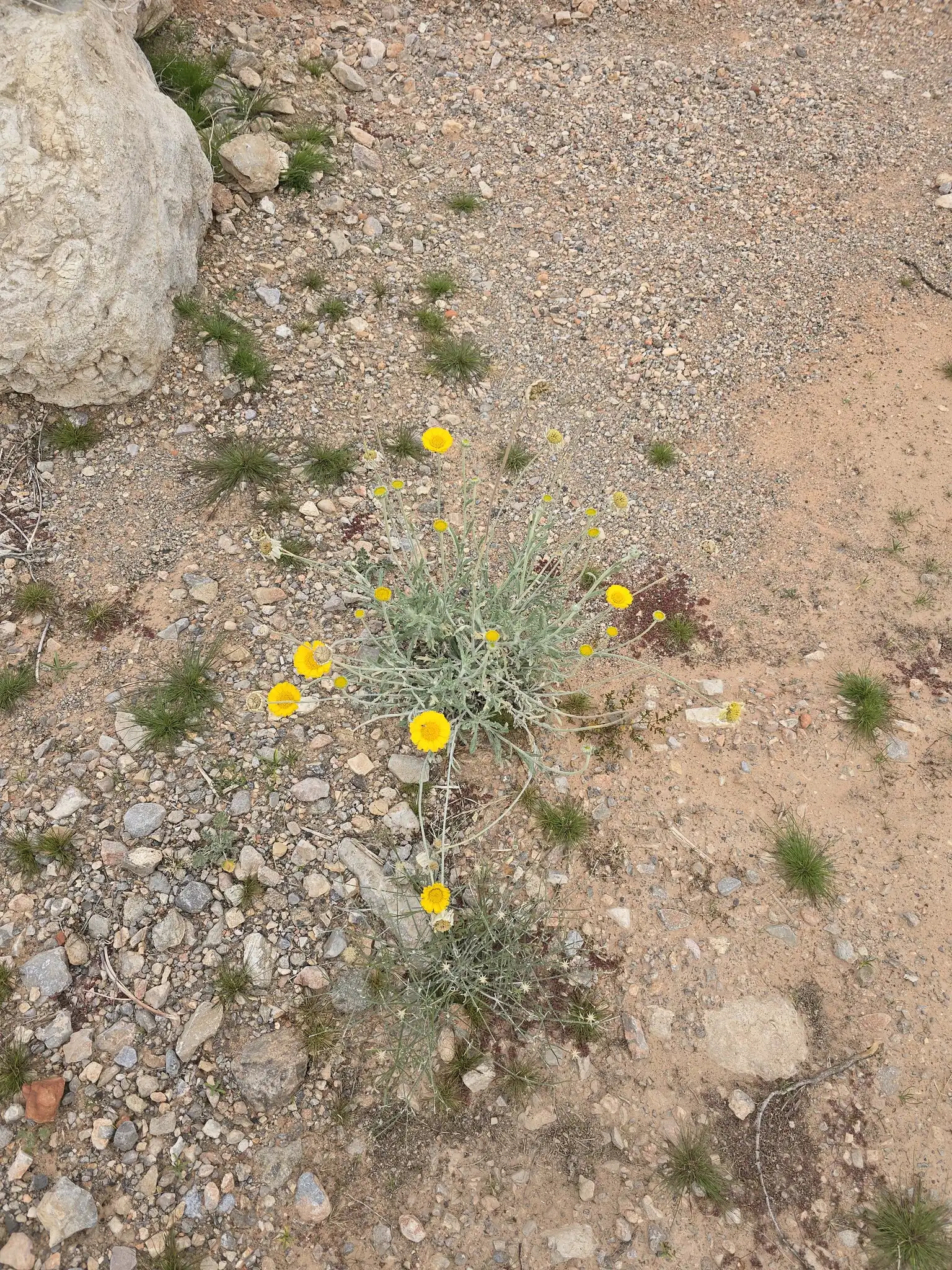
Baileya multiradiata, the desert marigold, is a clumping, short-lived perennial native to the arid regions of the southwestern United States and northern Mexico. It forms a neat basal rosette of woolly, silvery-green foliage from which slender, leafless stems rise to bear bright golden-yellow, daisy-like flowers.
The dense, felted hairs on the leaves reflect intense sunlight and conserve moisture, giving the plant its characteristic pale gray appearance. As the flower heads age, the ray florets turn papery and fade to a pale tan color while remaining on the stalks.
Uses & Benefits:
Essentials
At a Glance
Plant Type
Perennial
Height
24"
Width
18"
Light
Full Sun
Zones
8, 9, 10
Water
Low
Humidity
Low
Lifespan
Short-lived perennial
Native To
North America
Toxicity
Toxic to livestock
Bloom period
Spring – Fall
In flower about 9 months of the year
Planting
How to Grow
- Select a planting site that receives at least six hours of direct daily sunlight.
- Prepare a planting bed with sandy, gravelly, or stony soil to ensure rapid drainage.
- Dig a hole twice as wide as the root ball but equal in depth, keeping the crown slightly above the soil line.
- Backfill with native mineral soil without adding organic amendments or fertilizer, and water sparingly until established.
Pro Tip
Avoid organic mulches and rich compost around the crown; instead, use an inorganic mineral topdressing like gravel or crushed rock to prevent moisture retention and subsequent root rot.
Keep It Thriving
Care Guide
Do
- Use gravel or crushed stone as a topdressing to keep the root crown dry.
- Allow the soil to dry out completely between waterings.
- Deadhead spent flowers to encourage continuous blooming from spring through fall.
Don't
- Do not apply organic bark mulch directly against the base of the plant.
- Do not plant in heavy clay or poorly drained soils.
- Do not apply high-nitrogen fertilizers, which cause weak, floppy growth.
Seasonal Care Calendar
| Task | Jan | Feb | Mar | Apr | May | Jun | Jul | Aug | Sep | Oct | Nov | Dec |
|---|---|---|---|---|---|---|---|---|---|---|---|---|
| Deadhead | ||||||||||||
| Pest Check | ||||||||||||
| Plant | ||||||||||||
| Winter Prep |
Watch Out For
Pests & Diseases
Common Pests
Common Diseases
In the Garden
Landscape Uses & Companions
Landscape Uses
Companion Plants
Multiply
Propagation Methods
Good to Know
Common Questions
Desert Marigold questions
What zones can Desert Marigold grow in?
Desert Marigold is hardy in USDA Zones 8–10. Inside that range it survives winter in the ground; outside it, grow it as an annual or a container plant you protect.
Is Desert Marigold deer resistant?
Not reliably. Deer may browse Desert Marigold, especially tender spring growth — plan on repellents or fencing where pressure is high.
When does Desert Marigold bloom?
Desert Marigold typically blooms in spring through fall. Exact timing shifts a week or two with your zone — Sow's bloom calendar maps it to your garden.
Does Desert Marigold need full sun?
Desert Marigold does best in full sun (6+ hours).
Is Desert Marigold drought tolerant?
Yes — once established (usually after the first full season), Desert Marigold handles dry spells with minimal watering. Water deeply its first year to build the root system that makes that possible.
Keep exploring
Explore the genus
Hardy in your zone?
Grow Desert Marigold with confidence
See it in a design of your actual yard, get zone-matched care reminders, and track it season by season in your garden journal.