The Story
Plant Bio
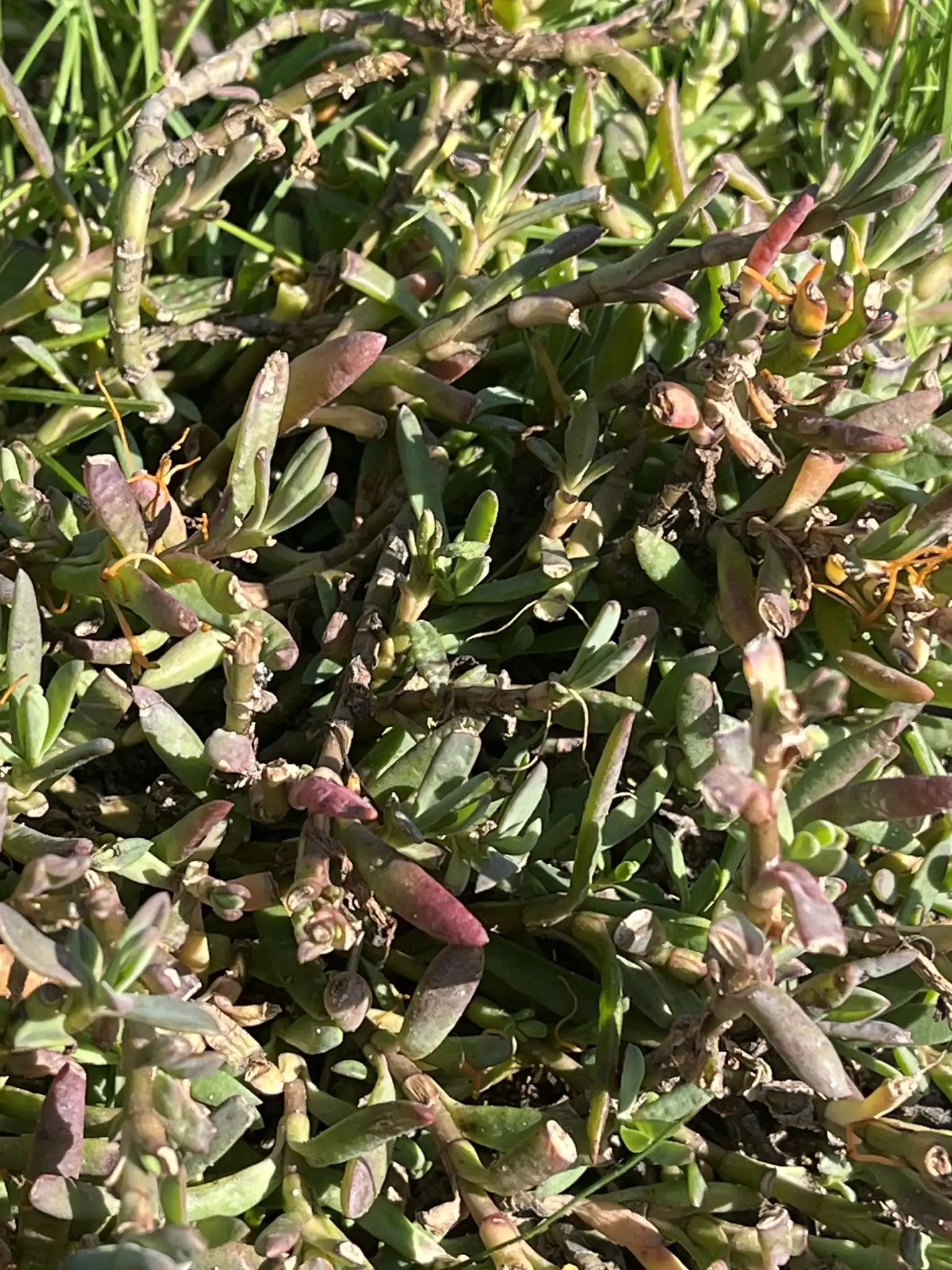
Jaumea carnosa, commonly known as marsh jaumea, is a succulent, mat-forming perennial herb native to the salt marshes and tidal flats of the Pacific Coast. The plant spreads extensively via underground rhizomes, sending up weak, pinkish-green stems clad in fleshy, bright green leaves that clasp the stem directly.
In spring and summer, the stems terminate in bright yellow, daisy-like flower heads held within fleshy, maroon-tipped bracts. This specialized halophyte thrives in highly saline, waterlogged environments, concentrating salt within its cell vacuoles to survive where other plants fail.
Uses & Benefits:
Essentials
At a Glance
Plant Type
Perennial
Height
14"
Width
197"
Light
Full Sun
Zones
6, 7, 8, 9, 10
Water
High
Humidity
High
Lifespan
Perennial
Native To
North America
Toxicity
Non-toxic
Bloom period
Spring – Summer
In flower about 6 months of the year
Planting
How to Grow
- Select a planting site in full sun with wet, poorly drained, or seasonally flooded soil.
- Amend the planting area with clay or loam if needed, ensuring the soil pH remains between 5.0 and 9.0.
- Space plugs or potted divisions twelve to eighteen inches apart to allow the rhizomes room to spread.
- Water deeply and consistently to maintain saturated soil conditions, mimicking its natural salt marsh habitat.
Pro Tip
Do not treat this plant as a dry-land succulent; it requires consistent moisture and fails quickly in dry garden soils despite its fleshy, drought-resistant appearance.
Keep It Thriving
Care Guide
Do
- Keep the soil consistently moist or wet.
- Grow in full sun to maintain compact, healthy growth.
- Use in coastal or brackish areas where soil salinity is high.
Don't
- Do not allow the soil to dry out completely.
- Avoid over-fertilizing, which can trigger root rot in non-saline conditions.
- Do not prune heavily into old, leafless wood.
Seasonal Care Calendar
| Task | Jan | Feb | Mar | Apr | May | Jun | Jul | Aug | Sep | Oct | Nov | Dec |
|---|---|---|---|---|---|---|---|---|---|---|---|---|
| Fertilize | ||||||||||||
| Pest Check | ||||||||||||
| Propagate | ||||||||||||
| Prune |
Watch Out For
Pests & Diseases
Common Pests
Common Diseases
In the Garden
Landscape Uses & Companions
Landscape Uses
Companion Plants
Multiply
Propagation Methods
Good to Know
Common Questions
Marsh Jaumea questions
What zones can Marsh Jaumea grow in?
Marsh Jaumea is hardy in USDA Zones 6–10. Inside that range it survives winter in the ground; outside it, grow it as an annual or a container plant you protect.
When does Marsh Jaumea bloom?
Marsh Jaumea typically blooms in spring through summer. Exact timing shifts a week or two with your zone — Sow's bloom calendar maps it to your garden.
Does Marsh Jaumea need full sun?
Marsh Jaumea does best in full sun (6+ hours).
Keep exploring
Explore the genus
Hardy in your zone?
Grow Marsh Jaumea with confidence
See it in a design of your actual yard, get zone-matched care reminders, and track it season by season in your garden journal.