The Story
Plant Bio
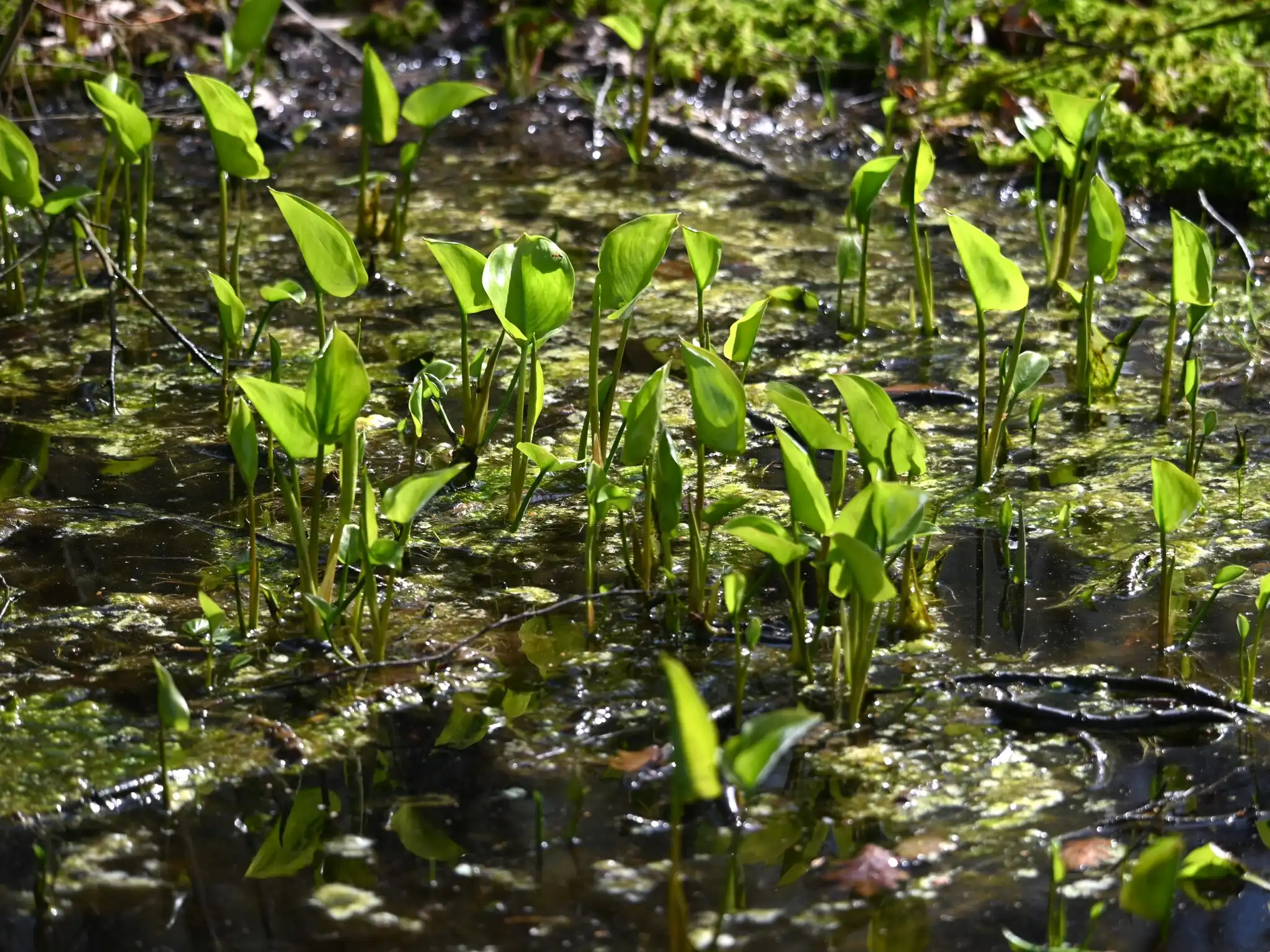
Calla palustris, the water arum, is a low-growing, rhizomatous, herbaceous aquatic perennial native to cold-temperate wetlands of the Northern Hemisphere. Smooth, glossy, heart-shaped leaves arise on long petioles from creeping horizontal rootstocks, forming spreading colonies in wet muck or shallow water.
The distinctive inflorescence features a showy, flat white spathe partially surrounding an upright, yellowish-green central spadix. Following pollination, the spadix develops into a tight cluster of pear-shaped berries that ripen from green to bright red.
Uses & Benefits:
Essentials
At a Glance
Plant Type
Aquatic
Height
12"
Width
12"
Light
Partial Sun, Shade
Zones
4, 5, 6
Water
Wet / Standing water
Humidity
High
Lifespan
Perennial
Native To
North America, Europe, Asia
Toxicity
Highly toxic when fresh
Bloom period
Late spring – Summer
In flower about 4 months of the year
Planting
How to Grow
- Select a planting site in partial to full shade with acidic, organic-rich mud or shallow standing water up to two inches deep.
- Place the creeping rhizomes horizontally at the mud surface, pressing them lightly into the muck while keeping the growing tips exposed.
- Maintain continuously wet conditions, as the plant has no drought tolerance and will die rapidly if the soil dries out.
- Anchor the rhizomes with a thin layer of gravel if planting in areas with light water movement to prevent them from floating away.
Pro Tip
Do not submerge the rhizomes deeper than two inches under water; they must sit at the mud surface or in very shallow water to prevent suffocation.
Keep It Thriving
Care Guide
Do
- Keep the growing medium continuously saturated or submerged in shallow water.
- Prune back dead or yellowed foliage and spent flower stalks once per year in late fall or early spring.
- Wear gloves when handling the plant, as all parts contain highly toxic calcium oxalate crystals.
Don't
- Do not plant in standard, well-drained garden soil or allow the root zone to dry out.
- Do not submerge the crown deeper than two inches below the water surface.
- Do not apply heavy fertilizers, which are unnecessary and promote algae growth in water features.
Seasonal Care Calendar
| Task | Jan | Feb | Mar | Apr | May | Jun | Jul | Aug | Sep | Oct | Nov | Dec |
|---|---|---|---|---|---|---|---|---|---|---|---|---|
| Divide | ||||||||||||
| Propagate | ||||||||||||
| Prune | ||||||||||||
| Winter Prep |
Watch Out For
Pests & Diseases
Common Pests
Common Diseases
In the Garden
Landscape Uses & Companions
Landscape Uses
Companion Plants
Multiply
Propagation Methods
Good to Know
Common Questions
Water Arum questions
What zones can Water Arum grow in?
Water Arum is hardy in USDA Zones 4–6. Inside that range it survives winter in the ground; outside it, grow it as an annual or a container plant you protect.
When does Water Arum bloom?
Water Arum typically blooms in late spring through summer. Exact timing shifts a week or two with your zone — Sow's bloom calendar maps it to your garden.
Does Water Arum need full sun?
Water Arum does best in part shade.
Keep exploring
Explore the genus
Hardy in your zone?
Grow Water Arum with confidence
See it in a design of your actual yard, get zone-matched care reminders, and track it season by season in your garden journal.