
The Story
Plant Bio
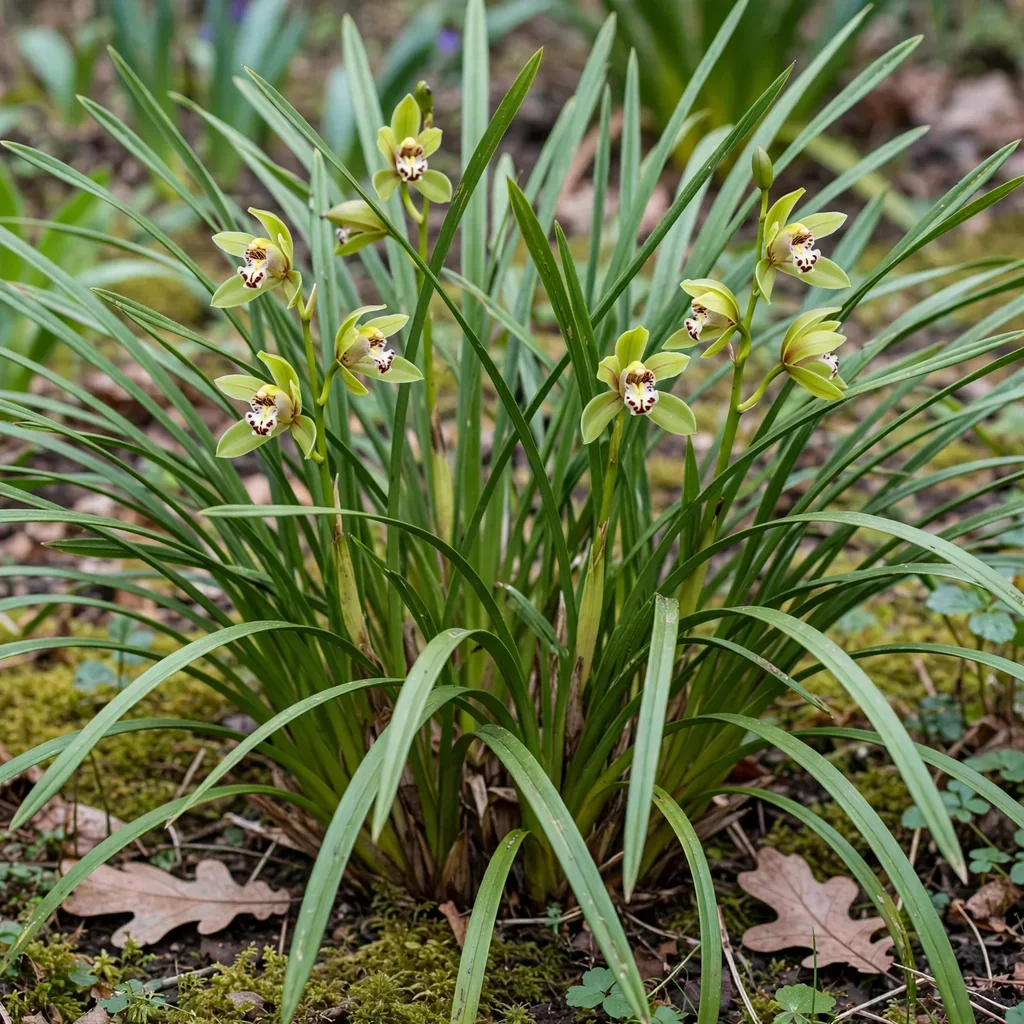
Cymbidium devonianum is a compact, epiphytic or lithophytic orchid native to the humid forests of the Eastern Himalayas and Southeast Asia. It produces small, subcylindrical pseudobulbs wrapped in persistent leaf bases, bearing two to four thick, leathery leaves that remain upright.
This species is distinguished by its dramatically pendulous flower spikes that weep downward, carrying fifteen to thirty-five non-fragrant blooms. The flowers feature pale green or yellow-green petals heavily patterned with purple-brown, contrasted by a white lip marked with dark maroon spots.
Uses & Benefits:
Essentials
At a Glance
Plant Type
Perennial
Height
12"
Width
24"
Light
Shade
Zones
10
Water
Moderate (high in summer, low in winter)
Humidity
High (60% or higher)
Lifespan
Perennial
Native To
Asia (Eastern Himalayas to Southeast Asia)
Toxicity
Non-toxic
Bloom period
Late spring – Early summer
In flower about 2 months of the year
Planting
How to Grow
- Select a wire basket or highly ventilated orchid pot lined with sphagnum moss or filled with coarse, open orchid bark.
- Position the plant in deep to moderate shade, ensuring it receives bright, filtered light while avoiding any direct, scorching afternoon sun.
- Water thoroughly during the spring and summer active growth phases to keep the medium consistently damp but never waterlogged.
- Reduce watering significantly in winter to provide a semi-rest period, allowing the media to dry out between light mistings.
Pro Tip
Never pot this orchid in standard potting soil, which suffocates the roots; instead, grow it in highly porous orchid bark or a wire basket lined with sphagnum moss, and provide a cool, dry winter rest to trigger the pendulous flower spikes.
Keep It Thriving
Care Guide
Do
- Grow in hanging baskets to allow the pendulous flower spikes to cascade naturally.
- Maintain high humidity levels of 60% or more around the plant.
- Apply a balanced orchid fertilizer weakly every week during the active spring and summer growing season.
- Keep the roots well-aerated with highly porous, free-draining media.
Don't
- Do not use standard potting soil or heavy media that retains stagnant water.
- Do not cut into old, leafless backbulbs, as they store vital energy and water for the plant.
- Do not expose the foliage to direct, harsh sunlight, which causes rapid leaf scorching.
- Do not fertilize the plant during its dry winter rest period.
Seasonal Care Calendar
| Task | Jan | Feb | Mar | Apr | May | Jun | Jul | Aug | Sep | Oct | Nov | Dec |
|---|---|---|---|---|---|---|---|---|---|---|---|---|
| Deadhead | ||||||||||||
| Fertilize | ||||||||||||
| Pest Check | ||||||||||||
| Propagate | ||||||||||||
| Winter Prep |
Watch Out For
Pests & Diseases
Common Pests
Common Diseases
In the Garden
Landscape Uses & Companions
Landscape Uses
Companion Plants
Multiply
Propagation Methods
Good to Know
Common Questions
Devon's Cymbidium questions
What zones can Devon's Cymbidium grow in?
Devon's Cymbidium is hardy in USDA Zone 10. Inside that range it survives winter in the ground; outside it, grow it as an annual or a container plant you protect.
When does Devon's Cymbidium bloom?
Devon's Cymbidium typically blooms in late spring through early summer. Exact timing shifts a week or two with your zone — Sow's bloom calendar maps it to your garden.
More Cymbidium to compare
Keep exploring
Explore the genus
Hardy in your zone?
Grow Devon's Cymbidium with confidence
See it in a design of your actual yard, get zone-matched care reminders, and track it season by season in your garden journal.