The Story
Plant Bio
Monotropa uniflora, commonly known as ghost pipe, is an achlorophyllous, myco-heterotrophic perennial native to deep, shaded forests across North America. Lacking chlorophyll, the plant produces fleshy, translucent white stems with scale-like bracts that emerge from the forest floor in small clusters.
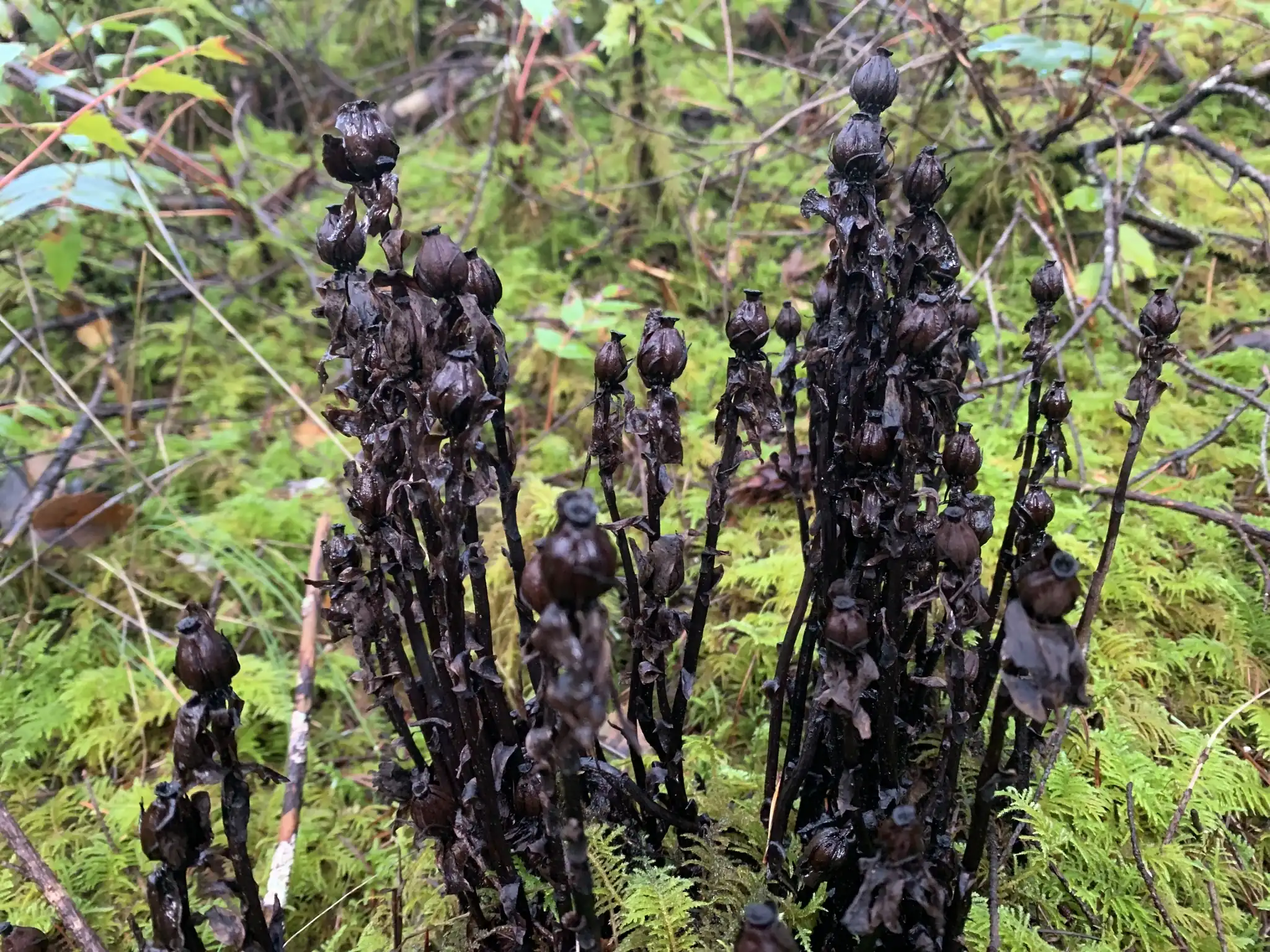
The solitary, nodding bell-shaped flowers are waxy white and turn upright as their seeds mature in summer and fall. Because it derives all nutrients from a symbiotic relationship with subterranean fungi and host trees, the entire plant turns black as it decays after seed set.
Uses & Benefits:
Essentials
At a Glance
Plant Type
Perennial
Height
12"
Width
6"
Light
Partial Sun, Shade
Zones
4, 5, 6, 7, 8, 9
Water
Consistently moist
Humidity
High
Lifespan
Perennial
Native To
North America, Central/Northern South America, East Asia
Toxicity
Toxic if ingested
Bloom period
Summer – Fall
In flower about 6 months of the year
Planting
How to Grow
- Select a site with deep shade and rich, undisturbed woodland humus or leaf litter.
- Do not attempt to plant or sow seeds, as the species requires pre-existing Russulaceae fungal networks and host tree roots.
- Maintain a thick, natural layer of leaf litter to protect the subterranean fungal host network.
- Avoid applying any chemical fertilizers, fungicides, or soil amendments that could disrupt the delicate mycorrhizal symbiosis.
Pro Tip
Do not attempt to transplant or cultivate this species, as severing its connection to the underground mycorrhizal network of Russulaceae fungi and host tree roots results in rapid death.
Keep It Thriving
Care Guide
Do
- Leave the plant entirely undisturbed in its native forest habitat.
- Protect the surrounding woodland canopy to maintain high humidity and deep shade.
- Allow the stems to naturally blacken and decay in place after seed set.
Don't
- Do not attempt to dig up, transplant, or propagate this species.
- Do not apply any fertilizers, as the plant relies entirely on its fungal host for nutrients.
- Do not clear away the natural leaf litter layer around the plant.
Seasonal Care Calendar
| Task | Jan | Feb | Mar | Apr | May | Jun | Jul | Aug | Sep | Oct | Nov | Dec |
|---|---|---|---|---|---|---|---|---|---|---|---|---|
| Mulch | ||||||||||||
| Pest Check | ||||||||||||
| Spring Cleanup | ||||||||||||
| Winter Prep |
Watch Out For
Pests & Diseases
Common Pests
Common Diseases
In the Garden
Landscape Uses & Companions
Landscape Uses
Companion Plants
Multiply
Propagation Methods
Good to Know
Common Questions
Ghost pipe questions
What zones can Ghost pipe grow in?
Ghost pipe is hardy in USDA Zones 4–9. Inside that range it survives winter in the ground; outside it, grow it as an annual or a container plant you protect.
When does Ghost pipe bloom?
Ghost pipe typically blooms in summer through fall. Exact timing shifts a week or two with your zone — Sow's bloom calendar maps it to your garden.
Does Ghost pipe need full sun?
Ghost pipe does best in part shade.
Keep exploring
Explore the genus
Grow Ghost pipe with confidence
See it in a design of your actual yard, get zone-matched care reminders, and track it season by season in your garden journal.