The Story
Plant Bio
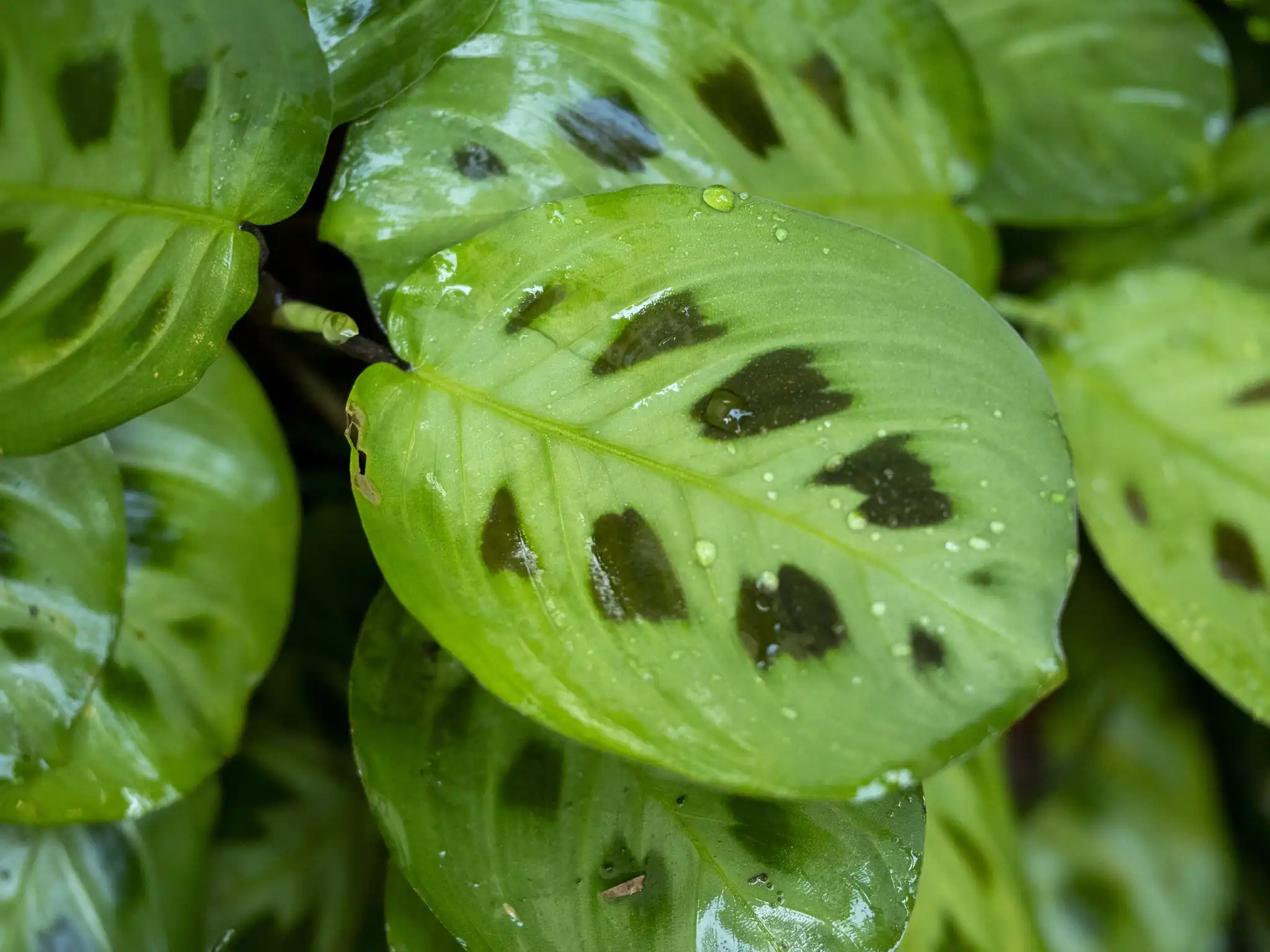
Maranta leuconeura is an evergreen, low-growing, and clump-forming herbaceous perennial native to the tropical rainforest floors of Brazil. The species is characterized by broadly elliptic, grayish-green leaves with dark blotches and contrasting light veins, which fold upward at night in a process called nyctinasty.
The foliage features prominent herringbone-like patterns of white or light veins against a dark background, with new leaves emerging tightly rolled from older leaf sheaths. Small, two-lipped white flowers with purple markings appear infrequently on slender, sparse spikes during late spring and early summer.
Uses & Benefits:
Essentials
At a Glance
Plant Type
Tropical
Height
15"
Width
15"
Light
Partial Sun, Shade
Water
High
Humidity
High
Lifespan
Perennial
Native To
Brazil
Toxicity
Non-toxic
Bloom period
Late spring – Early summer
In flower about 2 months of the year
Planting
How to Grow
- Situate the plant in a location receiving bright, indirect indoor light or partial to full shade, avoiding any direct hot sun that bleaches the foliage.
- Plant in a rich, organic, humus-rich potting mix with a slightly acidic to neutral pH between 5.5 and 6.5.
- Maintain high humidity levels around the plant and keep the potting medium consistently moist without allowing the roots to sit in standing water.
- Apply a balanced liquid fertilizer at half-strength monthly during the spring and summer, withholding all fertilizer from autumn through late winter.
Pro Tip
Irrigate exclusively with distilled water, reverse-osmosis water, or rainwater; tap water containing high levels of chlorine, fluorine, or sodium causes the leaf tips to turn crisp and brown.
Keep It Thriving
Care Guide
Do
- Keep the soil consistently moist to prevent leaf drop.
- Provide high humidity to support healthy foliage development.
- Prune leggy stems back to just above a node in spring to encourage bushier growth.
Don't
- Do not use hard tap water high in chlorine, fluorine, or sodium.
- Do not allow the plant to sit in standing water, which triggers root rot.
- Do not cut back into old, leafless woody stems where nodes cannot activate.
Seasonal Care Calendar
| Task | Jan | Feb | Mar | Apr | May | Jun | Jul | Aug | Sep | Oct | Nov | Dec |
|---|---|---|---|---|---|---|---|---|---|---|---|---|
| Fertilize | ||||||||||||
| Pest Check | ||||||||||||
| Propagate | ||||||||||||
| Prune |
Watch Out For
Pests & Diseases
Common Pests
Common Diseases
In the Garden
Landscape Uses & Companions
Landscape Uses
Companion Plants
Multiply
Propagation Methods
Good to Know
Common Questions
Prayer Plant questions
When does Prayer Plant bloom?
Prayer Plant typically blooms in late spring through early summer. Exact timing shifts a week or two with your zone — Sow's bloom calendar maps it to your garden.
Does Prayer Plant need full sun?
Prayer Plant does best in part shade.
Keep exploring
Explore the genus
Grow Prayer Plant with confidence
See it in a design of your actual yard, get zone-matched care reminders, and track it season by season in your garden journal.