The Story
Plant Bio
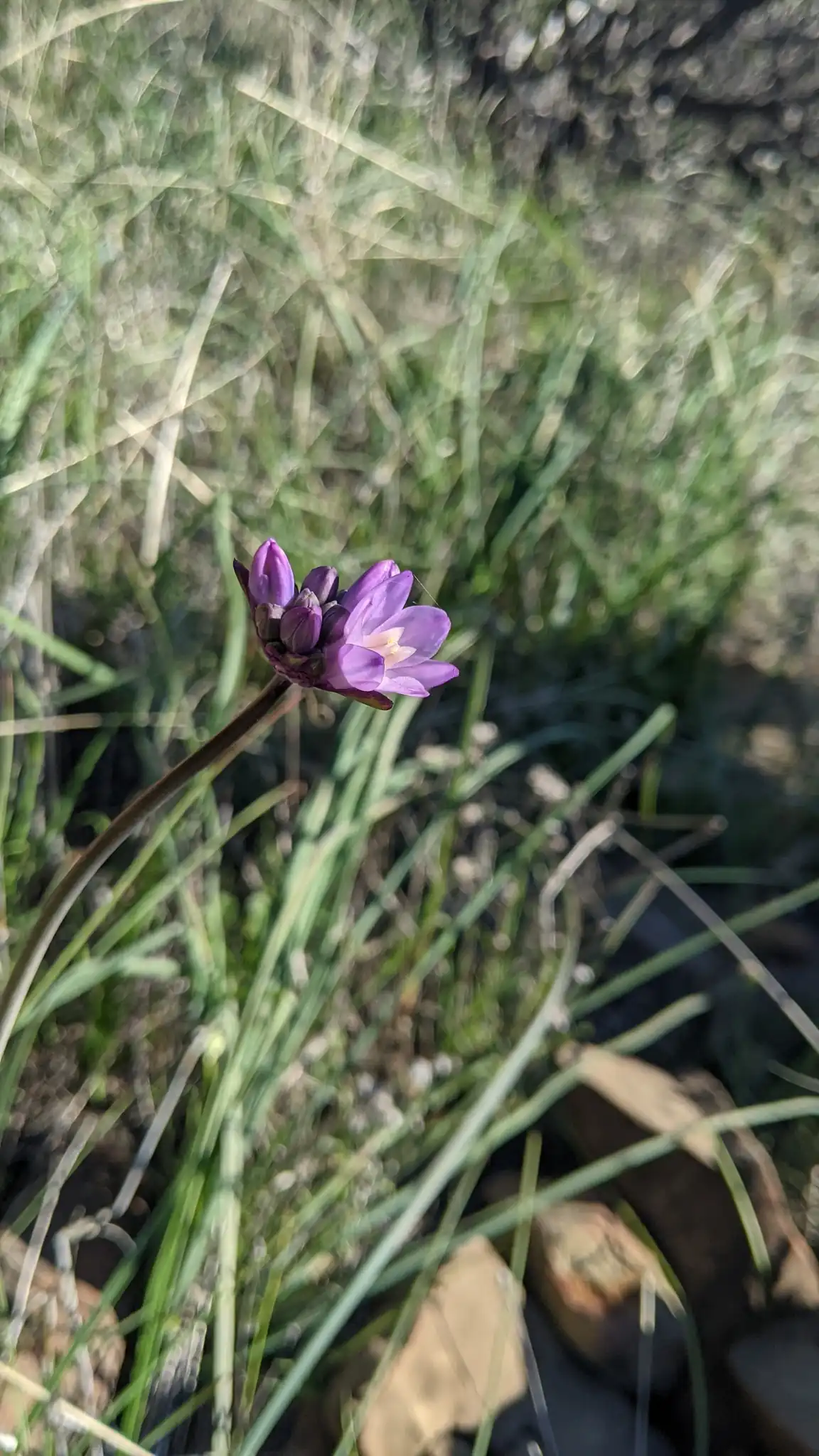
Dipterostemon capitatus is a spring-flowering herbaceous geophyte native to western North America, rising from an underground corm to form a slender, leafless flowering scape up to two feet tall. The basal foliage consists of two to three narrow, arching leaves that emerge in winter and wither completely as the plant enters summer dormancy.
The species is distinguished by its dense, head-like terminal clusters of six-stamened flowers that range in color from deep violet-blue to pink-purple. Prominent membranous bracts subtend these tight floral glomerules, which sit atop a characteristically twisted, naked stem.
Uses & Benefits:
Essentials
At a Glance
Plant Type
Bulb Corm Tuber
Height
24"
Width
12"
Light
Full Sun, Partial Sun
Zones
7, 8, 9, 10
Water
Low
Humidity
Low to Moderate
Lifespan
Perennial
Native To
Western North America
Toxicity
Non-toxic
Bloom period
Winter – Spring
In flower about 6 months of the year
Planting
How to Grow
- Select a planting site in full sun to partial shade with sandy, gravelly, or highly porous soil.
- Plant dormant corms in early autumn at a depth of three inches, spacing them two to three inches apart.
- Water thoroughly once after planting to settle the soil, then rely on natural winter and spring rainfall.
- Allow the foliage to die back completely and turn brown after spring flowering before removing any spent stems.
Pro Tip
Withhold all water during the summer dormancy period; any moisture applied while the corm is dormant triggers rapid fungal decay and rot.
Keep It Thriving
Care Guide
Do
- Ensure absolute summer dryness to mimic the native Mediterranean climate.
- Plant in raised beds or containers if your local soil retains moisture.
- Protect underground corms from burrowing rodents using wire gopher baskets.
Don't
- Do not irrigate the planting area during the summer dormancy phase.
- Do not cut back green leaves, as they must photosynthesize to rebuild the corm.
- Do not apply heavy fertilizers, which cause weak, floppy growth.
Seasonal Care Calendar
| Task | Jan | Feb | Mar | Apr | May | Jun | Jul | Aug | Sep | Oct | Nov | Dec |
|---|---|---|---|---|---|---|---|---|---|---|---|---|
| Deadhead | ||||||||||||
| Pest Check | ||||||||||||
| Plant | ||||||||||||
| Propagate |
Watch Out For
Pests & Diseases
Common Pests
Common Diseases
In the Garden
Landscape Uses & Companions
Landscape Uses
Companion Plants
Multiply
Propagation Methods
Good to Know
Common Questions
Blue Dicks questions
What zones can Blue Dicks grow in?
Blue Dicks is hardy in USDA Zones 7–10. Inside that range it survives winter in the ground; outside it, grow it as an annual or a container plant you protect.
Is Blue Dicks deer resistant?
Not reliably. Deer may browse Blue Dicks, especially tender spring growth — plan on repellents or fencing where pressure is high.
When does Blue Dicks bloom?
Blue Dicks typically blooms in winter through spring. Exact timing shifts a week or two with your zone — Sow's bloom calendar maps it to your garden.
Does Blue Dicks need full sun?
Blue Dicks does best in full sun to part shade. In hot climates, afternoon shade keeps blooms fresher longer.
Is Blue Dicks drought tolerant?
Yes — once established (usually after the first full season), Blue Dicks handles dry spells with minimal watering. Water deeply its first year to build the root system that makes that possible.
Keep exploring
Explore the genus
Hardy in your zone?
Grow Blue Dicks with confidence
See it in a design of your actual yard, get zone-matched care reminders, and track it season by season in your garden journal.