The Story
Plant Bio
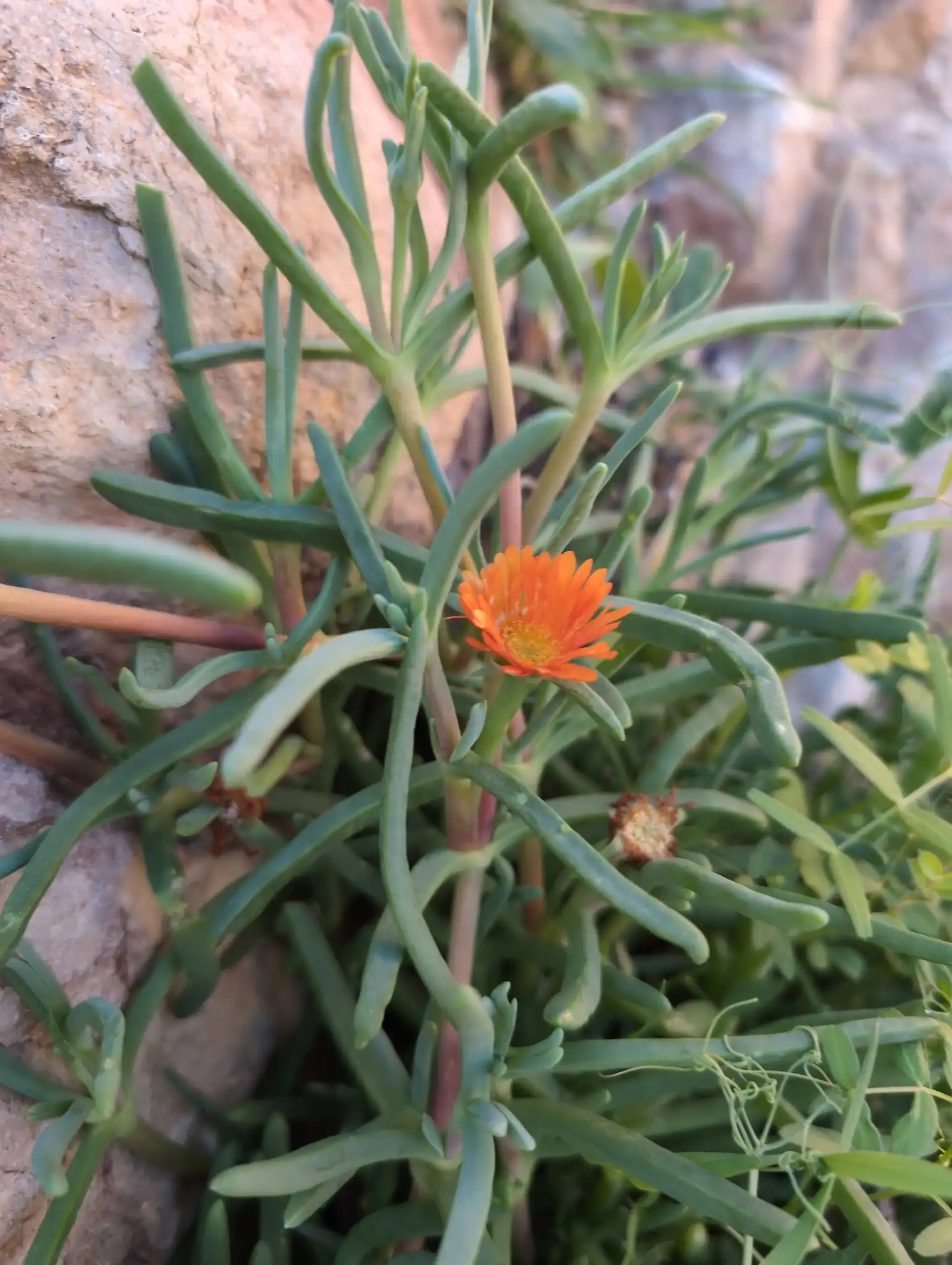
Malephora crocea is a low-growing, succulent perennial subshrub from southern Africa that forms dense, spreading mats of pale gray-green, glaucous foliage. The prostrate stems root at the nodes upon touching the soil, producing solitary, daisy-like flowers in shades of coppery orange, red, or yellow from spring through fall.
This species is highly salt-tolerant and thrives in coastal winds, making it an effective groundcover for erosion control on dry slopes. Under environmental stress, the smooth, semi-cylindrical leaves frequently develop distinct red tinges.
Uses & Benefits:
Essentials
At a Glance
Plant Type
Cactus Succulent
Height
12"
Width
60"
Light
Full Sun
Zones
9, 10
Water
Low
Humidity
Moderate
Lifespan
Perennial
Native To
Southern Africa
Toxicity
Non-toxic
Bloom period
Spring – Fall
In flower about 9 months of the year
Planting
How to Grow
- Select a planting site in full sun with loose, sandy, or gritty soil that drains rapidly.
- Space plants 24 to 36 inches apart to allow the prostrate stems room to spread and root at the nodes.
- Water sparingly after planting to establish the root system, then reduce irrigation to a minimum.
- Prune lightly after the main flowering flushes to maintain a tidy mat and stimulate fresh vegetative growth.
Pro Tip
Trim only within the leafy green outer perimeter of the mat; the inner stems become woody and corky with age and lack the dormant buds required to regenerate if sheared hard.
Keep It Thriving
Care Guide
Do
- Plant in sharply draining mineral soils to prevent root and stem rot.
- Ensure the site receives full sun throughout the day to maximize flowering.
- Prune exclusively within the active green foliage zone.
Don't
- Do not irrigate on a standard turf schedule or allow water to pool around the stems.
- Do not shear back into old, leafless, woody wood.
- Do not over-fertilize, as excessive nutrients weaken the succulent growth.
Seasonal Care Calendar
| Task | Jan | Feb | Mar | Apr | May | Jun | Jul | Aug | Sep | Oct | Nov | Dec |
|---|---|---|---|---|---|---|---|---|---|---|---|---|
| Fertilize | ||||||||||||
| Pest Check | ||||||||||||
| Propagate | ||||||||||||
| Prune |
Watch Out For
Pests & Diseases
Common Pests
Common Diseases
In the Garden
Landscape Uses & Companions
Landscape Uses
Companion Plants
Multiply
Propagation Methods
Good to Know
Common Questions
Coppery Mesemb questions
What zones can Coppery Mesemb grow in?
Coppery Mesemb is hardy in USDA Zones 9–10. Inside that range it survives winter in the ground; outside it, grow it as an annual or a container plant you protect.
Is Coppery Mesemb deer resistant?
Yes — Coppery Mesemb is rated deer-resistant. Deer typically pass it over, though extreme hunger can override any plant's defenses.
When does Coppery Mesemb bloom?
Coppery Mesemb typically blooms in spring through fall. Exact timing shifts a week or two with your zone — Sow's bloom calendar maps it to your garden.
Does Coppery Mesemb need full sun?
Coppery Mesemb does best in full sun (6+ hours).
Is Coppery Mesemb drought tolerant?
Yes — once established (usually after the first full season), Coppery Mesemb handles dry spells with minimal watering. Water deeply its first year to build the root system that makes that possible.
Keep exploring
Explore the genus
Hardy in your zone?
Grow Coppery Mesemb with confidence
See it in a design of your actual yard, get zone-matched care reminders, and track it season by season in your garden journal.