The Story
Plant Bio
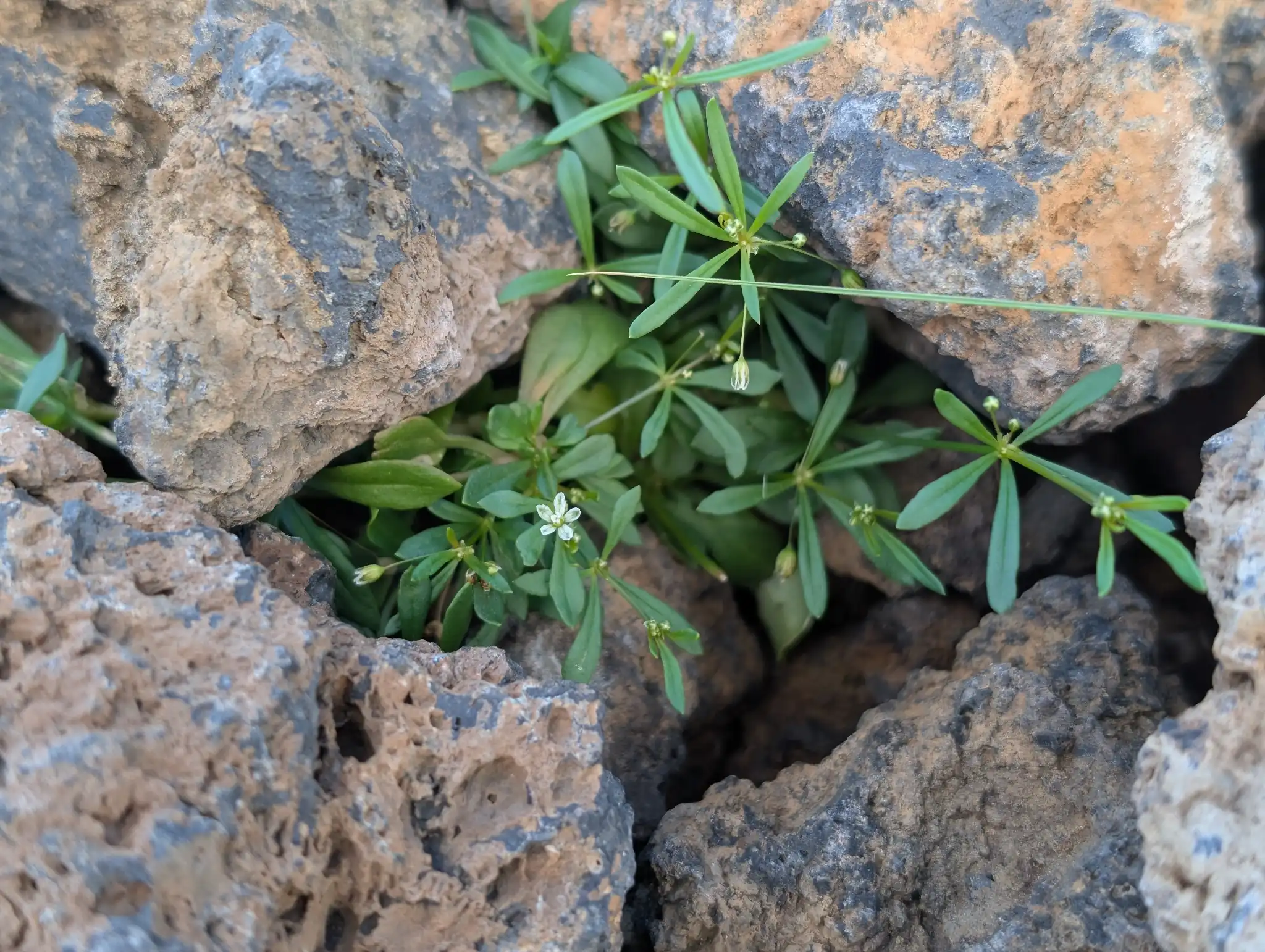
Mollugo verticillata, commonly known as green carpetweed, is a prostrate, mat-forming summer annual that spreads radially from a central taproot to form ground-hugging carpets. The smooth, light green leaves are arranged in distinctive false whorls of three to eight at each stem node.
During the warm months, tiny, petal-less flowers with five white-rimmed sepals emerge in small axillary clusters from the leaf joints. The plant completes its entire life cycle rapidly during the frost-free season, thriving in open, sandy, or highly disturbed soils where taller vegetation cannot compete.
Uses & Benefits:
Essentials
At a Glance
Plant Type
Annual
Height
6"
Width
24"
Light
Full Sun, Partial Sun
Zones
4, 5, 6, 7, 8, 9, 10
Water
Low to Moderate
Humidity
Adaptable
Lifespan
Annual
Native To
Central and South America
Toxicity
Non-toxic
Bloom period
Summer – Autumn
In flower about 6 months of the year
Planting
How to Grow
- Identify the central taproot of the radial mat to ensure complete removal during weeding.
- Hand-pull or scrape the soil surface with a hoe while the plants are young and before seed pods mature.
- Establish a thick layer of organic mulch or maintain dense turf cover to shade out emerging seedlings.
- Avoid over-watering and improve drainage in garden beds, as this species thrives in open, damp, disturbed mineral soils.
Pro Tip
To control carpetweed without chemicals, hand-pull or shallowly hoe the central taproot in late spring before the first flowers appear and deposit their prolific seeds.
Keep It Thriving
Care Guide
Do
- Pull the plant from the central root hub to ensure the entire mat is removed.
- Apply pre-emergent mulches in early spring to prevent seed germination in bare soil.
- Monitor sandy riverbanks and tilled garden beds where seeds easily establish.
Don't
- Do not allow the plant to set seed, as a single specimen produces thousands of highly viable seeds.
- Do not apply nitrogen fertilizers to areas infested with carpetweed, which triggers aggressive vegetative expansion.
- Do not leave pulled plants on open soil, as they can ripen seeds even after uprooting.
Seasonal Care Calendar
| Task | Jan | Feb | Mar | Apr | May | Jun | Jul | Aug | Sep | Oct | Nov | Dec |
|---|---|---|---|---|---|---|---|---|---|---|---|---|
| Pest Check | ||||||||||||
| Prune | ||||||||||||
| Spring Cleanup | ||||||||||||
| Winter Prep |
Watch Out For
Pests & Diseases
Common Pests
Common Diseases
In the Garden
Landscape Uses & Companions
Landscape Uses
Companion Plants
Multiply
Propagation Methods
Good to Know
Common Questions
Green Carpetweed questions
What zones can Green Carpetweed grow in?
Green Carpetweed is hardy in USDA Zones 4–10. Inside that range it survives winter in the ground; outside it, grow it as an annual or a container plant you protect.
Is Green Carpetweed deer resistant?
Yes — Green Carpetweed is rated deer-resistant. Deer typically pass it over, though extreme hunger can override any plant's defenses.
When does Green Carpetweed bloom?
Green Carpetweed typically blooms in summer through autumn. Exact timing shifts a week or two with your zone — Sow's bloom calendar maps it to your garden.
Does Green Carpetweed need full sun?
Green Carpetweed does best in full sun to part shade. In hot climates, afternoon shade keeps blooms fresher longer.
Is Green Carpetweed drought tolerant?
Yes — once established (usually after the first full season), Green Carpetweed handles dry spells with minimal watering. Water deeply its first year to build the root system that makes that possible.
Keep exploring
Explore the genus
Grow Green Carpetweed with confidence
See it in a design of your actual yard, get zone-matched care reminders, and track it season by season in your garden journal.