The Story
Plant Bio
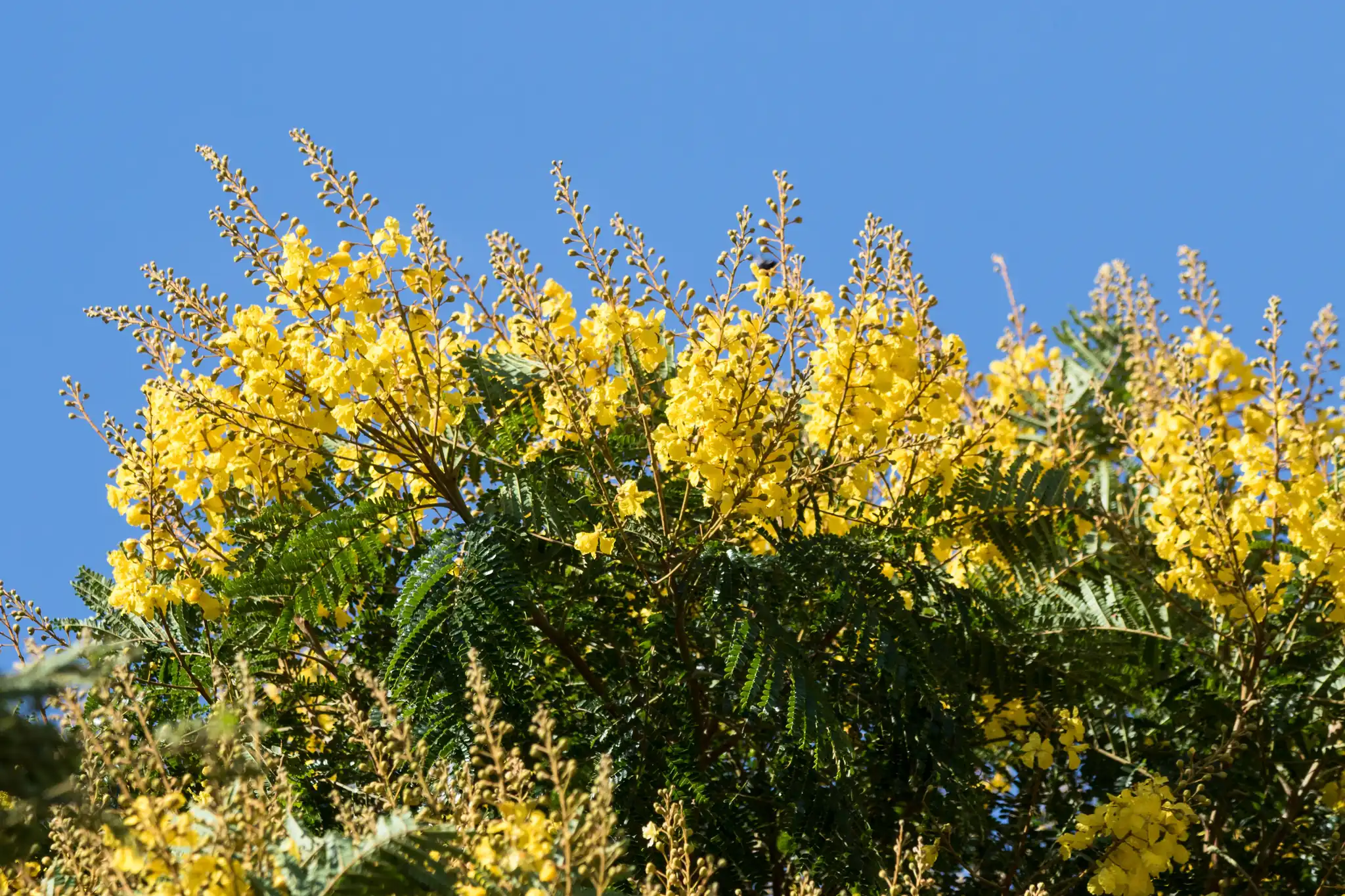
Peltophorum dubium, known as the yellow poinciana, is a fast-growing deciduous tree that develops a broad, spreading canopy of fine, fern-like foliage. During summer, the branches are topped with large terminal panicles of bright golden-yellow flowers featuring distinctive crinkled petals.
This species is distinguished by its bipinnately compound, bright green leaflets that exhibit a slightly sticky texture. Unlike other tropical legumes, it maintains a highly symmetrical, rounded form even under rapid growth phases.
Uses & Benefits:
Essentials
At a Glance
Plant Type
Tree
Height
984"
Width
787"
Light
Full Sun
Zones
9, 10
Water
Low to Moderate
Humidity
Moderate
Lifespan
Long-lived
Native To
South America
Toxicity
Non-toxic
Bloom period
Summer – Autumn
In flower about 6 months of the year
Planting
How to Grow
- Select a planting site in full sun with fertile, well-draining soil to prevent root rot.
- Dig a hole twice the width of the root ball and set the tree at its original container depth.
- Water deeply and regularly during the first growing season to establish a deep root system.
- Apply a balanced slow-release fertilizer sparingly during the spring of the first few years.
Pro Tip
Prune young trees early to establish a strong central leader, and lightly thin the canopy after flowering to prevent heavy seed pods from overloading and breaking the branches.
Keep It Thriving
Care Guide
Do
- Water deeply but infrequently once established to encourage drought tolerance.
- Clean up fallen seed pods and leaf litter seasonally to maintain tidy garden beds.
- Provide structural pruning when the tree is young to build a balanced canopy.
Don't
- Do not plant in low-lying areas prone to standing water or heavy waterlogging.
- Never prune hard into old, leafless wood, as this results in slow and patchy regrowth.
- Avoid planting in direct maritime coastal exposures where salt spray will damage foliage.
Seasonal Care Calendar
| Task | Jan | Feb | Mar | Apr | May | Jun | Jul | Aug | Sep | Oct | Nov | Dec |
|---|---|---|---|---|---|---|---|---|---|---|---|---|
| Fertilize | ||||||||||||
| Pest Check | ||||||||||||
| Prune | ||||||||||||
| Spring Cleanup |
Watch Out For
Pests & Diseases
Common Pests
Common Diseases
In the Garden
Landscape Uses & Companions
Landscape Uses
Companion Plants
Multiply
Propagation Methods
Good to Know
Common Questions
Yellow Poinciana questions
What zones can Yellow Poinciana grow in?
Yellow Poinciana is hardy in USDA Zones 9–10. Inside that range it survives winter in the ground; outside it, grow it as an annual or a container plant you protect.
Is Yellow Poinciana deer resistant?
Not reliably. Deer may browse Yellow Poinciana, especially tender spring growth — plan on repellents or fencing where pressure is high.
When does Yellow Poinciana bloom?
Yellow Poinciana typically blooms in summer through autumn. Exact timing shifts a week or two with your zone — Sow's bloom calendar maps it to your garden.
Does Yellow Poinciana need full sun?
Yellow Poinciana does best in full sun (6+ hours).
Is Yellow Poinciana drought tolerant?
Yes — once established (usually after the first full season), Yellow Poinciana handles dry spells with minimal watering. Water deeply its first year to build the root system that makes that possible.
Keep exploring
Explore the genus
Hardy in your zone?
Grow Yellow Poinciana with confidence
See it in a design of your actual yard, get zone-matched care reminders, and track it season by season in your garden journal.