The Story
Plant Bio
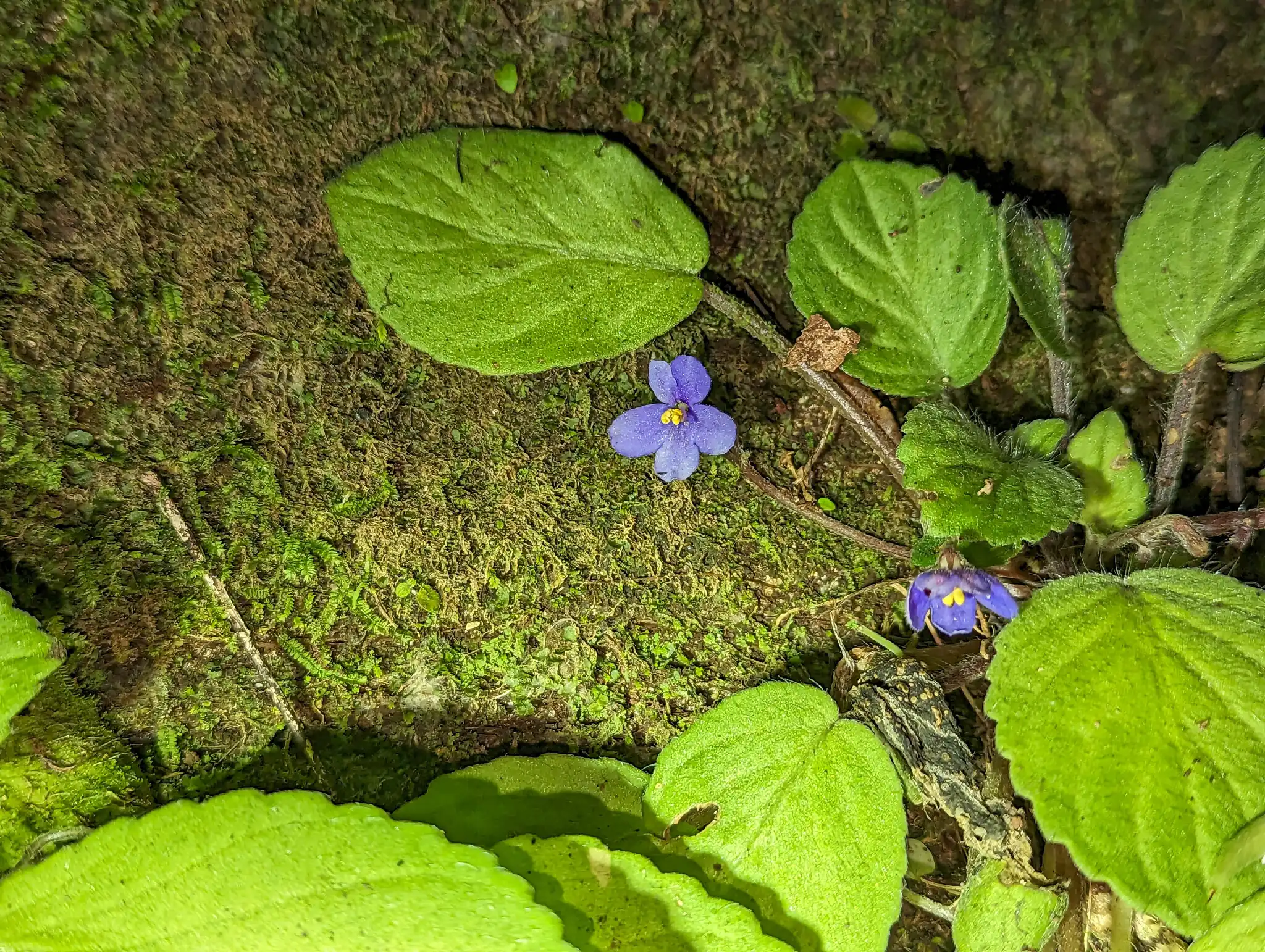
Streptocarpus ionanthus, the African violet, is a low-growing, stemless, evergreen herbaceous perennial that forms a compact, symmetrical rosette of fleshy leaves. The thick, dark green, oval to cordate leaves are covered in fine, soft, multicellular hairs, with new growth emerging from the center of the rosette as tightly folded, densely hairy miniature leaves.
The zygomorphic flowers rise above the foliage on slender stalks in axillary cymes, displaying five spreading lobes in shades of blue, purple, pink, or white around prominent yellow anthers. Under indoor cultivation, flowering occurs continuously for ten to twelve months of the year.
Uses & Benefits:
Essentials
At a Glance
Plant Type
Tropical
Height
8"
Width
16"
Light
Partial Sun, Shade
Water
Medium
Humidity
Moderate to high (50-60%)
Lifespan
Perennial
Native To
Tanzania
Toxicity
Non-toxic
Bloom period
Year round
In flower about 12 months of the year
Planting
How to Grow
- Plant in a light, highly porous, peat-based soilless potting mix with a pH between 6.0 and 6.5.
- Place in a location with bright, indirect indoor light, ensuring protection from direct, scorching midday sun.
- Maintain moderate to high humidity, ideally between 50% and 60%, and keep temperatures strictly above 10°C (50°F).
- Water only when the top of the potting mix feels dry, using tepid water applied to the saucer rather than the foliage.
Pro Tip
Water from the bottom by placing the pot in a saucer of tepid water for 15 to 20 minutes before discarding the excess; top-watering traps moisture in the crown and on the pubescent leaves, causing fatal rot and unsightly yellow ring-spots.
Keep It Thriving
Care Guide
Do
- Bottom-water the container to keep the crown and foliage completely dry.
- Use a light, highly aerated soilless medium to ensure exceptional drainage.
- Pinch off spent flowers and yellowed outer leaves at the base of the stem.
Don't
- Do not use cold water on the leaves, which triggers cellular collapse and yellow ring-spots.
- Do not perform heavy structural pruning or cut into the main rosette stem, which kills the plant.
- Do not allow the potting mix to become waterlogged or sit constantly in standing water.
Seasonal Care Calendar
| Task | Jan | Feb | Mar | Apr | May | Jun | Jul | Aug | Sep | Oct | Nov | Dec |
|---|---|---|---|---|---|---|---|---|---|---|---|---|
| Fertilize | ||||||||||||
| Pest Check | ||||||||||||
| Propagate | ||||||||||||
| Prune | ||||||||||||
| Winter Prep |
Watch Out For
Pests & Diseases
Common Pests
Common Diseases
In the Garden
Landscape Uses & Companions
Landscape Uses
Multiply
Propagation Methods
Good to Know
Common Questions
African Violet questions
When does African Violet bloom?
African Violet typically blooms in year round through year round. Exact timing shifts a week or two with your zone — Sow's bloom calendar maps it to your garden.
Does African Violet need full sun?
African Violet does best in part shade.
Keep exploring
Explore the genus
Grow African Violet with confidence
See it in a design of your actual yard, get zone-matched care reminders, and track it season by season in your garden journal.