


The Story
Plant Bio
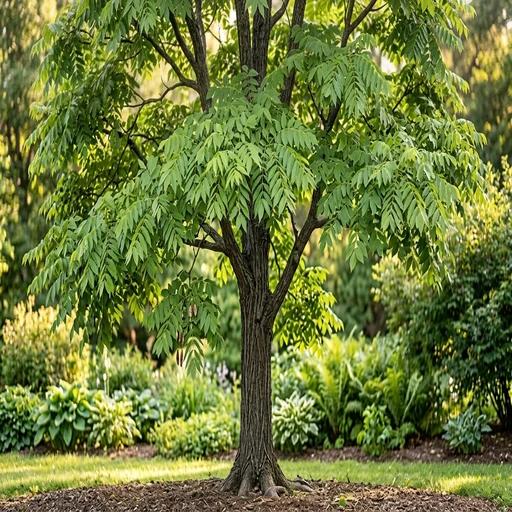
Gymnocladus dioica is a large, deciduous tree native to the Midwest US, featuring immense, doubly compound leaves that create a tropical effect. It has distinctive, rugged bark and a bold winter silhouette.
'Espresso' is a superior male selection, meaning it is seedless and therefore much tidier in the landscape. It develops a more uniform, upright-oval to vase-shaped canopy and has deeper green foliage than the species.
Uses & Benefits:
Essentials
At a Glance
Plant Type
Tree
Height
600"
Width
420"
Light
Full Sun
Zones
4, 5, 6, 7, 8
Water
Low to medium
Humidity
Adaptable
Lifespan
75+ years
Native To
Central and Eastern North America
Toxicity
Seeds and pulp are toxic if ingested
Bloom period
Late spring – Early summer
In flower about 2 months of the year
Planting
How to Grow
- Select a site in full sun with ample space for mature growth.
- Dig a planting hole two to three times wider than the root ball.
- Set the tree so the top of the root ball is slightly above ground level.
- Backfill with the original soil, breaking up any large clumps.
- Water deeply to eliminate air pockets and settle the soil.
- Mulch around the base, but keep it away from the trunk.
Pro Tip
Be patient; it leafs out very late in spring, often looking lifeless when other trees are green, but it is worth the wait.
Keep It Thriving
Care Guide
Do
- Provide deep, infrequent waterings during prolonged drought, especially when young.
- Prune during dormancy to develop a strong structure.
- Allow plenty of overhead and lateral space for it to mature.
- Appreciate its coarse winter texture and late spring leaf-out.
Don't
- Don't plant in a small yard or under power lines.
- Avoid heavy fertilization; this tree thrives in average soil.
- Don't worry if it's the last tree to leaf out in spring; this is normal.
- Don't plant the species if you don't want the large, messy seed pods; choose a male cultivar like 'Espresso'.
Seasonal Care Calendar
| Task | Jan | Feb | Mar | Apr | May | Jun | Jul | Aug | Sep | Oct | Nov | Dec |
|---|---|---|---|---|---|---|---|---|---|---|---|---|
| Plant | ||||||||||||
| Prune | ||||||||||||
| Spring Cleanup |
Watch Out For
Pests & Diseases
Common Pests
Common Diseases
In the Garden
Landscape Uses & Companions
Landscape Uses
Multiply
Propagation Methods
Good to Know
Common Questions
Espresso Kentucky Coffeetree questions
What zones can Espresso Kentucky Coffeetree grow in?
Espresso Kentucky Coffeetree is hardy in USDA Zones 4–8. Inside that range it survives winter in the ground; outside it, grow it as an annual or a container plant you protect.
Is Espresso Kentucky Coffeetree deer resistant?
Yes — Espresso Kentucky Coffeetree is rated deer-resistant. Deer typically pass it over, though extreme hunger can override any plant's defenses.
When does Espresso Kentucky Coffeetree bloom?
Espresso Kentucky Coffeetree typically blooms in late spring through early summer. Exact timing shifts a week or two with your zone — Sow's bloom calendar maps it to your garden.
Does Espresso Kentucky Coffeetree need full sun?
Espresso Kentucky Coffeetree does best in full sun (6+ hours).
Is Espresso Kentucky Coffeetree drought tolerant?
Yes — once established (usually after the first full season), Espresso Kentucky Coffeetree handles dry spells with minimal watering. Water deeply its first year to build the root system that makes that possible.
More Gymnocladus to compare
Keep exploring
Explore the genus
Hardy in your zone?
Grow Espresso Kentucky Coffeetree with confidence
See it in a design of your actual yard, get zone-matched care reminders, and track it season by season in your garden journal.