The Story
Plant Bio
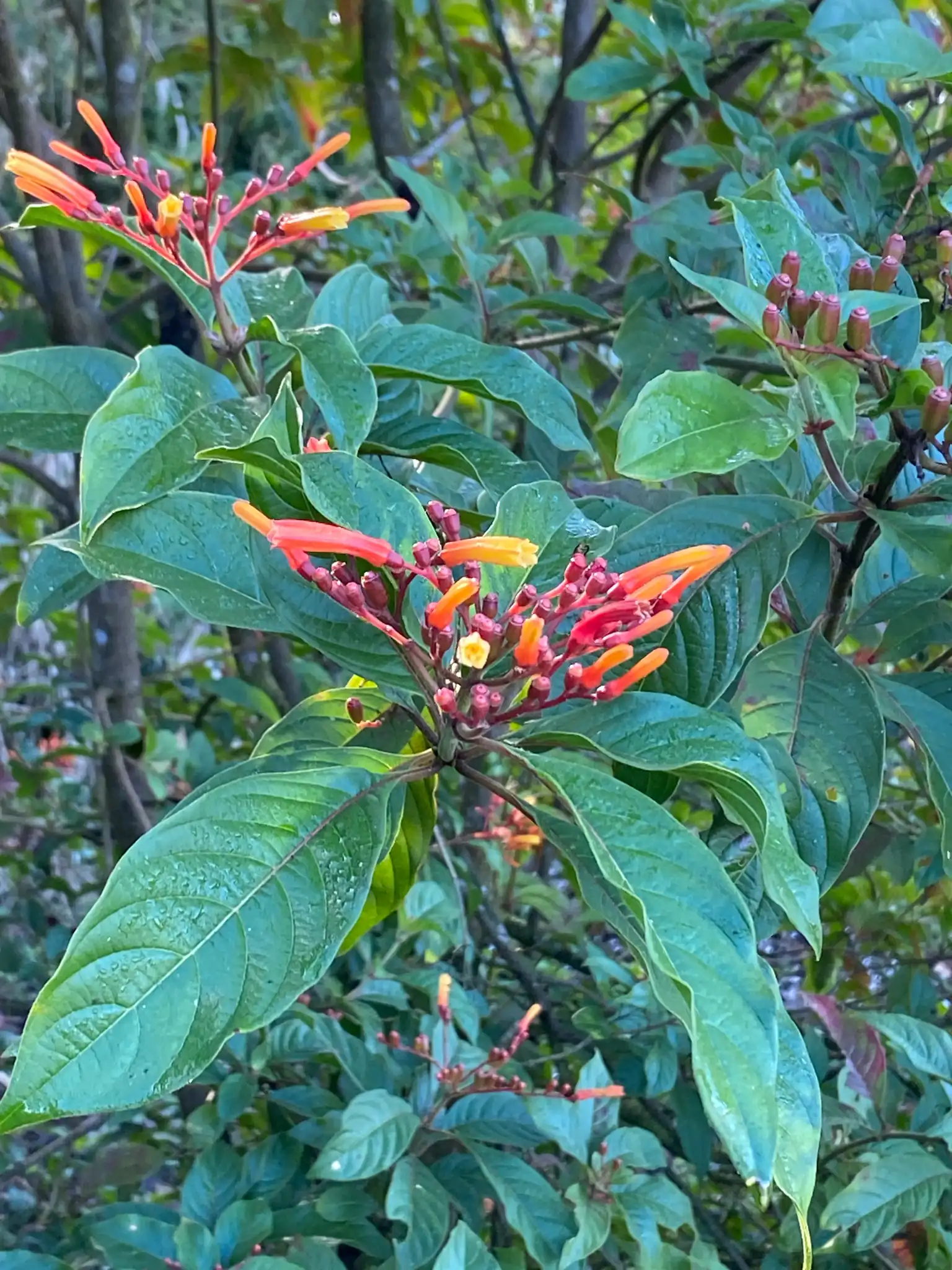
Hamelia patens is a fast-growing, multi-stemmed evergreen shrub native to the American subtropics, characterized by whorled, gray-green leaves with distinctive reddish veins. Terminal branching clusters of tubular, orange-red flowers bloom continuously in warm climates, followed by small black berries that attract songbirds.
In USDA Zones 9 through 11, this species maintains a woody, upright form reaching up to twelve feet tall, while in Zone 8 it functions as a root-hardy perennial that dies back to the ground in winter. The foliage turns a deep burgundy-red during cooler autumn temperatures, providing seasonal color variation.
Uses & Benefits:
Essentials
At a Glance
Plant Type
Shrub
Height
120"
Width
96"
Light
Full Sun, Partial Sun
Zones
8, 9, 10
Water
Moderate
Humidity
High
Lifespan
Perennial
Native To
American tropics and subtropics
Toxicity
Non-toxic
Bloom period
Summer – Autumn
In flower about 6 months of the year
Planting
How to Grow
- Select a planting site in full sun to maximize flower production, though partial shade is acceptable.
- Dig a hole twice the width of the root ball and plant in well-drained soil, backfilling without soil amendments.
- Water deeply twice a week until the root system is established, then reduce frequency to rely on natural rainfall.
- Apply a thick layer of organic mulch around the base in late fall to protect the root system from winter freezes.
Pro Tip
Avoid shearing this shrub into formal, tight hedges; shearing removes the terminal buds where flower clusters develop, severely suppressing the bloom display.
Keep It Thriving
Care Guide
Do
- Prune selectively by cutting individual stems back to a lateral branch to maintain a natural, arching habit.
- Mulch heavily in Zone 8 to insulate the root crown against winter frost.
- Plant in full sun to secure the most abundant and vibrant red-orange blooms.
Don't
- Do not shear the outer foliage into a formal box shape, as this cuts off the terminal flowering tips.
- Do not over-fertilize, as excessive nitrogen stimulates leafy growth at the expense of flowers.
- Do not plant in poorly drained, permanently soggy soils where roots can rot.
Seasonal Care Calendar
| Task | Jan | Feb | Mar | Apr | May | Jun | Jul | Aug | Sep | Oct | Nov | Dec |
|---|---|---|---|---|---|---|---|---|---|---|---|---|
| Fertilize | ||||||||||||
| Mulch | ||||||||||||
| Pest Check | ||||||||||||
| Prune |
Watch Out For
Pests & Diseases
Common Pests
Common Diseases
In the Garden
Landscape Uses & Companions
Landscape Uses
Multiply
Propagation Methods
Good to Know
Common Questions
Firebush questions
What zones can Firebush grow in?
Firebush is hardy in USDA Zones 8–10. Inside that range it survives winter in the ground; outside it, grow it as an annual or a container plant you protect.
When does Firebush bloom?
Firebush typically blooms in summer through autumn. Exact timing shifts a week or two with your zone — Sow's bloom calendar maps it to your garden.
Does Firebush need full sun?
Firebush does best in full sun to part shade. In hot climates, afternoon shade keeps blooms fresher longer.
Is Firebush drought tolerant?
Yes — once established (usually after the first full season), Firebush handles dry spells with minimal watering. Water deeply its first year to build the root system that makes that possible.
Keep exploring
Explore the genus
Hardy in your zone?
Grow Firebush with confidence
See it in a design of your actual yard, get zone-matched care reminders, and track it season by season in your garden journal.