The Story
Plant Bio
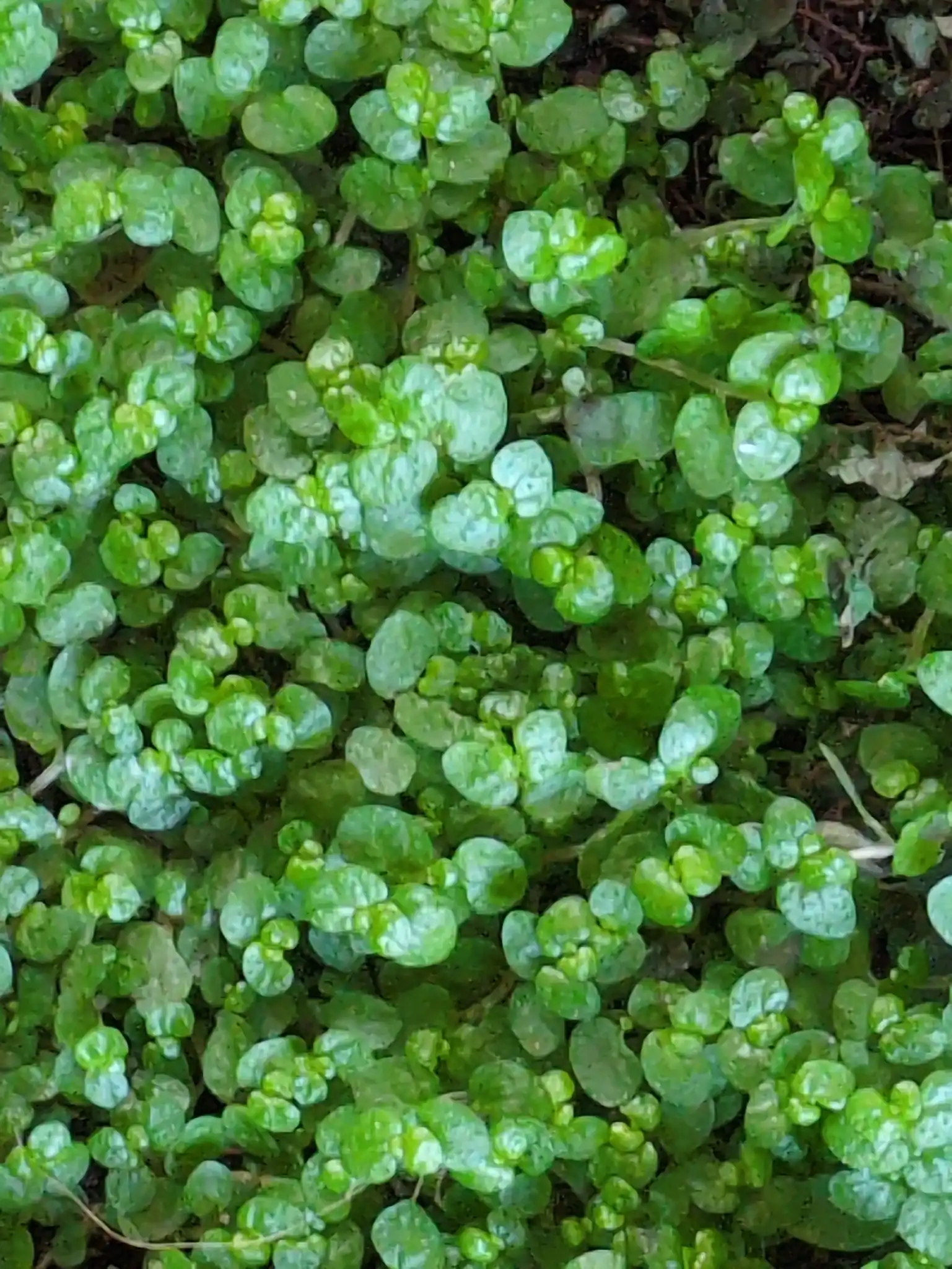
Soleirolia soleirolii is a creeping, mat-forming evergreen perennial that produces fine, fragile stems rooting at the nodes as they spread. The dense, moss-like foliage consists of tiny, rounded to kidney-shaped leaves that remain rich green throughout the year in mild climates.
The species is distinguished by its extremely low profile, rarely exceeding five inches in height while spreading indefinitely to form a lush carpet. Inconspicuous, petal-less creamy-white flowers appear in the leaf axils during spring and early summer but remain ornamentally insignificant.
Uses & Benefits:
Essentials
At a Glance
Plant Type
Groundcover
Height
5"
Width
72"
Light
Partial Sun, Shade
Zones
9, 10
Water
High
Humidity
High
Lifespan
Perennial
Native To
Western Mediterranean (Corsica and Sardinia)
Toxicity
Non-toxic
Bloom period
Spring – Summer
In flower about 6 months of the year
Planting
How to Grow
- Select a fully shaded or partially shaded planting site protected from direct afternoon sun.
- Incorporate organic matter into the soil to ensure a rich, moisture-retentive, yet well-draining medium.
- Space plants 12 to 18 inches apart, pressing the root balls gently into the soil without burying the delicate crown.
- Water thoroughly immediately after planting and maintain consistent moisture, never allowing the soil to dry out completely.
Pro Tip
Avoid planting this species in areas with any foot traffic, as the fragile stems crush easily and do not tolerate being walked on.
Keep It Thriving
Care Guide
Do
- Keep the soil consistently moist to prevent rapid desiccation and foliage collapse.
- Provide high humidity, especially when growing indoors or in dry climates.
- Trim the edges of the mat to control spread or clear dead winter foliage in marginal zones.
Don't
- Do not expose the plant to direct sunlight, which quickly scorches and kills the foliage.
- Do not allow the soil to become waterlogged or sit in standing water, which induces root rot.
- Do not cut back aggressively into old, leafless woody stems, as they may fail to resprout.
- Do not step on the plant, as the fragile stems cannot tolerate foot traffic.
Seasonal Care Calendar
| Task | Jan | Feb | Mar | Apr | May | Jun | Jul | Aug | Sep | Oct | Nov | Dec |
|---|---|---|---|---|---|---|---|---|---|---|---|---|
| Fertilize | ||||||||||||
| Pest Check | ||||||||||||
| Propagate | ||||||||||||
| Prune |
Watch Out For
Pests & Diseases
Common Pests
Common Diseases
In the Garden
Landscape Uses & Companions
Landscape Uses
Companion Plants
Multiply
Propagation Methods
Good to Know
Common Questions
Baby's Tears questions
What zones can Baby's Tears grow in?
Baby's Tears is hardy in USDA Zones 9–10. Inside that range it survives winter in the ground; outside it, grow it as an annual or a container plant you protect.
When does Baby's Tears bloom?
Baby's Tears typically blooms in spring through summer. Exact timing shifts a week or two with your zone — Sow's bloom calendar maps it to your garden.
Does Baby's Tears need full sun?
Baby's Tears does best in part shade.
Keep exploring
Explore the genus
Hardy in your zone?
Grow Baby's Tears with confidence
See it in a design of your actual yard, get zone-matched care reminders, and track it season by season in your garden journal.