The Story
Plant Bio
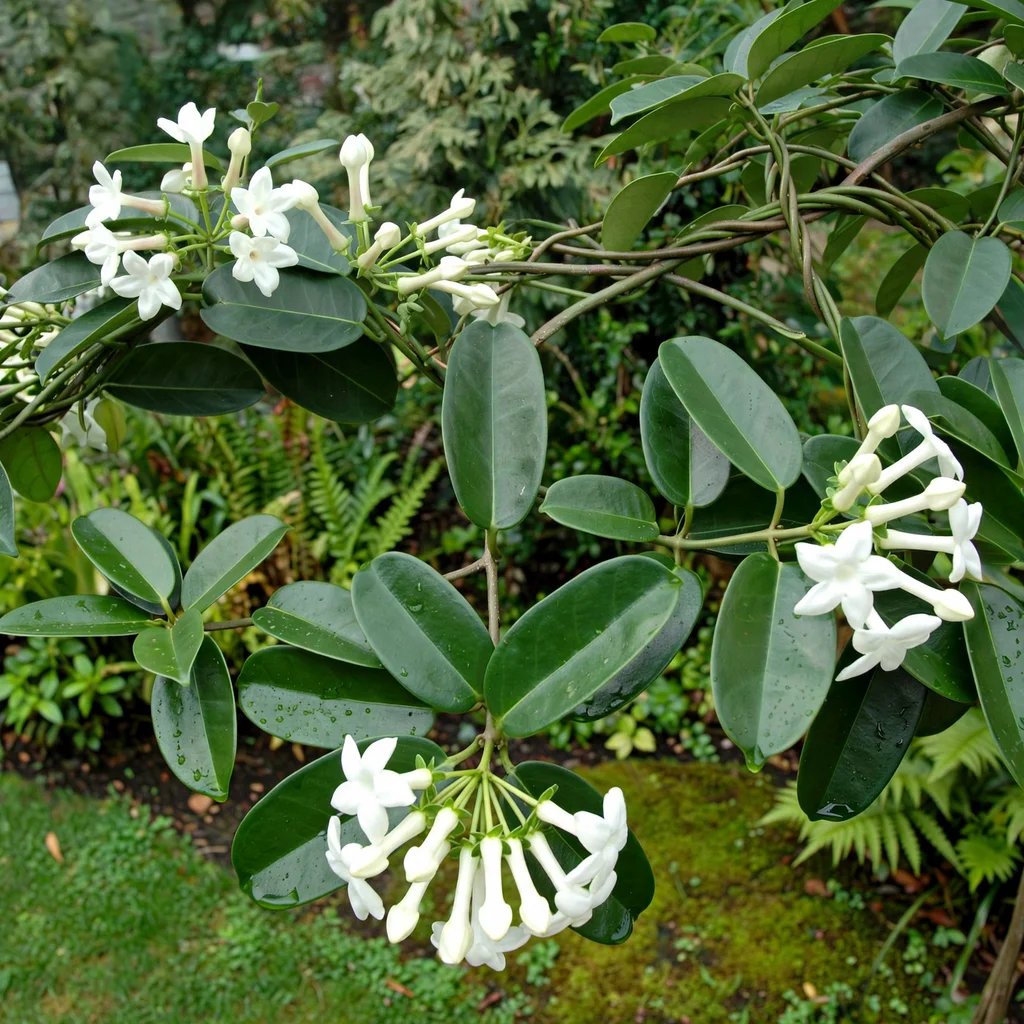
Stephanotis floribunda, the Madagascar jasmine, is an evergreen woody climber featuring thick, leathery, glossy dark green leaves arranged in opposite pairs along sparsely branched twining stems. During the active growing season, it produces axillary clusters of highly fragrant, waxy, star-shaped white flowers that gradually fade to a pale yellow as they age.
This species is highly valued for its intense, sweet fragrance and its twining habit, which allows it to be easily trained onto hoops, trellises, or indoor wire frames. Unlike many tropical vines, its new foliage matches the deep green texture of mature leaves immediately, maintaining a uniform appearance year-round.
Uses & Benefits:
Essentials
At a Glance
Plant Type
Vine
Height
120"
Width
60"
Light
Full Sun, Partial Sun
Zones
10
Water
Low to moderate
Humidity
High
Lifespan
Perennial
Native To
Madagascar
Toxicity
Non-toxic
Bloom period
Spring – Fall
In flower about 9 months of the year
Planting
How to Grow
- Select a container with excellent drainage holes and fill it with a rich, humus-rich, loamy potting mix.
- Position the container in a location that receives bright, filtered light or morning sun, protecting the foliage from harsh afternoon sun.
- Water thoroughly when the top inch of soil feels dry, ensuring excess water drains away completely to prevent root rot.
- Maintain high humidity around the plant by misting regularly or using a humidifier, especially during dry winter months.
Pro Tip
Provide a distinct cool-winter rest period with reduced watering and temperatures between 50°F and 60°F to trigger abundant flower bud initiation for the following spring.
Keep It Thriving
Care Guide
Do
- Water thoroughly and allow the top inch of soil to dry out before watering again.
- Provide a sturdy trellis, hoop, or wire frame for the twining stems to climb.
- Apply a balanced, water-soluble fertilizer every two to four weeks during the spring and summer.
Don't
- Do not prune heavily into old, leafless woody stems, as they rarely produce new shoots.
- Avoid exposing the plant to sudden drafts, temperature fluctuations, or drastic light changes to prevent bud drop.
- Do not allow the pot to sit in standing water, which rapidly causes root rot.
Seasonal Care Calendar
| Task | Jan | Feb | Mar | Apr | May | Jun | Jul | Aug | Sep | Oct | Nov | Dec |
|---|---|---|---|---|---|---|---|---|---|---|---|---|
| Fertilize | ||||||||||||
| Pest Check | ||||||||||||
| Prune | ||||||||||||
| Winter Prep |
Watch Out For
Pests & Diseases
Common Pests
Common Diseases
In the Garden
Landscape Uses & Companions
Landscape Uses
Companion Plants
Multiply
Propagation Methods
Good to Know
Common Questions
Madagascar Jasmine questions
What zones can Madagascar Jasmine grow in?
Madagascar Jasmine is hardy in USDA Zone 10. Inside that range it survives winter in the ground; outside it, grow it as an annual or a container plant you protect.
When does Madagascar Jasmine bloom?
Madagascar Jasmine typically blooms in spring through fall. Exact timing shifts a week or two with your zone — Sow's bloom calendar maps it to your garden.
Does Madagascar Jasmine need full sun?
Madagascar Jasmine does best in full sun to part shade. In hot climates, afternoon shade keeps blooms fresher longer.
Keep exploring
Explore the genus
Hardy in your zone?
Grow Madagascar Jasmine with confidence
See it in a design of your actual yard, get zone-matched care reminders, and track it season by season in your garden journal.