The Story
Plant Bio
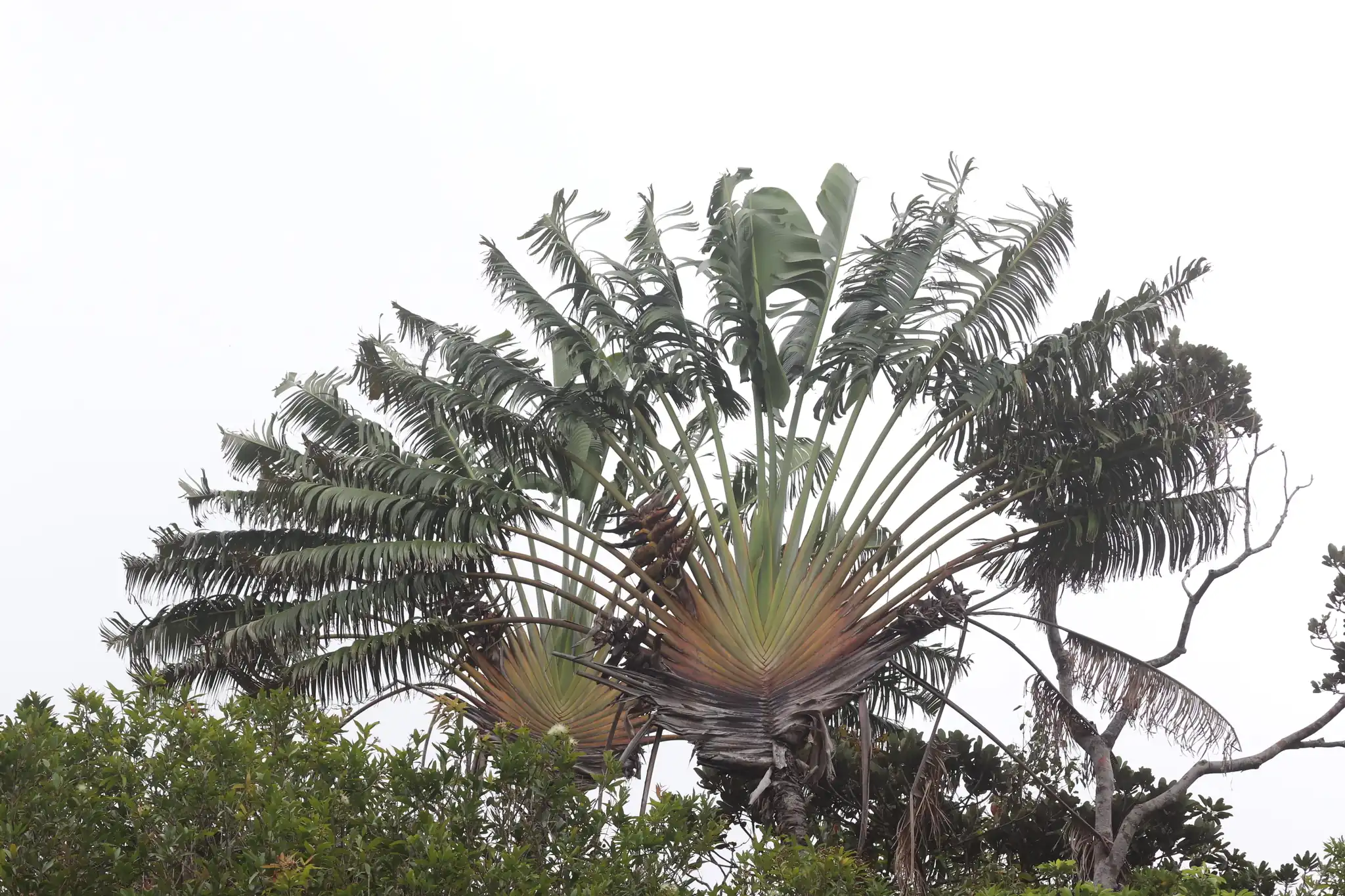
Ravenala madagascariensis is a massive evergreen monocot that develops a woody, ringed trunk topped by a single-plane, two-dimensional fan of giant banana-like leaves. The species is native to Madagascar and produces large, boat-shaped woody spathes containing creamy-white flowers followed by capsules of bright blue-arilled seeds.
The enormous leaf blades, reaching up to ten feet in length, naturally split into ribbons under wind stress to prevent the plant from blowing over. Over time, the base produces suckers that form dense clumps unless regularly removed to maintain the single-trunk architectural silhouette.
Uses & Benefits:
Essentials
At a Glance
Plant Type
Tropical
Height
600"
Width
300"
Light
Full Sun, Partial Sun
Zones
10
Water
Moderate
Humidity
High
Lifespan
Perennial
Native To
Madagascar
Toxicity
Non-toxic
Bloom period
Summer
In flower about 3 months of the year
Marketplace
Where to Buy
Shipping costs Year-round shipping Free shipping
Planting
How to Grow
- Select a planting site in full sun with deep, fertile, organically rich loam that drains rapidly.
- Dig a hole twice as wide as the root ball and set the plant at its original container depth.
- Water deeply at the base, keeping the soil consistently moist but never saturated or waterlogged.
- Apply a balanced, slow-release tropical fertilizer regularly during the warm summer growing season.
Pro Tip
Never prune into the old, leafless woody trunk tissue; only remove completely spent, brown lower leaves by cutting them close to the petiole base.
Keep It Thriving
Care Guide
Do
- Clear away fallen leaf bases and debris from the trunk to prevent stagnant water accumulation.
- Provide shelter from strong, direct coastal winds to minimize severe leaf shredding.
- Keep soil consistently moist to maintain pristine foliage quality.
Don't
- Do not allow the root zone to sit in standing water or poorly drained, waterlogged soil.
- Do not prune into the woody trunk tissue when removing lower leaves.
- Do not expose the plant to freezing temperatures or light frosts, which cause severe foliage damage.
Seasonal Care Calendar
| Task | Jan | Feb | Mar | Apr | May | Jun | Jul | Aug | Sep | Oct | Nov | Dec |
|---|---|---|---|---|---|---|---|---|---|---|---|---|
| Fertilize | ||||||||||||
| Pest Check | ||||||||||||
| Prune | ||||||||||||
| Winter Prep |
Watch Out For
Pests & Diseases
Common Pests
Common Diseases
In the Garden
Landscape Uses & Companions
Landscape Uses
Companion Plants
Multiply
Propagation Methods
Good to Know
Common Questions
Traveler's Tree questions
What zones can Traveler's Tree grow in?
Traveler's Tree is hardy in USDA Zone 10. Inside that range it survives winter in the ground; outside it, grow it as an annual or a container plant you protect.
Is Traveler's Tree deer resistant?
Yes — Traveler's Tree is rated deer-resistant. Deer typically pass it over, though extreme hunger can override any plant's defenses.
When does Traveler's Tree bloom?
Traveler's Tree typically blooms in summer through summer. Exact timing shifts a week or two with your zone — Sow's bloom calendar maps it to your garden.
Does Traveler's Tree need full sun?
Traveler's Tree does best in full sun to part shade. In hot climates, afternoon shade keeps blooms fresher longer.
Keep exploring
Explore the genus
Hardy in your zone?
Grow Traveler's Tree with confidence
See it in a design of your actual yard, get zone-matched care reminders, and track it season by season in your garden journal.