The Story
Plant Bio
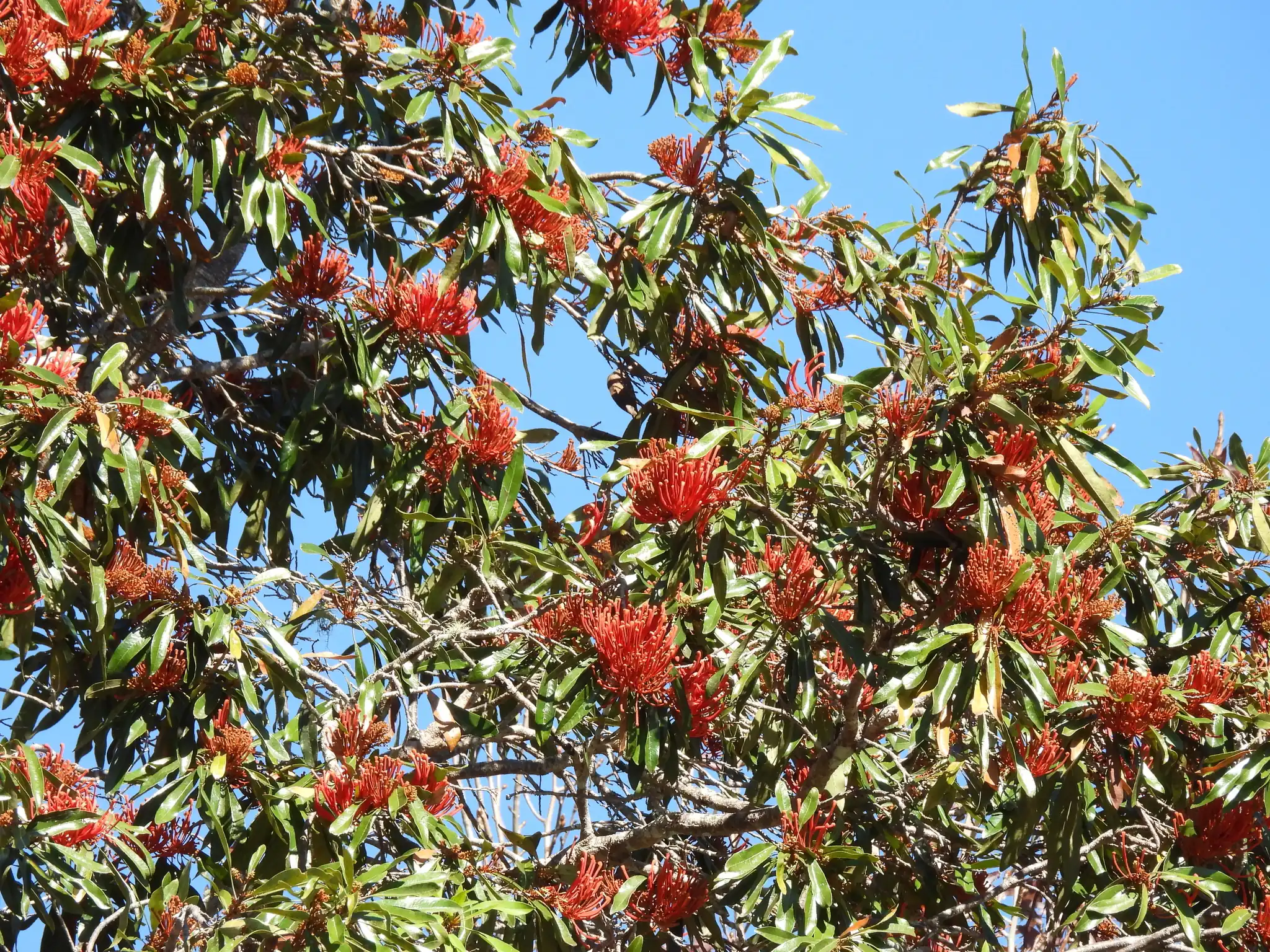
Alloxylon flammeum, the Queensland tree waratah, is an evergreen Australian tree reaching twenty to thirty feet in cultivation, with glossy, dark green leaves that shift from deeply lobed in youth to entire and leathery at maturity. The flowers are bright red, tubular, and packed into dense, terminal clusters of over one hundred blooms that lack the large surrounding bracts of true Telopea waratahs.
This species is highly sensitive to phosphorus, possessing specialized proteoid roots adapted for nutrient-poor soils that fail rapidly when exposed to standard fertilizers. It requires exceptional drainage combined with consistent moisture, making heavy clay soils fatal.
Uses & Benefits:
Essentials
At a Glance
Plant Type
Tree
Height
360"
Width
180"
Light
Full Sun, Partial Sun
Zones
9, 10
Water
Moderate
Humidity
High
Lifespan
Long-lived
Native To
Australia
Toxicity
Non-toxic
Bloom period
Spring – Early summer
In flower about 4 months of the year
Planting
How to Grow
- Select a planting site in full sun to light shade with deep, rich, acidic to neutral loam.
- Ensure the soil drains rapidly, as waterlogged conditions cause fatal Phytophthora root rot.
- Dig a hole twice the width of the root ball and plant without disturbing the sensitive root system.
- Water deeply and regularly during dry periods to maintain consistent moisture without saturating the soil.
Pro Tip
Never prune back into old, leafless wood, as the plant lacks dormant buds on bare timber and will fail to shoot.
Keep It Thriving
Care Guide
Do
- Use exclusively low-phosphorus fertilizers formulated for native Australian plants.
- Apply iron chelates if foliage begins to yellow after transplanting.
- Prune lightly immediately after flowering to shape the canopy and encourage dense growth.
Don't
- Do not prune into old, bare wood.
- Do not plant in heavy clay or poorly drained soils.
- Do not use standard general-purpose fertilizers containing phosphorus.
- Do not disturb the root ball during planting or cultivation.
Seasonal Care Calendar
| Task | Jan | Feb | Mar | Apr | May | Jun | Jul | Aug | Sep | Oct | Nov | Dec |
|---|---|---|---|---|---|---|---|---|---|---|---|---|
| Fertilize | ||||||||||||
| Mulch | ||||||||||||
| Pest Check | ||||||||||||
| Prune | ||||||||||||
| Winter Prep |
Watch Out For
Pests & Diseases
Common Pests
Common Diseases
In the Garden
Landscape Uses & Companions
Landscape Uses
Companion Plants
Multiply
Propagation Methods
Good to Know
Common Questions
Queensland Tree Waratah questions
What zones can Queensland Tree Waratah grow in?
Queensland Tree Waratah is hardy in USDA Zones 9–10. Inside that range it survives winter in the ground; outside it, grow it as an annual or a container plant you protect.
Is Queensland Tree Waratah deer resistant?
Not reliably. Deer may browse Queensland Tree Waratah, especially tender spring growth — plan on repellents or fencing where pressure is high.
When does Queensland Tree Waratah bloom?
Queensland Tree Waratah typically blooms in spring through early summer. Exact timing shifts a week or two with your zone — Sow's bloom calendar maps it to your garden.
Does Queensland Tree Waratah need full sun?
Queensland Tree Waratah does best in full sun to part shade. In hot climates, afternoon shade keeps blooms fresher longer.
Keep exploring
Explore the genus
Hardy in your zone?
Grow Queensland Tree Waratah with confidence
See it in a design of your actual yard, get zone-matched care reminders, and track it season by season in your garden journal.