The Story
Plant Bio
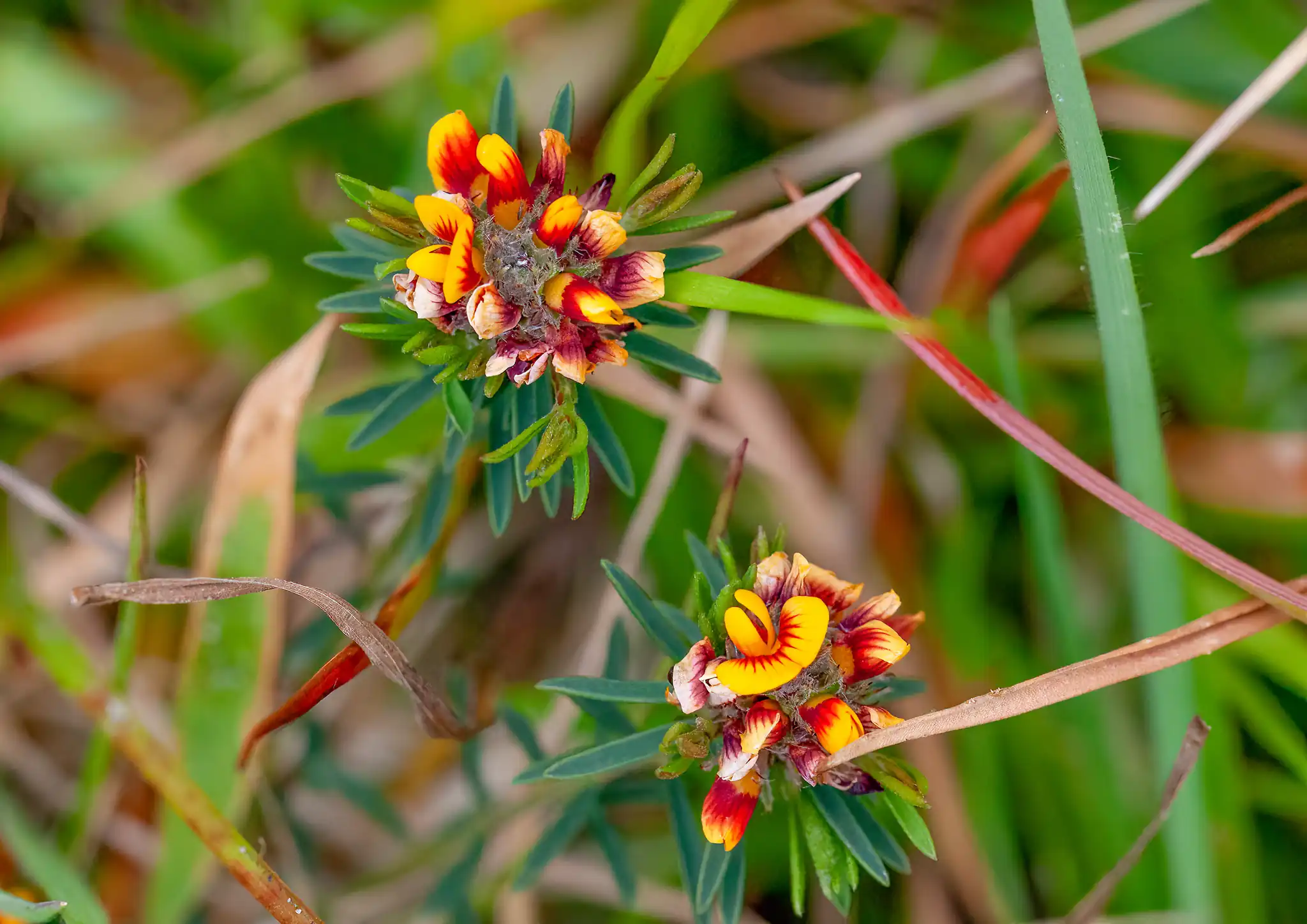
Pultenaea dentata, commonly known as the clustered bush-pea, is an open, sprawling evergreen shrub native to the damp heathlands and swamp margins of southeastern Australia. It produces dense terminal heads of bright yellow pea-flowers marked with red and purple, set against narrow, dark green leaves with incurved margins.
This species is distinguished by its low-lying, finely ribbed stems and the prominent tooth-like, dark brown stipular bracts that surround the flower clusters. It thrives in consistently moist, acidic, sandy or peaty soils that mimic its native wetland-margin habitats.
Uses & Benefits:
Essentials
At a Glance
Plant Type
Shrub
Height
31"
Width
39"
Light
Full Sun, Partial Sun
Zones
9, 10
Water
Medium
Humidity
Moderate to High
Lifespan
Short to Medium
Native To
Australia
Toxicity
Non-toxic
Bloom period
Spring
In flower about 3 months of the year
Planting
How to Grow
- Select a planting site with full sun to partial shade and highly acidic, sandy, loamy, or peaty soil.
- Ensure the soil remains consistently moist but provides excellent sub-surface drainage to prevent root rot.
- Apply a specialized, slow-release native plant fertilizer with low phosphorus levels in early spring.
- Prune the branch tips lightly after the spring flowering period to prevent the habit from becoming leggy.
Pro Tip
Prune lightly immediately after spring flowering to maintain a compact shape; cutting back into old, leafless wood prevents the plant from reshooting.
Keep It Thriving
Care Guide
Do
- Keep the soil consistently moist, especially during dry summer spells.
- Use only low-phosphorus fertilizers formulated specifically for Australian native plants.
- Provide excellent drainage to protect the root system from standing water.
Don't
- Do not allow the root zone to dry out completely, as the plant has low drought tolerance.
- Never prune hard into old, bare wood, as it lacks dormant buds to regenerate.
- Avoid using standard general-purpose garden fertilizers containing high phosphorus.
Seasonal Care Calendar
| Task | Jan | Feb | Mar | Apr | May | Jun | Jul | Aug | Sep | Oct | Nov | Dec |
|---|---|---|---|---|---|---|---|---|---|---|---|---|
| Fertilize | ||||||||||||
| Pest Check | ||||||||||||
| Propagate | ||||||||||||
| Prune |
Watch Out For
Pests & Diseases
Common Pests
Common Diseases
In the Garden
Landscape Uses & Companions
Landscape Uses
Companion Plants
Multiply
Propagation Methods
Good to Know
Common Questions
Clustered Bush-Pea questions
What zones can Clustered Bush-Pea grow in?
Clustered Bush-Pea is hardy in USDA Zones 9–10. Inside that range it survives winter in the ground; outside it, grow it as an annual or a container plant you protect.
When does Clustered Bush-Pea bloom?
Clustered Bush-Pea typically blooms in spring through spring. Exact timing shifts a week or two with your zone — Sow's bloom calendar maps it to your garden.
Does Clustered Bush-Pea need full sun?
Clustered Bush-Pea does best in full sun to part shade. In hot climates, afternoon shade keeps blooms fresher longer.
More Pultenaea to compare
Keep exploring
Explore the genus
Hardy in your zone?
Grow Clustered Bush-Pea with confidence
See it in a design of your actual yard, get zone-matched care reminders, and track it season by season in your garden journal.