The Story
Plant Bio
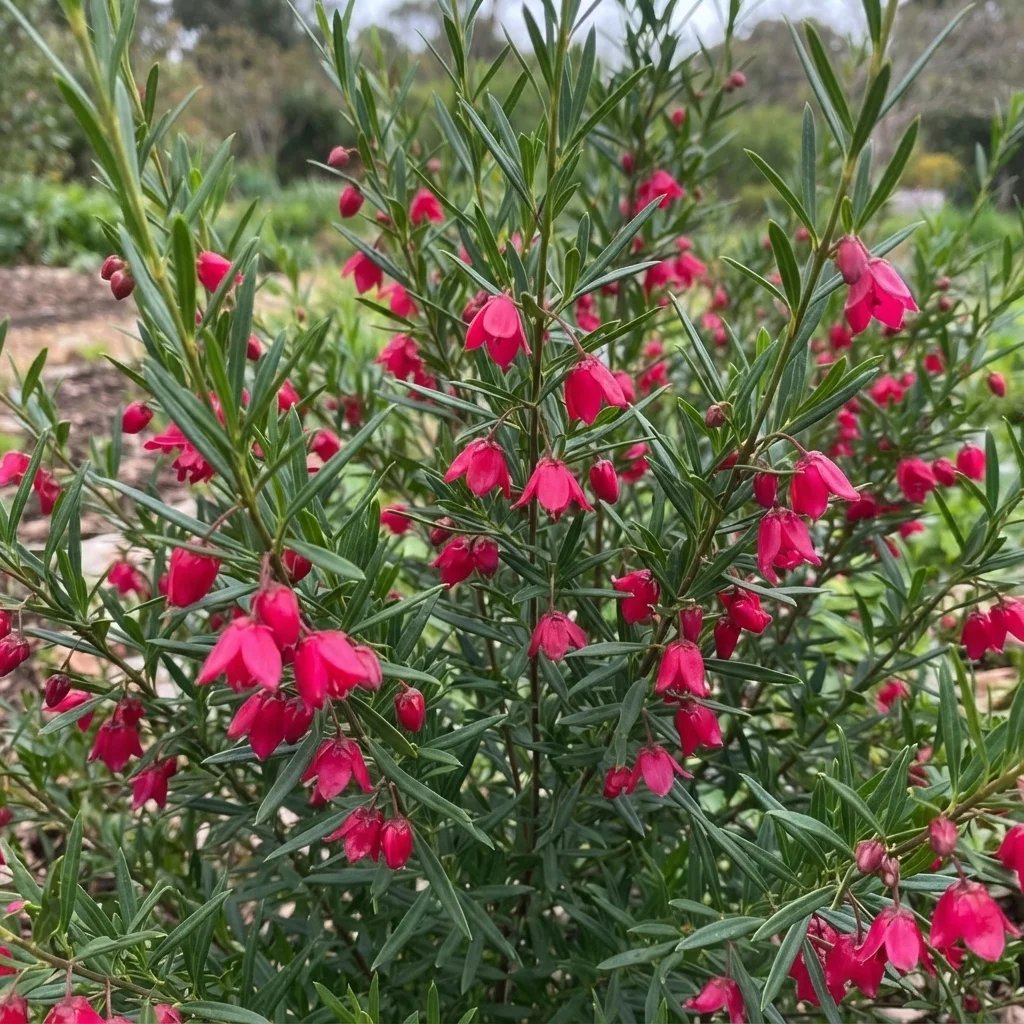
Boronia heterophylla is an upright, slender Australian shrub with dense, rounded growth and highly aromatic, glossy dark green foliage. In winter and spring, it produces a profuse display of nodding, bell-shaped flowers that line the stems in shades of bright reddish-pink to deep crimson.
The fine-textured leaves vary on the same branch from simple needles to pinnately divided leaflets, releasing a strong citrus-to-rue scent when bruised. The striking bell flowers arise directly from the leaf axils, hanging downward along the flexible, soft stems.
Uses & Benefits:
Essentials
At a Glance
Plant Type
Shrub
Height
118"
Width
79"
Light
Full Sun, Partial Sun
Zones
9, 10
Water
Regular moisture
Humidity
Moderate
Lifespan
Short to medium
Native To
Southwestern Western Australia
Toxicity
Mildly toxic if ingested; can cause mild contact dermatitis
Bloom period
Winter – Spring
In flower about 6 months of the year
Planting
How to Grow
- Select a planting site with well-drained sandy loam or organic-rich composted soil and an acidic to neutral pH.
- Position the plant in dappled shade or full sun, ensuring the ground around the base is heavily mulched to keep the roots cool.
- Water regularly to maintain consistent soil moisture, as the plant has low drought tolerance and will fail in dry conditions.
- Avoid waterlogged soils and heavy clay, which lead to immediate root rot and plant death.
Pro Tip
Keep the root zone cool and insulated by placing flat rocks or heavy organic mulch over the soil, and never prune back into old, leafless wood.
Keep It Thriving
Care Guide
Do
- Mulch heavily around the base to keep the root zone cool.
- Water regularly to maintain consistent soil moisture.
- Prune lightly by up to one-third immediately after flowering to maintain a dense shape.
- Use low-phosphorus, native-formulated fertilizers very sparingly in spring.
Don't
- Do not prune hard into old, leafless wood, as it will not regenerate.
- Do not allow the soil to dry out completely, especially during summer heat.
- Do not use standard high-phosphorus fertilizers.
- Do not plant in poorly drained or waterlogged soils.
Seasonal Care Calendar
| Task | Jan | Feb | Mar | Apr | May | Jun | Jul | Aug | Sep | Oct | Nov | Dec |
|---|---|---|---|---|---|---|---|---|---|---|---|---|
| Fertilize | ||||||||||||
| Mulch | ||||||||||||
| Pest Check | ||||||||||||
| Prune |
Watch Out For
Pests & Diseases
Common Pests
Common Diseases
In the Garden
Landscape Uses & Companions
Landscape Uses
Companion Plants
Multiply
Propagation Methods
Good to Know
Common Questions
Red Boronia questions
What zones can Red Boronia grow in?
Red Boronia is hardy in USDA Zones 9–10. Inside that range it survives winter in the ground; outside it, grow it as an annual or a container plant you protect.
Is Red Boronia deer resistant?
Not reliably. Deer may browse Red Boronia, especially tender spring growth — plan on repellents or fencing where pressure is high.
When does Red Boronia bloom?
Red Boronia typically blooms in winter through spring. Exact timing shifts a week or two with your zone — Sow's bloom calendar maps it to your garden.
Does Red Boronia need full sun?
Red Boronia does best in full sun to part shade. In hot climates, afternoon shade keeps blooms fresher longer.
More Boronia to compare
Keep exploring
Explore the genus
Hardy in your zone?
Grow Red Boronia with confidence
See it in a design of your actual yard, get zone-matched care reminders, and track it season by season in your garden journal.