The Story
Plant Bio
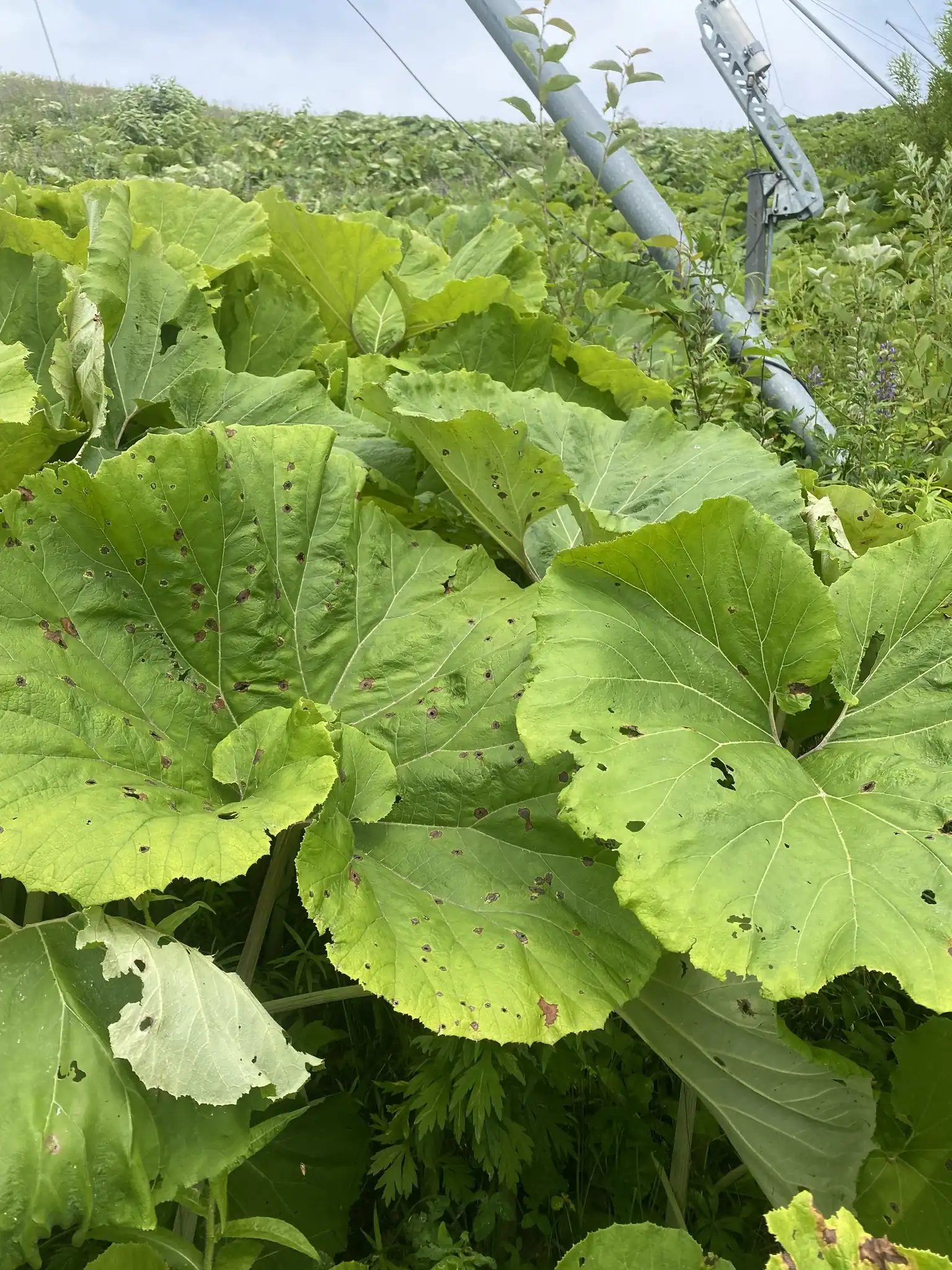
Petasites japonicus, butterbur or fuki, is a rhizomatous perennial from Korea, China and Japan, forming dense clumps to three feet high and five across. The huge rounded basal leaves are the display, sometimes two feet wide on long stalks. Fragrant yellowish-white flower heads push through bare ground in April, before any leaf appears.
It spreads aggressively by rhizome and will take a border if left loose in open ground, so plant it inside a sunken container or behind a solid barrier from the start rather than trying to reclaim ground later. Despite being eaten as fuki in Japan, the raw plant contains liver-toxic alkaloids and should not be treated as a casual edible.
Uses & Benefits:
Essentials
At a Glance
Plant Type
Perennial
Height
36"
Width
48"
Light
Partial Sun, Shade
Zones
4, 5, 6, 7, 8, 9
Water
High
Humidity
High
Lifespan
Perennial
Native To
Korea, China and Japan
Toxicity
Toxic if ingested
Planting
How to Grow
- Plant in spring in part to full shade.
- Choose consistently moist to wet soil.
- Confine the roots in a sunken container or behind a barrier.
- Water heavily; the leaves wilt if the soil dries.
- Cut spent foliage down in autumn.
- Check the barrier each spring for escaping rhizomes.
Pro Tip
Contain it at planting; once the rhizomes are into open ground, removing butterbur is a multi-season job rather than an afternoon's work.
Keep It Thriving
Care Guide
Do
- Plant it inside a root barrier 🧱
- Keep the soil constantly moist to wet 💧
- Grow it in part to full shade 🌳
- Use it at pond and stream banks 🪷
Don't
- Plant it loose in an open border ❌
- Let the soil dry out in summer ❌
- Treat the raw plant as an ordinary edible ❌
Seasonal Care Calendar
| Task | Jan | Feb | Mar | Apr | May | Jun | Jul | Aug | Sep | Oct | Nov | Dec |
|---|---|---|---|---|---|---|---|---|---|---|---|---|
| Check | ||||||||||||
| Cut Back |
Watch Out For
Pests & Diseases
Common Pests
Common Diseases
In the Garden
Landscape Uses & Companions
Landscape Uses
Companion Plants
Multiply
Propagation Methods
Good to Know
Common Questions
Japanese Butterbur questions
What zones can Japanese Butterbur grow in?
Japanese Butterbur is hardy in USDA Zones 4–9. Inside that range it survives winter in the ground; outside it, grow it as an annual or a container plant you protect.
Is Japanese Butterbur deer resistant?
Not reliably. Deer may browse Japanese Butterbur, especially tender spring growth — plan on repellents or fencing where pressure is high.
When does Japanese Butterbur bloom?
Japanese Butterbur typically blooms in early spring, before the leaves through late spring. Exact timing shifts a week or two with your zone — Sow's bloom calendar maps it to your garden.
Does Japanese Butterbur need full sun?
Japanese Butterbur does best in part shade.
More Petasites to compare
Keep exploring
Explore the genus
Grow Japanese Butterbur with confidence
See it in a design of your actual yard, get zone-matched care reminders, and track it season by season in your garden journal.