The Story
Plant Bio
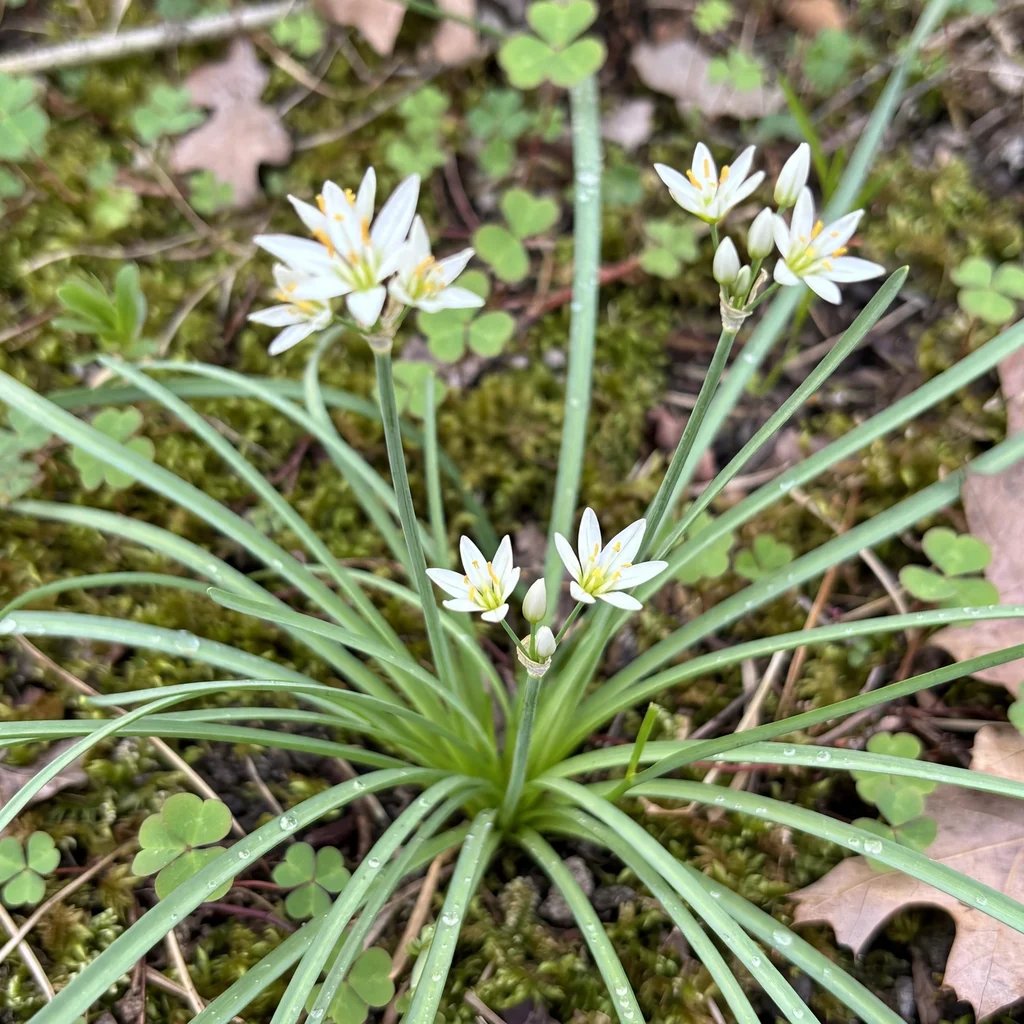
Nothoscordum bivalve is a bulbous herbaceous perennial native to North American prairies, glades, and open woodlands. It produces a basal rosette of narrow, grass-like leaves and erect, smooth flowering scapes that bear loose, terminal umbels of cream-white flowers.
Unlike true onions and garlics of the Allium genus, this species entirely lacks any sulfurous or garlic-like odor when the leaves or bulbs are crushed. The upward-facing flowers feature six tepals with a faint green or reddish-brown midvein on the exterior and yellow-orange anthers.
Uses & Benefits:
Essentials
At a Glance
Plant Type
Perennial
Height
16"
Width
8"
Light
Full Sun, Partial Sun
Zones
5, 6, 7, 8, 9
Water
Low to moderate
Humidity
Medium
Lifespan
Perennial
Native To
North America, South America
Toxicity
Toxic if Ingested
Bloom period
Spring – Autumn
In flower about 9 months of the year
Planting
How to Grow
- Select a planting site in full sun to partial shade with well-draining sandy, loamy, or clay soil.
- Plant dormant bulbs in early fall at a depth of three inches, spacing them two to three inches apart.
- Water thoroughly after planting to settle the soil, then rely on natural rainfall except during extreme droughts.
- Allow the foliage to die back naturally after spring flowering to store energy in the bulb for the next season.
Pro Tip
Avoid applying high-nitrogen fertilizers to lawns or beds where this species is naturalized; excess nitrogen weakens competing turfgrasses while this bulb easily exploits the lean, disturbed soil conditions.
Keep It Thriving
Care Guide
Do
- Grow in lean, unfertilized soils to maintain a compact habit and prevent aggressive self-seeding.
- Mow over naturalized lawn populations only after the spring flowering cycle is complete.
- Ensure excellent drainage to prevent bulb rot during wet winter months.
Don't
- Do not apply heavy chemical fertilizers, which disrupt the natural growth cycle and encourage weed competition.
- Do not plant in low-lying areas where stagnant water accumulates.
- Do not ingest any part of the plant, as it contains compounds historically associated with livestock toxicity.
Seasonal Care Calendar
| Task | Jan | Feb | Mar | Apr | May | Jun | Jul | Aug | Sep | Oct | Nov | Dec |
|---|---|---|---|---|---|---|---|---|---|---|---|---|
| Divide | ||||||||||||
| Pest Check | ||||||||||||
| Plant | ||||||||||||
| Spring Cleanup |
Watch Out For
Pests & Diseases
Common Pests
Common Diseases
In the Garden
Landscape Uses & Companions
Landscape Uses
Companion Plants
Multiply
Propagation Methods
Good to Know
Common Questions
False Garlic questions
What zones can False Garlic grow in?
False Garlic is hardy in USDA Zones 5–9. Inside that range it survives winter in the ground; outside it, grow it as an annual or a container plant you protect.
Is False Garlic deer resistant?
Yes — False Garlic is rated deer-resistant. Deer typically pass it over, though extreme hunger can override any plant's defenses.
When does False Garlic bloom?
False Garlic typically blooms in spring through autumn. Exact timing shifts a week or two with your zone — Sow's bloom calendar maps it to your garden.
Does False Garlic need full sun?
False Garlic does best in full sun to part shade. In hot climates, afternoon shade keeps blooms fresher longer.
Is False Garlic drought tolerant?
Yes — once established (usually after the first full season), False Garlic handles dry spells with minimal watering. Water deeply its first year to build the root system that makes that possible.
Keep exploring
Explore the genus
Hardy in your zone?
Grow False Garlic with confidence
See it in a design of your actual yard, get zone-matched care reminders, and track it season by season in your garden journal.