The Story
Plant Bio
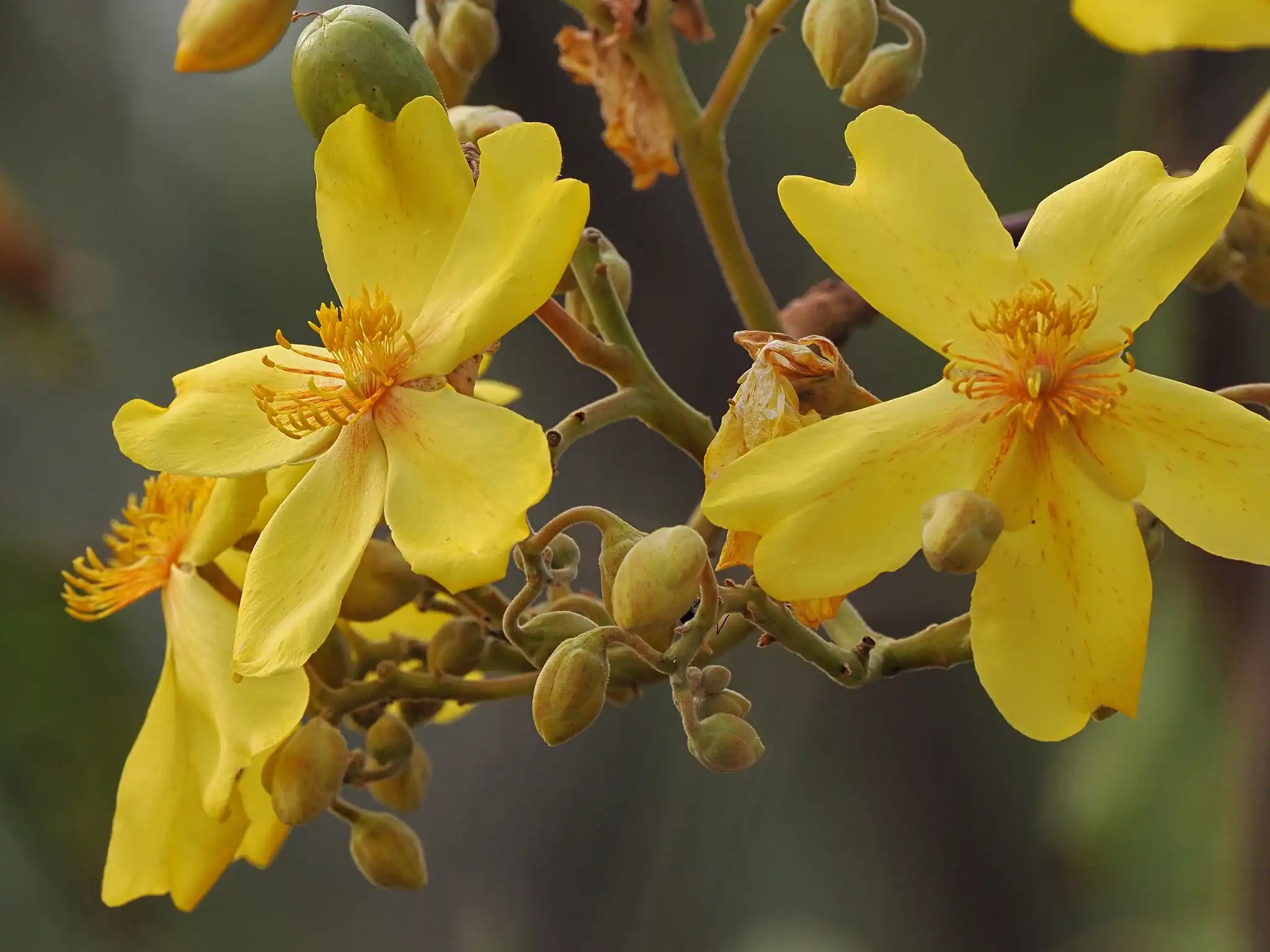
Cochlospermum fraseri is a deciduous large shrub or small slender tree native to northern Australia, characterized by its smooth grey bark and sparse canopy. The plant sheds its palmately-lobed leaves during the dry season, producing terminal panicles of bright golden-yellow flowers on bare branches.
New foliage emerges with distinct waxy pinkish-yellow or reddish tones before maturing to a light green. The subsequent seed pods contain fine, cotton-like hairs surrounding the seeds, which can act as a mechanical irritant if touched or inhaled.
Uses & Benefits:
Essentials
At a Glance
Plant Type
Tree
Height
275"
Width
157"
Light
Full Sun
Zones
9, 10
Water
Low
Humidity
High
Lifespan
Moderate
Native To
Australia
Toxicity
Non-toxic
Bloom period
Winter – Spring
In flower about 6 months of the year
Planting
How to Grow
- Select a planting site in full sun with exceptionally well-drained, sandy or rocky soil.
- Dig a hole twice the width of the root ball and plant at the same depth as the nursery container.
- Water deeply to settle the soil, then establish a minimal watering schedule that allows the soil to dry completely between applications.
- Cease irrigation entirely when the leaves drop in late fall to initiate the mandatory dry winter rest period.
Pro Tip
Withhold all water during the winter deciduous phase; keeping the soil dry during dormancy is critical to prevent fatal root rot.
Keep It Thriving
Care Guide
Do
- Provide full sun to maximize flowering and maintain a compact habit.
- Use a highly porous, sandy or gravelly potting mix if growing in containers.
- Protect the plant from all frost and freezing temperatures.
Don't
- Do not water during the winter dormancy period when the plant is leafless.
- Do not prune heavily into old, bare wood lacking active buds.
- Do not plant in heavy clay or poorly drained soils.
Seasonal Care Calendar
| Task | Jan | Feb | Mar | Apr | May | Jun | Jul | Aug | Sep | Oct | Nov | Dec |
|---|---|---|---|---|---|---|---|---|---|---|---|---|
| Fertilize | ||||||||||||
| Pest Check | ||||||||||||
| Prune | ||||||||||||
| Winter Prep |
Watch Out For
Pests & Diseases
Common Pests
Common Diseases
In the Garden
Landscape Uses & Companions
Landscape Uses
Companion Plants
Multiply
Propagation Methods
Good to Know
Common Questions
Kapok Tree questions
What zones can Kapok Tree grow in?
Kapok Tree is hardy in USDA Zones 9–10. Inside that range it survives winter in the ground; outside it, grow it as an annual or a container plant you protect.
Is Kapok Tree deer resistant?
Not reliably. Deer may browse Kapok Tree, especially tender spring growth — plan on repellents or fencing where pressure is high.
When does Kapok Tree bloom?
Kapok Tree typically blooms in winter through spring. Exact timing shifts a week or two with your zone — Sow's bloom calendar maps it to your garden.
Does Kapok Tree need full sun?
Kapok Tree does best in full sun (6+ hours).
Is Kapok Tree drought tolerant?
Yes — once established (usually after the first full season), Kapok Tree handles dry spells with minimal watering. Water deeply its first year to build the root system that makes that possible.
Keep exploring
Explore the genus
Hardy in your zone?
Grow Kapok Tree with confidence
See it in a design of your actual yard, get zone-matched care reminders, and track it season by season in your garden journal.