
The Story
Plant Bio
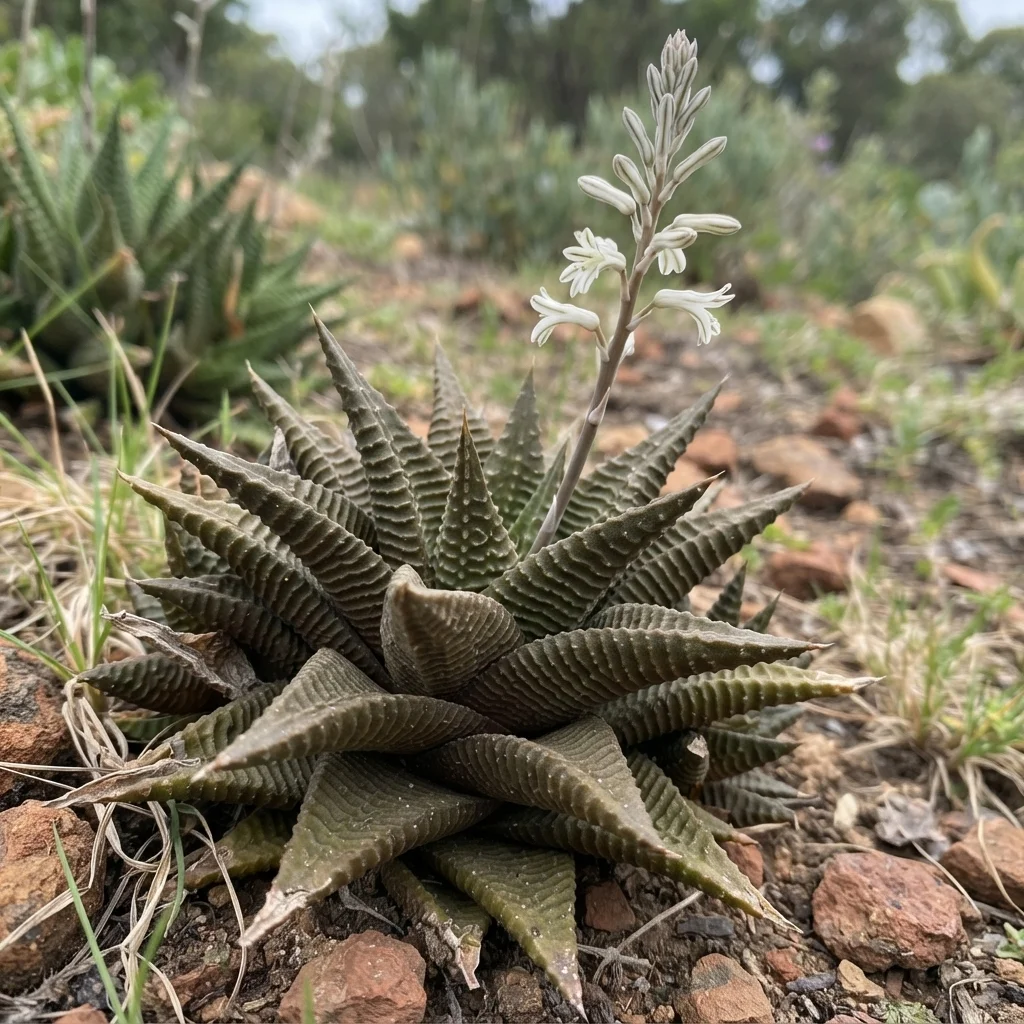
Haworthiopsis attenuata is a small, stemless succulent perennial native to the Eastern Cape Province of South Africa, where it grows in rocky, shaded positions within scrub and thicket vegetation. The plant forms tight, slow-growing rosettes of stiff, tapered leaves that offset freely from the base to create dense, low-spreading clumps.
This species is distinguished by prominent, white, bumpy tubercles that form raised bands and spots across both the upper and lower surfaces of its dark green foliage. In late spring and early summer, mature rosettes produce slender, upright flower stalks bearing small, tubular white blossoms marked with greenish-brown stripes.
Uses & Benefits:
Essentials
At a Glance
Plant Type
Cactus Succulent
Height
12"
Width
26"
Light
Partial Sun, Shade
Zones
9, 10
Water
Low
Humidity
Average
Lifespan
Perennial
Native To
South Africa
Toxicity
Non-toxic
Bloom period
Spring – Early summer
In flower about 4 months of the year
Planting
How to Grow
- Select a container with multiple drainage holes and fill it with a gritty, porous cactus and succulent potting mix.
- Position the plant in bright, indirect sunlight or partial shade, avoiding intense direct midday sun which scorches the foliage.
- Water thoroughly only when the potting medium has dried out completely down to the bottom of the container.
- Maintain average indoor temperatures and protect the plant from freezing conditions below 32 degrees Fahrenheit.
Pro Tip
Avoid planting in standard commercial potting soil without adding coarse grit or pumice; excess moisture retention around the roots causes rapid, irreversible decay.
Keep It Thriving
Care Guide
Do
- Use a highly porous, gritty potting mix to ensure rapid drainage.
- Provide bright, indirect light to maintain the compact rosette form and white leaf banding.
- Water deeply but infrequently, allowing the soil to dry out completely between waterings.
- Feed sparingly with a half-strength balanced liquid succulent fertilizer during the active spring and summer growth period.
Don't
- Never let the pot sit in standing water or a decorative outer saucer that holds moisture.
- Do not position the plant in deep shade, which causes weak, stretched growth and loss of white markings.
- Avoid watering the center of the rosette directly, as trapped water can initiate crown rot.
- Do not apply fertilizer during the winter dormancy period when growth slows.
Seasonal Care Calendar
| Task | Jan | Feb | Mar | Apr | May | Jun | Jul | Aug | Sep | Oct | Nov | Dec |
|---|---|---|---|---|---|---|---|---|---|---|---|---|
| Fertilize | ||||||||||||
| Pest Check | ||||||||||||
| Propagate | ||||||||||||
| Winter Prep |
Watch Out For
Pests & Diseases
Common Pests
Common Diseases
In the Garden
Landscape Uses & Companions
Landscape Uses
Multiply
Propagation Methods
Good to Know
Common Questions
Zebra Haworthia questions
What zones can Zebra Haworthia grow in?
Zebra Haworthia is hardy in USDA Zones 9–10. Inside that range it survives winter in the ground; outside it, grow it as an annual or a container plant you protect.
Is Zebra Haworthia deer resistant?
Yes — Zebra Haworthia is rated deer-resistant. Deer typically pass it over, though extreme hunger can override any plant's defenses.
When does Zebra Haworthia bloom?
Zebra Haworthia typically blooms in spring through early summer. Exact timing shifts a week or two with your zone — Sow's bloom calendar maps it to your garden.
Does Zebra Haworthia need full sun?
Zebra Haworthia does best in part shade.
Is Zebra Haworthia drought tolerant?
Yes — once established (usually after the first full season), Zebra Haworthia handles dry spells with minimal watering. Water deeply its first year to build the root system that makes that possible.
More Haworthiopsis to compare
Keep exploring
Explore the genus
Hardy in your zone?
Grow Zebra Haworthia with confidence
See it in a design of your actual yard, get zone-matched care reminders, and track it season by season in your garden journal.