The Story
Plant Bio
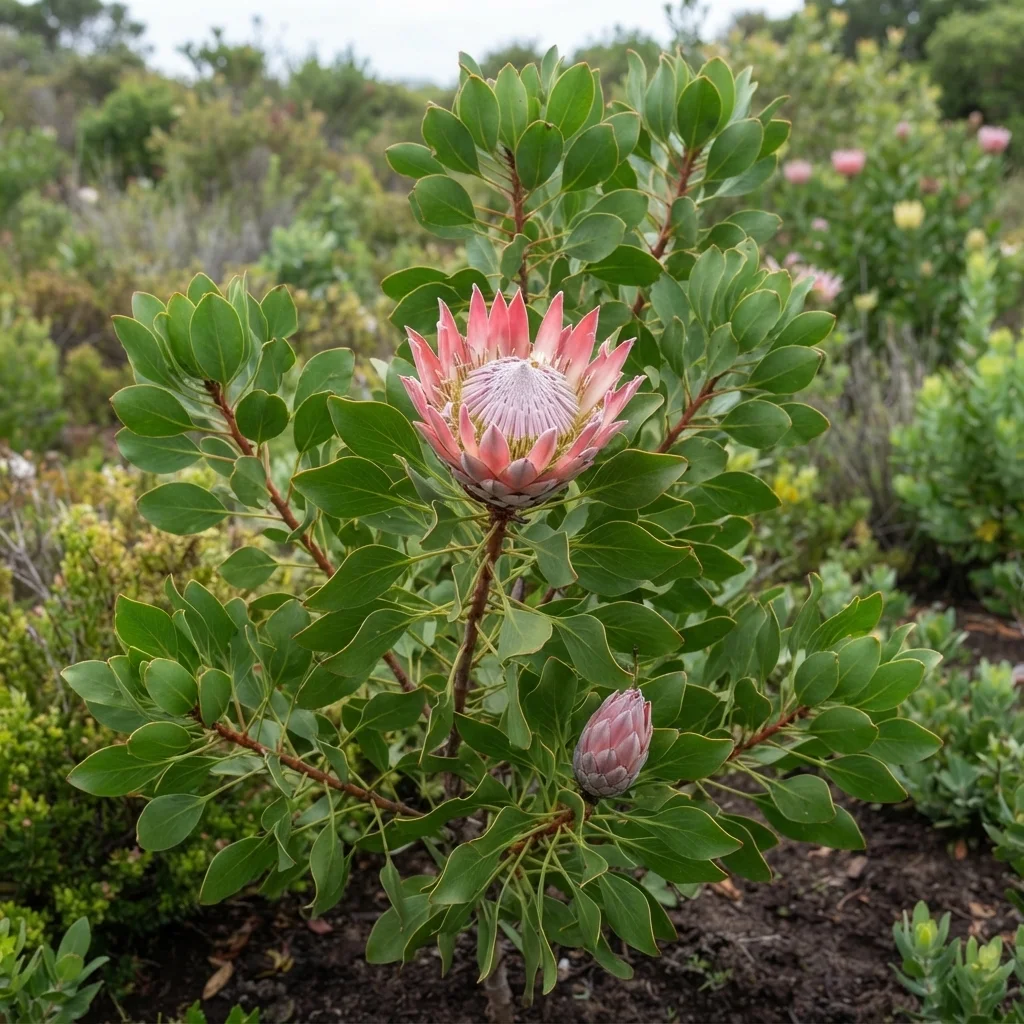
Protea neriifolia, commonly known as the pink mink or narrow-leaf sugarbush, is an upright, broadleaf evergreen shrub native to the mountain ranges of South Africa's Cape Provinces. It produces large, cup-shaped terminal flower heads featuring pink to creamy-green bracts fringed with a distinct, beard-like margin of dark brown or black hairs.
The narrow, leathery leaves curve upward along the stems and closely resemble those of oleander, starting with a soft texture before maturing to a smooth, blue-green finish. Flowering begins in fall and continues through spring, providing a critical nectar source during the cooler months of the year.
Uses & Benefits:
Essentials
At a Glance
Plant Type
Shrub
Height
120"
Width
100"
Light
Full Sun
Zones
9, 10
Water
Low
Humidity
Moderate
Lifespan
10 - 20 years
Native To
South Africa
Toxicity
Non-toxic
Bloom period
Fall – Spring
In flower about 9 months of the year
Planting
How to Grow
- Select a planting site in full sun with exceptionally well-draining, acidic, sandy or gritty soil.
- Dig a hole twice as wide as the root ball but no deeper, ensuring the crown sits slightly above the surrounding soil level to prevent water pooling.
- Water deeply but infrequently during the first summer to establish the root system, allowing the soil to dry out completely between waterings.
- Prune the stems lightly after the spring flowering period, cutting just above a node with active leaves and never back into bare, woody branches.
Pro Tip
Never apply fertilizers containing phosphorus, as the specialized proteoid roots of this species absorb nutrients so efficiently that standard formulas cause rapid toxicity and death.
Keep It Thriving
Care Guide
Do
- Plant in a raised bed or mound if your garden has heavy or slow-draining soil.
- Ensure excellent air circulation around the shrub to minimize the risk of fungal leaf diseases.
- Use only specialized, phosphorus-free fertilizers formulated for native or proteoid plants if feeding is necessary.
Don't
- Do not overwater, especially during the warm summer months when the plant is less active.
- Never cut back hard into old, leafless wood, as the plant cannot regenerate from these stems.
- Do not apply standard garden fertilizers, compost, or manure, which contain toxic levels of phosphorus.
Seasonal Care Calendar
| Task | Jan | Feb | Mar | Apr | May | Jun | Jul | Aug | Sep | Oct | Nov | Dec |
|---|---|---|---|---|---|---|---|---|---|---|---|---|
| Fertilize | ||||||||||||
| Mulch | ||||||||||||
| Pest Check | ||||||||||||
| Prune |
Watch Out For
Pests & Diseases
Common Pests
Common Diseases
In the Garden
Landscape Uses & Companions
Landscape Uses
Multiply
Propagation Methods
Good to Know
Common Questions
Pink Mink questions
What zones can Pink Mink grow in?
Pink Mink is hardy in USDA Zones 9–10. Inside that range it survives winter in the ground; outside it, grow it as an annual or a container plant you protect.
When does Pink Mink bloom?
Pink Mink typically blooms in fall through spring. Exact timing shifts a week or two with your zone — Sow's bloom calendar maps it to your garden.
Does Pink Mink need full sun?
Pink Mink does best in full sun (6+ hours).
Is Pink Mink drought tolerant?
Yes — once established (usually after the first full season), Pink Mink handles dry spells with minimal watering. Water deeply its first year to build the root system that makes that possible.
More Protea to compare
Keep exploring
Explore the genus
Hardy in your zone?
Grow Pink Mink with confidence
See it in a design of your actual yard, get zone-matched care reminders, and track it season by season in your garden journal.