The Story
Plant Bio
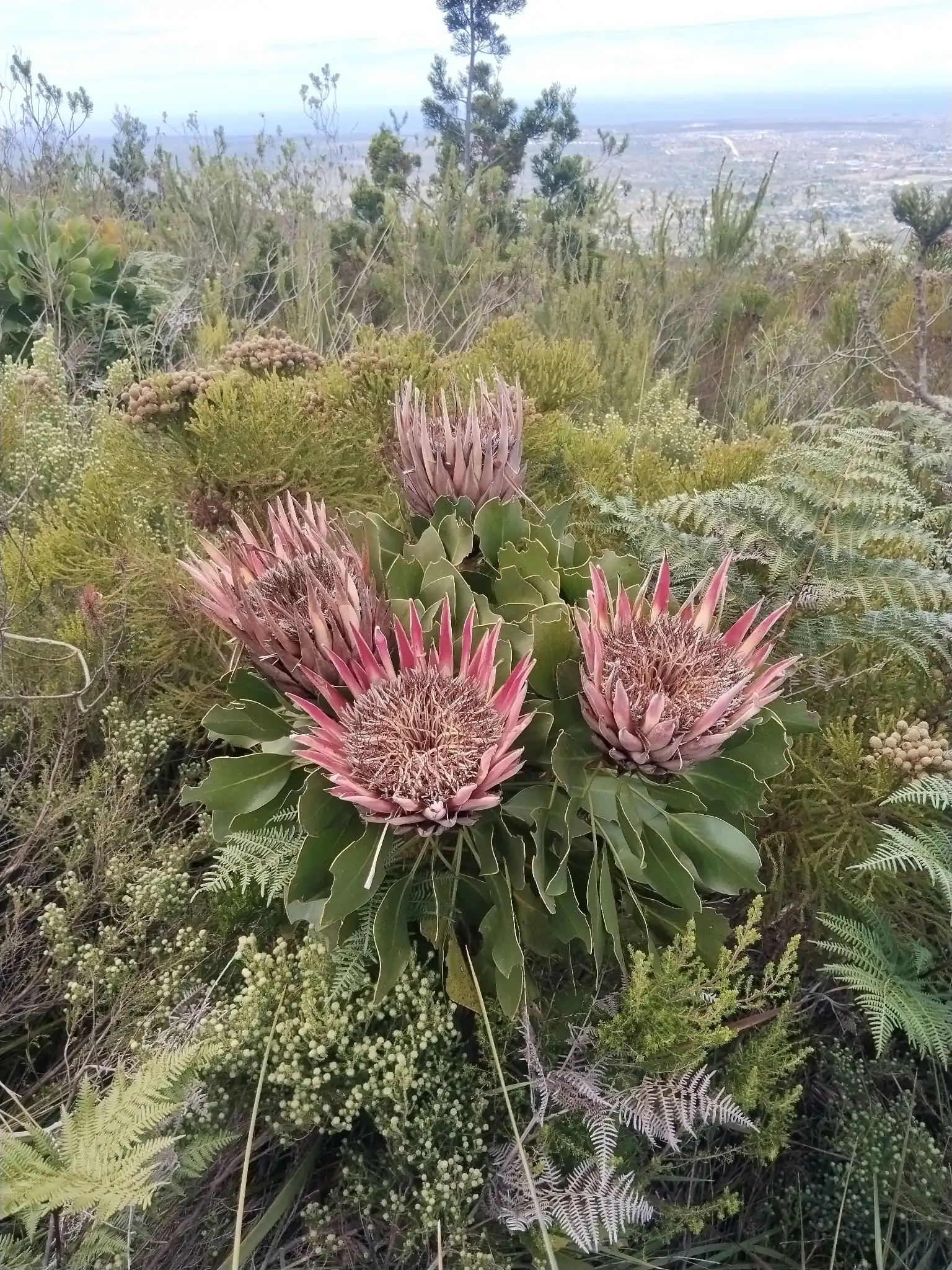
Protea cynaroides, the king protea, is a stiff, rounded, open-branched evergreen shrub native to the fynbos biome of South Africa. It develops a heavy woody rootstock known as a lignotuber and carries leathery, glossy dark green leaves on long reddish petioles.
The massive, bowl-shaped flower heads reach up to twelve inches in diameter, featuring a dense central cluster of tubular flowers ringed by stiff, colorful bracts ranging from pink to creamy white. These blooms appear primarily from late winter through spring and attract hummingbirds and bees with abundant nectar.
Uses & Benefits:
Essentials
At a Glance
Plant Type
Shrub
Height
72"
Width
72"
Light
Full Sun
Zones
8, 9, 10
Water
Low
Humidity
Low
Lifespan
Long-lived
Native To
South Africa
Toxicity
Non-toxic
Bloom period
Late winter – Spring
In flower about 4 months of the year
Planting
How to Grow
- Select a planting site in full sun with exceptionally well-drained, sandy or gravelly soil.
- Dig a hole twice the width of the rootball and plant the shrub slightly proud of the surrounding soil level.
- Water deeply to establish, then transition to infrequent watering, allowing the soil to dry completely between applications.
- Prune the stems back by several nodes after flowering to encourage branching and prevent leggy growth.
Pro Tip
Plant in nutrient-poor, highly acidic to neutral soil with flawless drainage, as any excess summer moisture or phosphorus fertilizer causes fatal root rot and toxicity.
Keep It Thriving
Care Guide
Do
- Plant in exceptionally well-drained, sandy or gravelly acidic soil.
- Prune back flowering stems to active growth nodes annually after blooming.
- Use only specialized, low-phosphorus fertilizers if feeding is necessary.
Don't
- Never apply standard garden fertilizers containing high levels of phosphorus.
- Do not plant in heavy clay soils or areas with standing water.
- Avoid pruning deep into old, bare, leafless wood.
Seasonal Care Calendar
| Task | Jan | Feb | Mar | Apr | May | Jun | Jul | Aug | Sep | Oct | Nov | Dec |
|---|---|---|---|---|---|---|---|---|---|---|---|---|
| Fertilize | ||||||||||||
| Pest Check | ||||||||||||
| Prune | ||||||||||||
| Winter Prep |
Watch Out For
Pests & Diseases
Common Pests
Common Diseases
In the Garden
Landscape Uses & Companions
Landscape Uses
Companion Plants
Multiply
Propagation Methods
Good to Know
Common Questions
King Protea questions
What zones can King Protea grow in?
King Protea is hardy in USDA Zones 8–10. Inside that range it survives winter in the ground; outside it, grow it as an annual or a container plant you protect.
Is King Protea deer resistant?
Yes — King Protea is rated deer-resistant. Deer typically pass it over, though extreme hunger can override any plant's defenses.
When does King Protea bloom?
King Protea typically blooms in late winter through spring. Exact timing shifts a week or two with your zone — Sow's bloom calendar maps it to your garden.
Does King Protea need full sun?
King Protea does best in full sun (6+ hours).
Is King Protea drought tolerant?
Yes — once established (usually after the first full season), King Protea handles dry spells with minimal watering. Water deeply its first year to build the root system that makes that possible.
More Protea to compare
Keep exploring
Explore the genus
Hardy in your zone?
Grow King Protea with confidence
See it in a design of your actual yard, get zone-matched care reminders, and track it season by season in your garden journal.