The Story
Plant Bio
Houstonia caerulea is a delicate, low-growing herbaceous perennial native to eastern North America, where it forms compact tufts or colonies via slender rhizomes. The species naturally thrives in moist, acidic, nutrient-poor soils along woodland edges, meadows, and grassy fields.
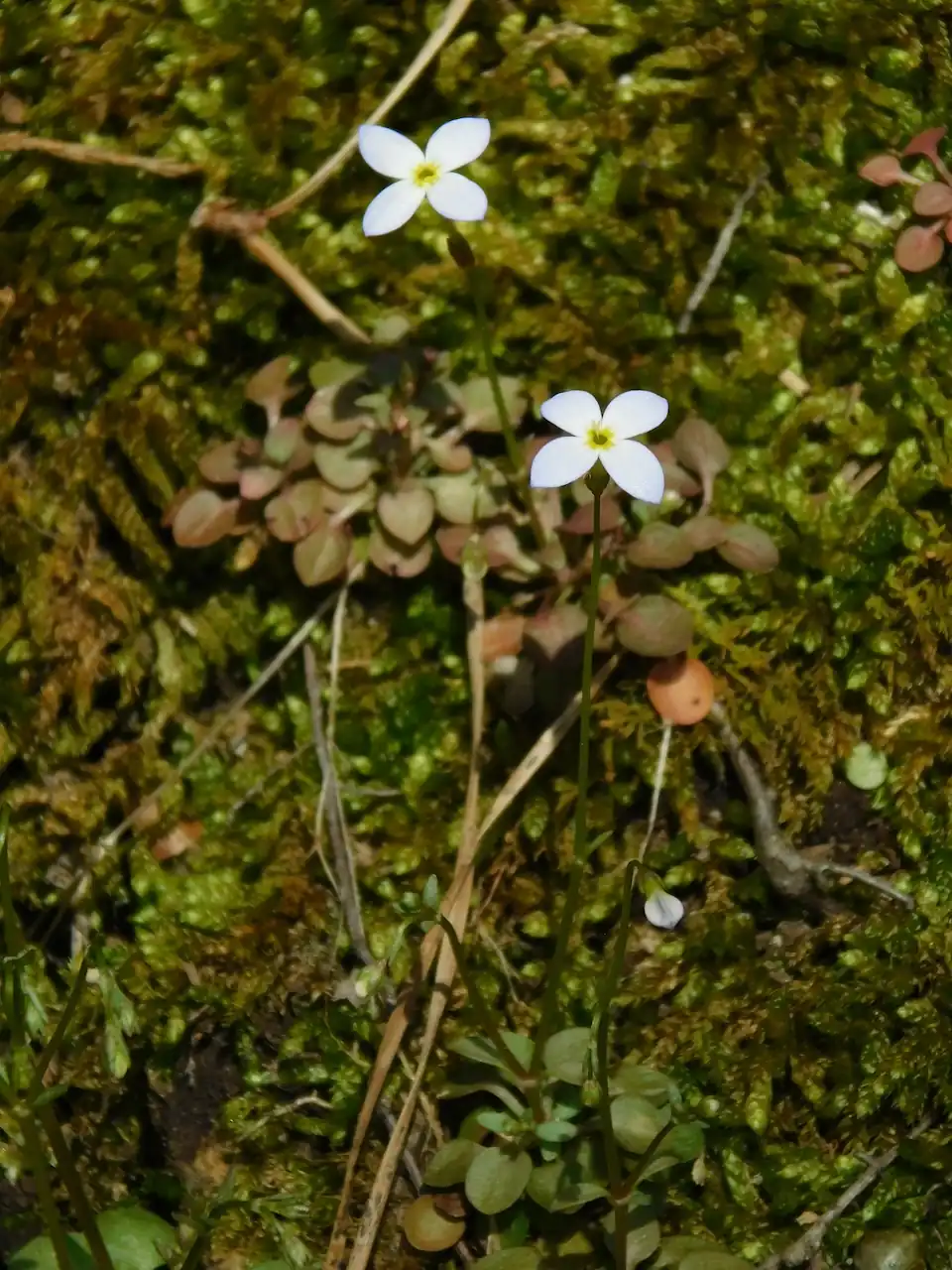
This species is distinguished by its tiny, spatula-shaped basal leaves and four-parted, trumpet-shaped flowers that feature pale blue petals surrounding a contrasting bright yellow center. The flowers rise singly on slender, upright terminal stalks, creating a carpet-like display during the peak growing season.
Uses & Benefits:
Essentials
At a Glance
Plant Type
Perennial
Height
8"
Width
6"
Light
Full Sun, Partial Sun
Zones
4, 5, 6, 7, 8
Water
Medium
Humidity
Medium to High
Lifespan
Perennial
Native To
North America
Toxicity
Non-toxic
Bloom period
Spring – Early summer
In flower about 4 months of the year
Planting
How to Grow
- Select a site with acidic, well-drained soil in partial shade or dappled sunlight.
- Clear the planting area of aggressive weeds and turf grasses that might crowd out the small rosettes.
- Plant plugs or divisions at soil level, spacing them three to six inches apart to allow colony formation.
- Water gently but thoroughly to settle the soil around the fragile roots without washing the plants away.
Pro Tip
Plant in poor, acidic, well-drained soil and avoid heavy fertilizers, which stimulate aggressive weed competition that easily smothers these delicate tufts.
Keep It Thriving
Care Guide
Do
- Keep the soil consistently moist, especially during hot summer dry spells.
- Allow plants to self-seed by leaving spent flowers intact until mid-summer.
- Divide established clumps in early spring to expand the colony.
Don't
- Do not apply heavy fertilizers, which can damage the roots and encourage competing weeds.
- Do not plant in heavy clay or areas with standing water where root rot can develop.
- Do not mow over lawn-grown colonies until they have finished flowering and set seed.
Seasonal Care Calendar
| Task | Jan | Feb | Mar | Apr | May | Jun | Jul | Aug | Sep | Oct | Nov | Dec |
|---|---|---|---|---|---|---|---|---|---|---|---|---|
| Divide | ||||||||||||
| Pest Check | ||||||||||||
| Propagate | ||||||||||||
| Spring Cleanup |
Watch Out For
Pests & Diseases
Common Pests
Common Diseases
In the Garden
Landscape Uses & Companions
Landscape Uses
Multiply
Propagation Methods
Good to Know
Common Questions
Azure Bluet questions
What zones can Azure Bluet grow in?
Azure Bluet is hardy in USDA Zones 4–8. Inside that range it survives winter in the ground; outside it, grow it as an annual or a container plant you protect.
Is Azure Bluet deer resistant?
Yes — Azure Bluet is rated deer-resistant. Deer typically pass it over, though extreme hunger can override any plant's defenses.
When does Azure Bluet bloom?
Azure Bluet typically blooms in spring through early summer. Exact timing shifts a week or two with your zone — Sow's bloom calendar maps it to your garden.
Does Azure Bluet need full sun?
Azure Bluet does best in full sun to part shade. In hot climates, afternoon shade keeps blooms fresher longer.
Keep exploring
Explore the genus
Hardy in your zone?
Grow Azure Bluet with confidence
See it in a design of your actual yard, get zone-matched care reminders, and track it season by season in your garden journal.