The Story
Plant Bio
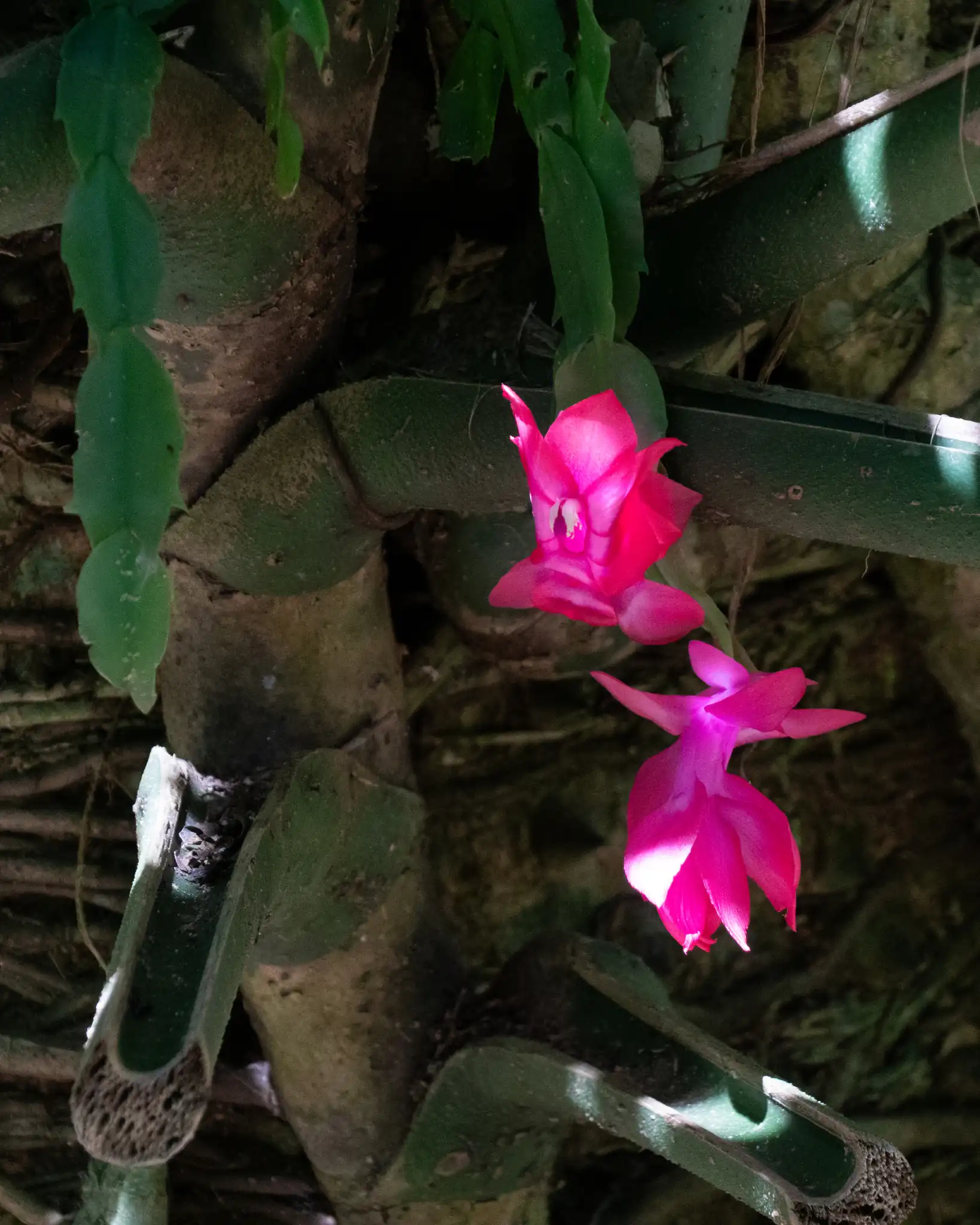
Schlumbergera truncata is a pendulous, multi-branched epiphytic succulent native to the coastal cloud forests of southeastern Brazil. It features flattened, segmented green stems with distinctive pointed, claw-like projections along the margins and lacks true leaves.
The species produces tubular, bilaterally symmetrical flowers from the terminal stem tips during late fall and early winter. While the wild form bears pink blossoms, cultivated varieties offer a range of red, purple, orange, yellow, and white flowers.
Uses & Benefits:
Essentials
At a Glance
Plant Type
Cactus Succulent
Height
18"
Width
36"
Light
Partial Sun, Shade
Zones
10
Water
Moderate
Humidity
Moderate to high
Lifespan
Long-lived
Native To
Brazil
Toxicity
Non-toxic
Bloom period
Fall – Winter
In flower about 6 months of the year
Planting
How to Grow
- Plant in a highly porous, well-draining epiphytic potting mix containing peat moss, orchid bark, and perlite.
- Position in bright indirect light, avoiding intense direct midday sun which scorches the stems.
- Water thoroughly when the top inch of soil feels dry, ensuring all excess water drains away immediately.
- Maintain moderate to high humidity and protect the plant from cold drafts and temperatures below 50°F.
Pro Tip
To trigger flower bud initiation in early fall, provide the plant with at least thirteen hours of continuous, uninterrupted darkness each night paired with cool temperatures.
Keep It Thriving
Care Guide
Do
- Keep the soil evenly moist but never waterlogged during the active spring and summer growing season.
- Provide 13 hours of uninterrupted darkness nightly starting in early fall to promote bud development.
- Repot every two to three years, as the plant flowers best when slightly root-bound.
Don't
- Do not allow the plant to sit in standing water, which rapidly induces fatal root rot.
- Avoid moving the plant or exposing it to sudden temperature shifts once buds have set to prevent bud drop.
- Never prune hard into old, woody, leafless stem sections.
Seasonal Care Calendar
| Task | Jan | Feb | Mar | Apr | May | Jun | Jul | Aug | Sep | Oct | Nov | Dec |
|---|---|---|---|---|---|---|---|---|---|---|---|---|
| Fertilize | ||||||||||||
| Pest Check | ||||||||||||
| Prune | ||||||||||||
| Winter Prep |
Watch Out For
Pests & Diseases
Common Pests
Common Diseases
In the Garden
Landscape Uses & Companions
Landscape Uses
Companion Plants
Multiply
Propagation Methods
Good to Know
Common Questions
Thanksgiving Cactus questions
What zones can Thanksgiving Cactus grow in?
Thanksgiving Cactus is hardy in USDA Zone 10. Inside that range it survives winter in the ground; outside it, grow it as an annual or a container plant you protect.
When does Thanksgiving Cactus bloom?
Thanksgiving Cactus typically blooms in fall through winter. Exact timing shifts a week or two with your zone — Sow's bloom calendar maps it to your garden.
Does Thanksgiving Cactus need full sun?
Thanksgiving Cactus does best in part shade.
Keep exploring
Explore the genus
Hardy in your zone?
Grow Thanksgiving Cactus with confidence
See it in a design of your actual yard, get zone-matched care reminders, and track it season by season in your garden journal.