The Story
Plant Bio
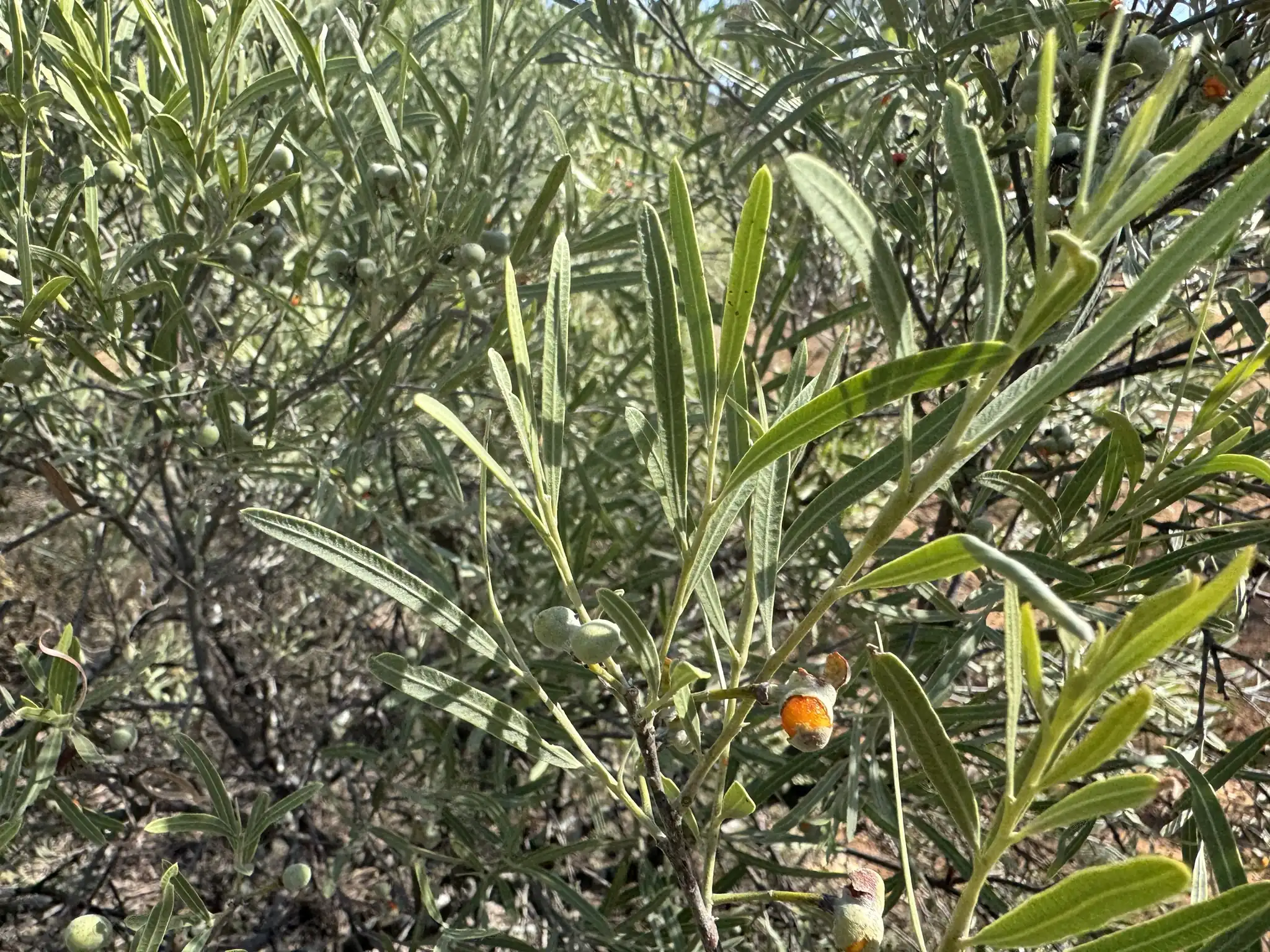
Alectryon oleifolius, the western rosewood, is a slow-growing evergreen tree native to arid inland Australia, reaching up to twenty-six feet in height with a dense, spreading crown of weeping branches. The narrow, grey-green leaves are covered in fine, silky hairs when young, while the petal-less flowers are small and greenish-brown, appearing in clusters from winter to spring.
This species is adapted to extreme drought and thrives in alkaline, calcareous soils where other trees fail. The weeping foliage and structural, often multi-stemmed trunk provide architectural interest in dry, arid landscapes.
Uses & Benefits:
Essentials
At a Glance
Plant Type
Tree
Height
315"
Width
197"
Light
Full Sun
Zones
9, 10
Water
Low
Humidity
Low to Moderate
Lifespan
Long-lived
Native To
Australia
Toxicity
Non-toxic
Bloom period
Winter – Spring
In flower about 6 months of the year
Planting
How to Grow
- Select a planting site in full sun with excellent drainage, such as a raised bed or sloped area.
- Dig a hole twice as wide as the root ball but no deeper, ensuring the soil line matches the container level.
- Backfill with native soil without adding organic amendments or fertilizers to the planting hole.
- Water deeply to settle the soil, then withhold further irrigation except during prolonged dry spells during the first summer.
Pro Tip
Establish this tree with minimal supplemental water and sharp drainage; over-irrigation or heavy organic mulch piled against the trunk will quickly cause fatal root rot.
Keep It Thriving
Care Guide
Do
- Plant in a position that receives full sun all day.
- Ensure the soil drains rapidly and completely.
- Keep mulch several inches away from the main trunk.
Don't
- Do not overwater or allow the soil to become waterlogged.
- Do not prune heavily into old, leafless wood.
- Do not apply heavy, phosphorus-rich fertilizers.
Seasonal Care Calendar
| Task | Jan | Feb | Mar | Apr | May | Jun | Jul | Aug | Sep | Oct | Nov | Dec |
|---|---|---|---|---|---|---|---|---|---|---|---|---|
| Fertilize | ||||||||||||
| Pest Check | ||||||||||||
| Prune | ||||||||||||
| Winter Prep |
Watch Out For
Pests & Diseases
Common Pests
Common Diseases
In the Garden
Landscape Uses & Companions
Landscape Uses
Companion Plants
Multiply
Propagation Methods
Good to Know
Common Questions
Western Rosewood questions
What zones can Western Rosewood grow in?
Western Rosewood is hardy in USDA Zones 9–10. Inside that range it survives winter in the ground; outside it, grow it as an annual or a container plant you protect.
Is Western Rosewood deer resistant?
Not reliably. Deer may browse Western Rosewood, especially tender spring growth — plan on repellents or fencing where pressure is high.
When does Western Rosewood bloom?
Western Rosewood typically blooms in winter through spring. Exact timing shifts a week or two with your zone — Sow's bloom calendar maps it to your garden.
Does Western Rosewood need full sun?
Western Rosewood does best in full sun (6+ hours).
Is Western Rosewood drought tolerant?
Yes — once established (usually after the first full season), Western Rosewood handles dry spells with minimal watering. Water deeply its first year to build the root system that makes that possible.
Keep exploring
Explore the genus
Hardy in your zone?
Grow Western Rosewood with confidence
See it in a design of your actual yard, get zone-matched care reminders, and track it season by season in your garden journal.