The Story
Plant Bio
Buckinghamia celsissima, the ivory curl tree, is an evergreen Australian rainforest tree that reaches twenty-five to forty feet in cultivation, forming a dense, rounded canopy of glossy dark green leaves. The juvenile foliage is often deeply lobed, while new growth emerges with a distinct bronze or pinkish-red flush.
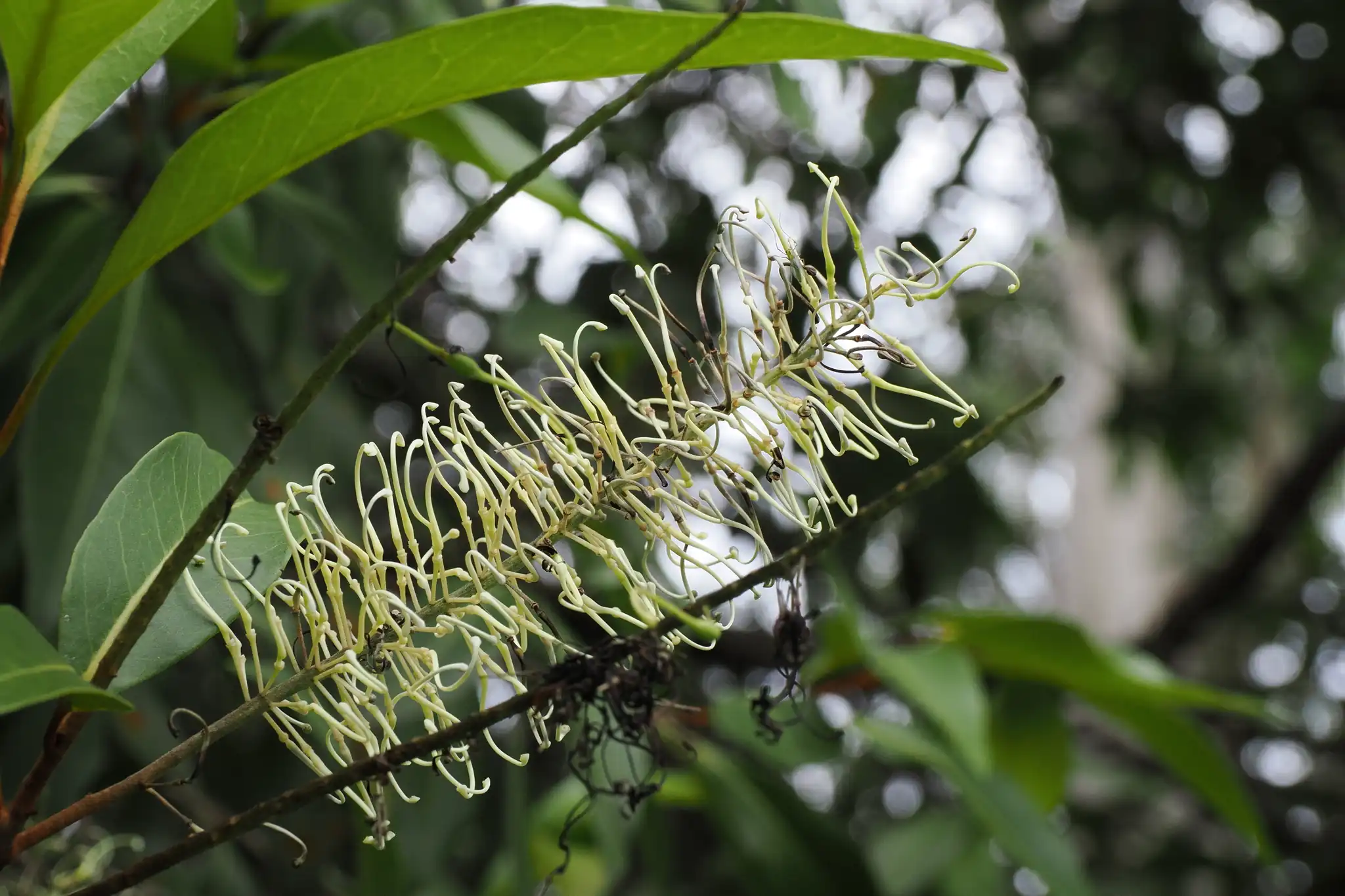
The sweetly scented, creamy-white flowers are curled and arranged in dense, drooping spikes up to eleven inches long that resemble a grevillea inflorescence. Flowering occurs during summer, covering the outer canopy in a profusion of ivory-colored blooms.
Uses & Benefits:
Essentials
At a Glance
Plant Type
Tree
Height
360"
Width
180"
Light
Full Sun, Partial Sun
Zones
10
Water
Medium
Humidity
Medium
Lifespan
Long-lived
Native To
Australia
Toxicity
Non-toxic
Bloom period
Summer
In flower about 3 months of the year
Planting
How to Grow
- Select a planting site with full sun to partial shade and highly drained, organic-rich soil.
- Dig a hole twice as wide as the root ball and plant at the same depth as the container.
- Water regularly during the first two growing seasons to establish a deep root system.
- Apply a low-phosphorus, native-formulated fertilizer sparingly in early spring.
Pro Tip
Prune lightly immediately after flowering to maintain shape and density; cutting back into old, leafless wood often fails to produce new shoots.
Keep It Thriving
Care Guide
Do
- Use only low-phosphorus fertilizers formulated for Australian native plants.
- Ensure the soil drains rapidly to prevent root decline.
- Provide protection or move containers indoors if temperatures approach freezing.
Don't
- Do not prune heavily into old, bare wood that lacks green leaves.
- Do not allow the roots to sit in waterlogged or heavy clay soils.
- Do not use standard phosphorus-rich fertilizers, which damage the root system.
Seasonal Care Calendar
| Task | Jan | Feb | Mar | Apr | May | Jun | Jul | Aug | Sep | Oct | Nov | Dec |
|---|---|---|---|---|---|---|---|---|---|---|---|---|
| Fertilize | ||||||||||||
| Pest Check | ||||||||||||
| Prune | ||||||||||||
| Winter Prep |
Watch Out For
Pests & Diseases
Common Pests
Common Diseases
In the Garden
Landscape Uses & Companions
Landscape Uses
Companion Plants
Multiply
Propagation Methods
Good to Know
Common Questions
Ivory Curl Tree questions
What zones can Ivory Curl Tree grow in?
Ivory Curl Tree is hardy in USDA Zone 10. Inside that range it survives winter in the ground; outside it, grow it as an annual or a container plant you protect.
When does Ivory Curl Tree bloom?
Ivory Curl Tree typically blooms in summer through summer. Exact timing shifts a week or two with your zone — Sow's bloom calendar maps it to your garden.
Does Ivory Curl Tree need full sun?
Ivory Curl Tree does best in full sun to part shade. In hot climates, afternoon shade keeps blooms fresher longer.
Is Ivory Curl Tree drought tolerant?
Yes — once established (usually after the first full season), Ivory Curl Tree handles dry spells with minimal watering. Water deeply its first year to build the root system that makes that possible.
Keep exploring
Explore the genus
Hardy in your zone?
Grow Ivory Curl Tree with confidence
See it in a design of your actual yard, get zone-matched care reminders, and track it season by season in your garden journal.