The Story
Plant Bio
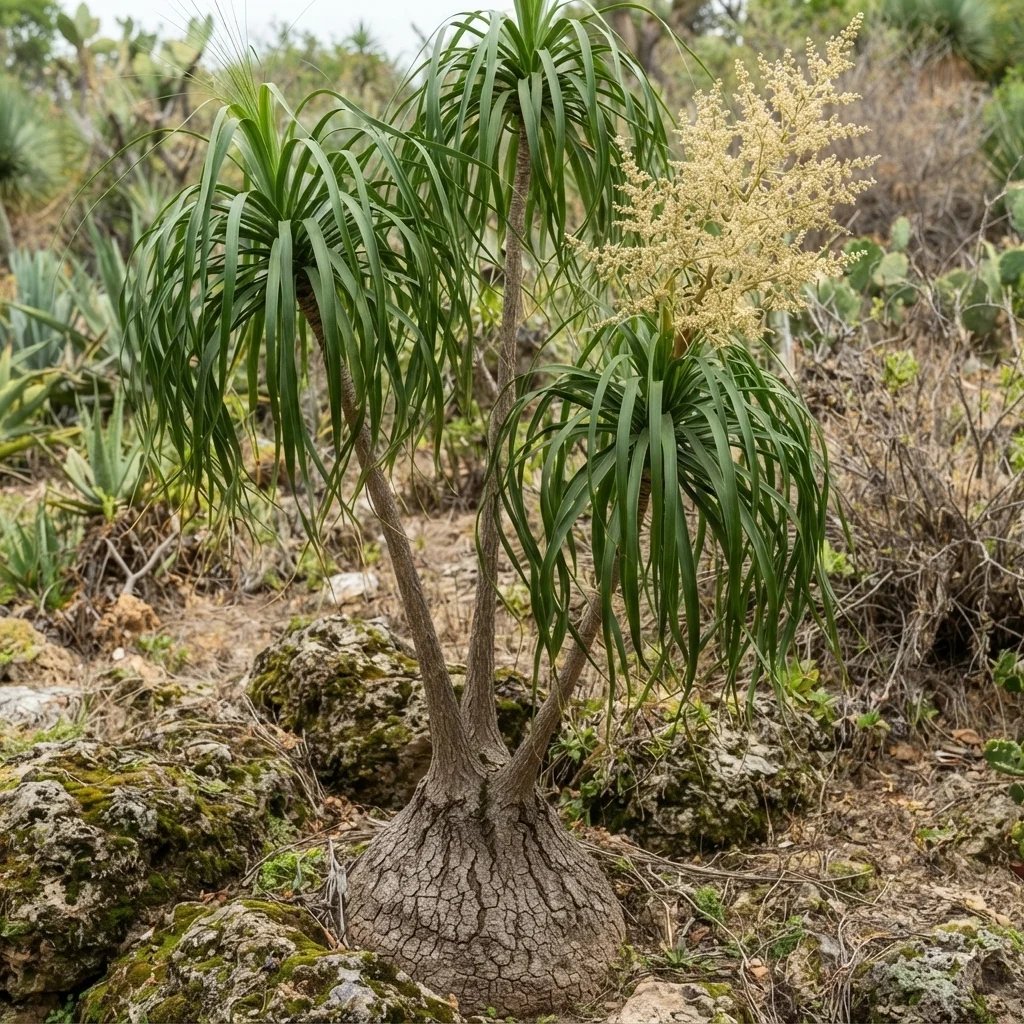
Beaucarnea recurvata, the ponytail palm, is a slow-growing evergreen caudiciform shrub or small tree native to the semi-desert regions of southeastern Mexico. It features a massively swollen, water-storing basal trunk resembling an elephant's foot that tapers into a slender stem topped with a dense fountain of arching, strap-shaped leaves.
The leathery, dark green leaves can reach up to six feet in length, cascading downward in a dense, symmetrical crown. Mature outdoor specimens produce large, upright pyramidal panicles of tiny creamy-white flowers during spring and summer, though these rarely appear on container-grown plants.
Uses & Benefits:
Essentials
At a Glance
Plant Type
Cactus Succulent
Height
354"
Width
118"
Light
Full Sun, Partial Sun
Zones
10
Water
Low
Humidity
Low to moderate
Lifespan
Long-lived
Native To
Mexico, Belize, Guatemala
Toxicity
Non-toxic
Bloom period
Spring – Summer
In flower about 6 months of the year
Marketplace
Where to Buy
Shipping costs Year-round shipping Free shipping
Planting
How to Grow
- Select a container with ample drainage holes and fill it with a fast-draining cactus or succulent potting mix.
- Position the plant so that the swollen caudex sits entirely above the soil line to prevent rot.
- Place the container in a location receiving full sun or very bright indirect light.
- Water thoroughly only when the soil has dried out completely, and withhold water entirely during winter.
Pro Tip
Never bury the swollen caudex below the soil line; keeping the base entirely at or slightly above the surface prevents collar rot. Always allow the potting medium to dry out completely between waterings, as the trunk stores ample moisture.
Keep It Thriving
Care Guide
Do
- Allow the soil to dry out completely between waterings.
- Grow in a sandy, fast-draining potting mix.
- Provide at least six hours of direct sunlight or very bright indirect light daily.
- Prune away completely dead, brown lower leaves at their base.
Don't
- Do not overwater or allow the plant to sit in soggy, wet soil.
- Do not bury the swollen caudex beneath the soil line.
- Do not cut into the main trunk or old, leafless wood.
- Do not fertilize during the fall and winter months.
Seasonal Care Calendar
| Task | Jan | Feb | Mar | Apr | May | Jun | Jul | Aug | Sep | Oct | Nov | Dec |
|---|---|---|---|---|---|---|---|---|---|---|---|---|
| Fertilize | ||||||||||||
| Pest Check | ||||||||||||
| Prune | ||||||||||||
| Winter Prep |
Watch Out For
Pests & Diseases
Common Pests
Common Diseases
In the Garden
Landscape Uses & Companions
Landscape Uses
Companion Plants
Multiply
Propagation Methods
Good to Know
Common Questions
Ponytail Palm questions
What zones can Ponytail Palm grow in?
Ponytail Palm is hardy in USDA Zone 10. Inside that range it survives winter in the ground; outside it, grow it as an annual or a container plant you protect.
Is Ponytail Palm deer resistant?
Yes — Ponytail Palm is rated deer-resistant. Deer typically pass it over, though extreme hunger can override any plant's defenses.
When does Ponytail Palm bloom?
Ponytail Palm typically blooms in spring through summer. Exact timing shifts a week or two with your zone — Sow's bloom calendar maps it to your garden.
Does Ponytail Palm need full sun?
Ponytail Palm does best in full sun to part shade. In hot climates, afternoon shade keeps blooms fresher longer.
Is Ponytail Palm drought tolerant?
Yes — once established (usually after the first full season), Ponytail Palm handles dry spells with minimal watering. Water deeply its first year to build the root system that makes that possible.
Keep exploring
Explore the genus
Hardy in your zone?
Grow Ponytail Palm with confidence
See it in a design of your actual yard, get zone-matched care reminders, and track it season by season in your garden journal.