The Story
Plant Bio
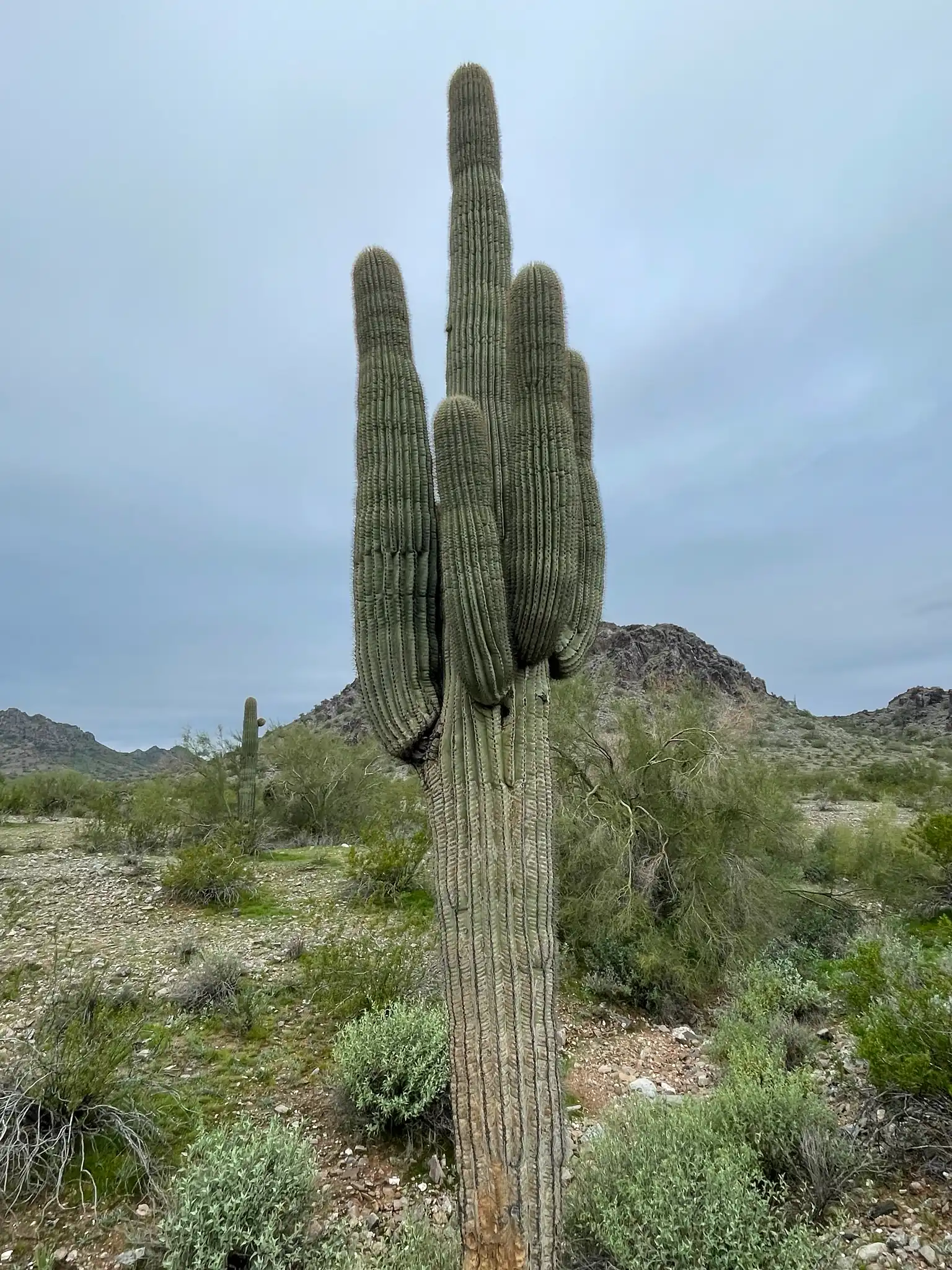
Carnegiea gigantea, the saguaro, is a massive, slow-growing columnar cactus native to the Sonoran Desert. It develops a thick, ribbed vertical trunk with accordion-like pleats that expand to store water during rainfall.
As the plant matures, it produces stout, upward-curving lateral branches and bears funnel-shaped, creamy white flowers at the stem tips in spring. The sharp, rigid spines provide physical protection and help channel moisture down to the shallow, wide-spreading root system.
Uses & Benefits:
Essentials
At a Glance
Plant Type
Cactus Succulent
Height
590"
Width
118"
Light
Full Sun
Zones
8, 9, 10
Water
Low
Humidity
Low
Lifespan
Over 150 years
Native To
North America
Toxicity
Non-toxic
Bloom period
Spring
In flower about 3 months of the year
Planting
How to Grow
- Select a planting site in full sun with coarse, rocky, mineral-rich soil that drains rapidly.
- Provide temporary partial shade or nurse-plant protection for young, nursery-grown plants to prevent sunscald.
- Refrain from watering once the plant is established, relying entirely on natural rainfall.
- Protect the plant from prolonged winter wetness and high humidity to prevent fungal pathogens.
Pro Tip
Never attempt to propagate this cactus from stem cuttings, as large saguaro branches fail to form roots and will rot; propagation must be done strictly from seed.
Keep It Thriving
Care Guide
Do
- Plant in highly porous, coarse, mineral-rich soil with rapid drainage.
- Provide full sun exposure for mature plants.
- Protect young plants with temporary shade to prevent sunscald.
- Allow wounds from bacterial necrosis to air-cure completely after clean excision.
Don't
- Do not overwater, especially during cool winter months.
- Never attempt to propagate using stem or branch cuttings.
- Do not prune or cut into old woody stem tissue.
- Avoid planting in heavy clay or soggy soils.
Seasonal Care Calendar
| Task | Jan | Feb | Mar | Apr | May | Jun | Jul | Aug | Sep | Oct | Nov | Dec |
|---|---|---|---|---|---|---|---|---|---|---|---|---|
| Fertilize | ||||||||||||
| Pest Check | ||||||||||||
| Plant | ||||||||||||
| Winter Prep |
Watch Out For
Pests & Diseases
Common Pests
Common Diseases
In the Garden
Landscape Uses & Companions
Landscape Uses
Companion Plants
Multiply
Propagation Methods
Good to Know
Common Questions
Saguaro questions
What zones can Saguaro grow in?
Saguaro is hardy in USDA Zones 8–10. Inside that range it survives winter in the ground; outside it, grow it as an annual or a container plant you protect.
Is Saguaro deer resistant?
Yes — Saguaro is rated deer-resistant. Deer typically pass it over, though extreme hunger can override any plant's defenses.
When does Saguaro bloom?
Saguaro typically blooms in spring through spring. Exact timing shifts a week or two with your zone — Sow's bloom calendar maps it to your garden.
Does Saguaro need full sun?
Saguaro does best in full sun (6+ hours).
Is Saguaro drought tolerant?
Yes — once established (usually after the first full season), Saguaro handles dry spells with minimal watering. Water deeply its first year to build the root system that makes that possible.
Keep exploring
Explore the genus
Hardy in your zone?
Grow Saguaro with confidence
See it in a design of your actual yard, get zone-matched care reminders, and track it season by season in your garden journal.