The Story
Plant Bio
Castilleja coccinea is an upright, herbaceous, hemiparasitic annual or biennial native to North American grasslands and open woodlands. The plant forms a basal rosette of entire, lance-shaped leaves in its first year, followed by an unbranched or sparsely branched flowering stem with deeply lobed leaves in its second year.
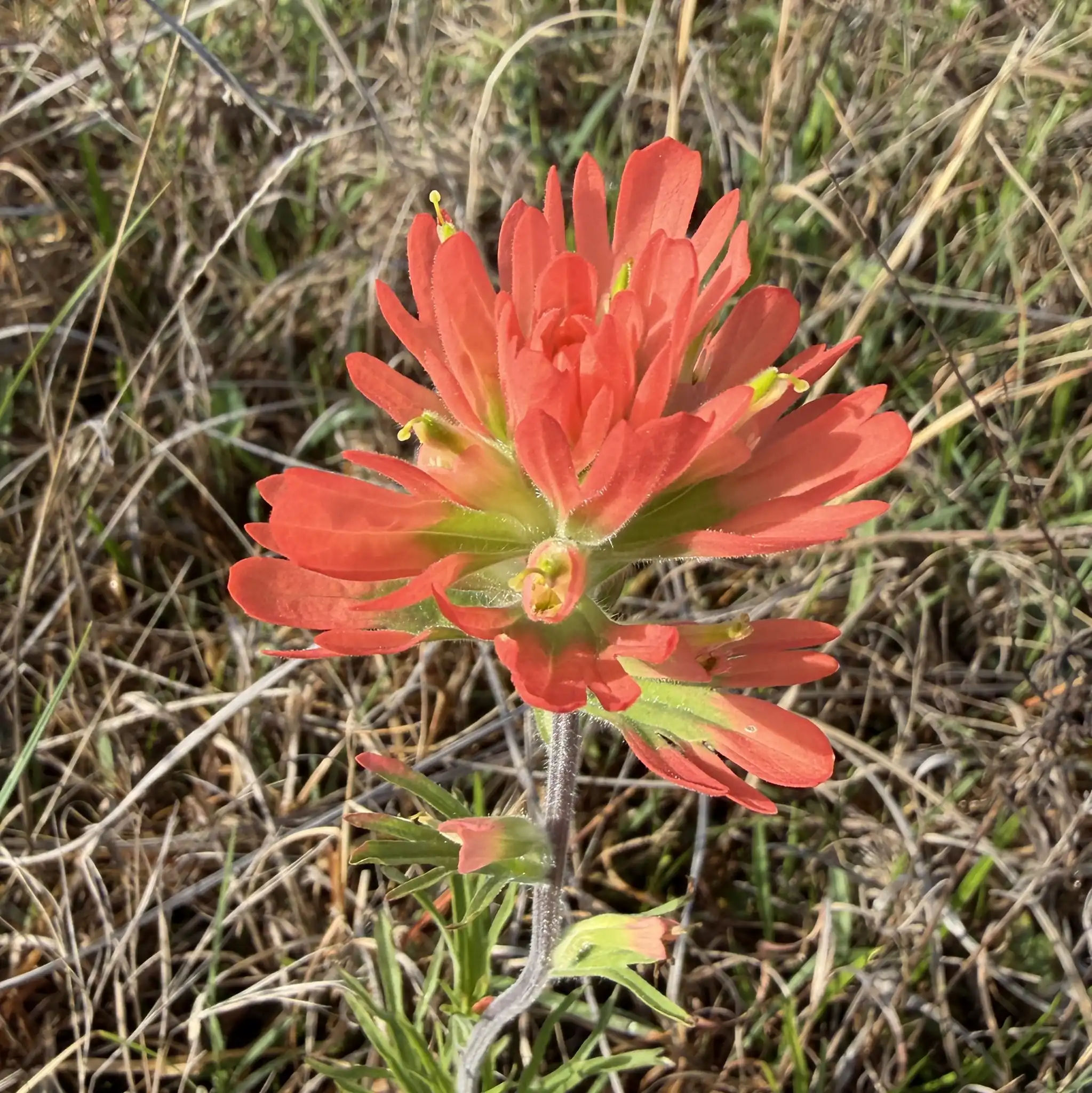
The true flowers are inconspicuous, greenish-yellow tubes mostly hidden within dense terminal spikes. The primary visual display comes from the surrounding large, three-lobed leafy bracts, which are colored brilliant scarlet, orange-red, or occasionally yellow.
Uses & Benefits:
Essentials
At a Glance
Plant Type
Annual
Height
30"
Width
12"
Light
Full Sun, Partial Sun
Zones
4, 5, 6, 7, 8
Water
Medium
Humidity
Unknown
Lifespan
Annual or Biennial
Native To
North America
Toxicity
Non-toxic
Bloom period
Spring – Summer
In flower about 6 months of the year
Planting
How to Grow
- Select a site in full sun with well-drained, medium-moisture soil.
- Sow seeds or plant young plugs directly adjacent to an established host plant, such as Schizachyrium or Penstemon.
- Keep the soil evenly moist during the first active growing season to help the seedlings establish.
- Leave the root systems completely undisturbed once planted to prevent breaking the parasitic connections.
Pro Tip
Establish this hemiparasite by sowing seeds directly alongside a compatible host plant, such as native bunchgrasses or Penstemon, as the roots must form parasitic connections to survive.
Keep It Thriving
Care Guide
Do
- Plant alongside a compatible host species to ensure nutrient exchange.
- Provide excellent soil drainage to prevent root rot.
- Water regularly during active growth to maintain even soil moisture.
Don't
- Do not attempt to transplant established wild or garden specimens.
- Do not apply heavy artificial fertilizers, which inhibit natural root associations.
- Do not plant in poorly drained or waterlogged soils.
Seasonal Care Calendar
| Task | Jan | Feb | Mar | Apr | May | Jun | Jul | Aug | Sep | Oct | Nov | Dec |
|---|---|---|---|---|---|---|---|---|---|---|---|---|
| Deadhead | ||||||||||||
| Pest Check | ||||||||||||
| Plant | ||||||||||||
| Propagate | ||||||||||||
| Spring Cleanup |
Watch Out For
Pests & Diseases
Common Pests
Common Diseases
In the Garden
Landscape Uses & Companions
Landscape Uses
Companion Plants
Multiply
Propagation Methods
Good to Know
Common Questions
Indian paintbrush questions
What zones can Indian paintbrush grow in?
Indian paintbrush is hardy in USDA Zones 4–8. Inside that range it survives winter in the ground; outside it, grow it as an annual or a container plant you protect.
Is Indian paintbrush deer resistant?
Not reliably. Deer may browse Indian paintbrush, especially tender spring growth — plan on repellents or fencing where pressure is high.
When does Indian paintbrush bloom?
Indian paintbrush typically blooms in spring through summer. Exact timing shifts a week or two with your zone — Sow's bloom calendar maps it to your garden.
Does Indian paintbrush need full sun?
Indian paintbrush does best in full sun to part shade. In hot climates, afternoon shade keeps blooms fresher longer.
Is Indian paintbrush drought tolerant?
Yes — once established (usually after the first full season), Indian paintbrush handles dry spells with minimal watering. Water deeply its first year to build the root system that makes that possible.
Keep exploring
Explore the genus
Hardy in your zone?
Grow Indian paintbrush with confidence
See it in a design of your actual yard, get zone-matched care reminders, and track it season by season in your garden journal.