The Story
Plant Bio
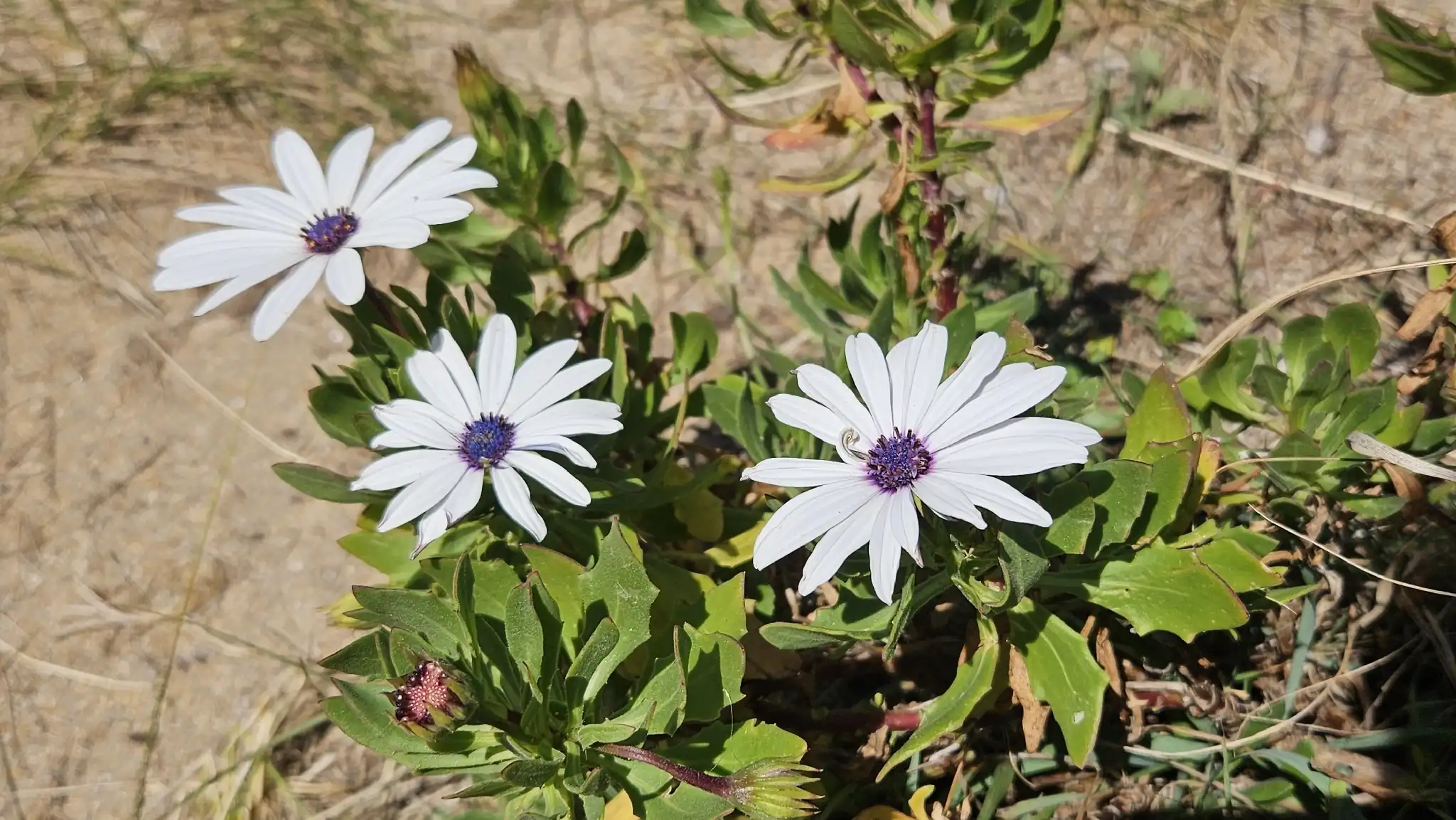
Dimorphotheca ecklonis is an evergreen, soft-wooded perennial subshrub native to South Africa, forming a sprawling mound of slightly succulent, glandular-pubescent foliage. The large, daisy-like flowerheads feature bright white ray florets with purplish-blue undersides surrounding a dark blue central disc, opening only in full sunlight.
The species is highly resilient in coastal environments, showing exceptional tolerance to salt spray, wind, and sandy soils. Its flowers close completely at night, during heavily overcast weather, and immediately preceding rainfall.
Uses & Benefits:
Essentials
At a Glance
Plant Type
Perennial
Height
39"
Width
59"
Light
Full Sun, Partial Sun
Zones
9, 10
Water
Low
Humidity
Low
Lifespan
Short-lived perennial
Native To
South Africa
Toxicity
Toxic to pets and livestock
Bloom period
Spring – Summer
In flower about 6 months of the year
Planting
How to Grow
- Select a planting site that receives full, unobstructed sun to ensure the flowers open fully during the day.
- Amend heavy soils with coarse sand or gravel to guarantee rapid drainage, as waterlogged conditions cause rapid decline.
- Water sparingly once established, allowing the top few inches of soil to dry out completely between irrigations.
- Deadhead spent flower stalks regularly to stimulate continuous bud production throughout the spring and summer.
Pro Tip
To prevent the plant from developing a sparse, woody base, prune the stems back aggressively by half every two to three years, and grow in lean, fast-draining soil to avoid fatal root rot.
Keep It Thriving
Care Guide
Do
- Plant in lean, low-fertility soils to encourage abundant flowering rather than excessive foliage growth.
- Ensure excellent air circulation around the foliage to minimize the risk of powdery mildew in humid climates.
- Prune lightly immediately after the main summer flowering flush to maintain a compact, mounded shape.
Don't
- Do not use high-nitrogen fertilizers, which produce weak, soft stems and drastically reduce bloom count.
- Do not use overhead irrigation; wet foliage in stagnant air triggers foliar fungal diseases.
- Do not plant in heavy clay or low-lying areas where water accumulates.
Seasonal Care Calendar
| Task | Jan | Feb | Mar | Apr | May | Jun | Jul | Aug | Sep | Oct | Nov | Dec |
|---|---|---|---|---|---|---|---|---|---|---|---|---|
| Deadhead | ||||||||||||
| Fertilize | ||||||||||||
| Pest Check | ||||||||||||
| Prune |
Watch Out For
Pests & Diseases
Common Pests
Common Diseases
In the Garden
Landscape Uses & Companions
Landscape Uses
Companion Plants
Multiply
Propagation Methods
Good to Know
Common Questions
Cape Marguerite questions
What zones can Cape Marguerite grow in?
Cape Marguerite is hardy in USDA Zones 9–10. Inside that range it survives winter in the ground; outside it, grow it as an annual or a container plant you protect.
Is Cape Marguerite deer resistant?
Yes — Cape Marguerite is rated deer-resistant. Deer typically pass it over, though extreme hunger can override any plant's defenses.
When does Cape Marguerite bloom?
Cape Marguerite typically blooms in spring through summer. Exact timing shifts a week or two with your zone — Sow's bloom calendar maps it to your garden.
Does Cape Marguerite need full sun?
Cape Marguerite does best in full sun to part shade. In hot climates, afternoon shade keeps blooms fresher longer.
Is Cape Marguerite drought tolerant?
Yes — once established (usually after the first full season), Cape Marguerite handles dry spells with minimal watering. Water deeply its first year to build the root system that makes that possible.
More Dimorphotheca to compare
Keep exploring
Explore the genus
Hardy in your zone?
Grow Cape Marguerite with confidence
See it in a design of your actual yard, get zone-matched care reminders, and track it season by season in your garden journal.