1 named cultivar

The Story
Plant Bio
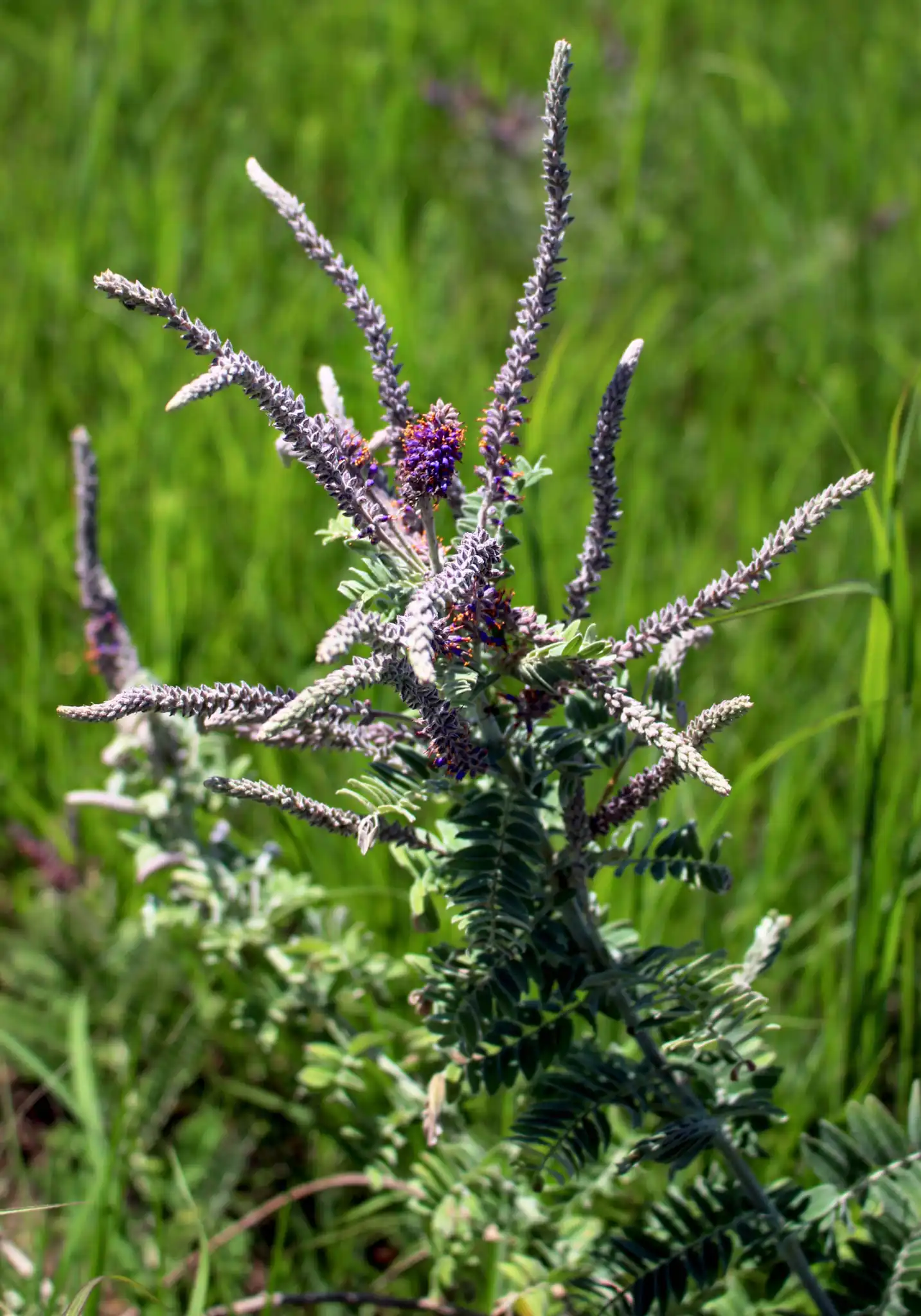
Amorpha canescens, leadplant, is a low woody subshrub native to the North American prairies, reaching one to three feet. Finely divided pinnate leaves with up to forty-five small leaflets are covered in grey hairs, giving the whole plant a soft leaden cast. Dense spikes of tiny purple flowers with bright orange anthers open in summer.
Its roots reach fifteen feet or more into the prairie soil, which makes it almost indestructible once established and correspondingly difficult to transplant. As a legume it fixes nitrogen, and the flower spikes — purple studded with orange — are among the most distinctive in the native flora.
Uses & Benefits:
Essentials
At a Glance
Plant Type
Shrub
Height
24"
Width
27"
Light
Full Sun
Zones
4, 5, 6, 7, 8, 9
Water
Low
Humidity
Low
Lifespan
Perennial
Native To
Central North America
Toxicity
Non-toxic
Planting
How to Grow
- Plant in spring in well-drained, lean soil.
- Choose full sun to light shade.
- Site it permanently; the taproot resents moving.
- Water only to establish.
- Do not feed; it fixes its own nitrogen.
- Cut back in late winter to keep it dense.
Pro Tip
Plant it small and leave it — a young plant establishes far better than a large one, whose deep taproot will already be coiled in the pot.
Keep It Thriving
Care Guide
Do
- Plant in full sun and lean soil ☀️
- Site it once and leave it 🌱
- Cut back in late winter ✂️
- Use it on dry slopes and prairie planting 🌾
Don't
- Feed it; it fixes its own nitrogen ❌
- Move an established plant ❌
- Plant in wet, heavy soil ❌
Seasonal Care Calendar
| Task | Jan | Feb | Mar | Apr | May | Jun | Jul | Aug | Sep | Oct | Nov | Dec |
|---|---|---|---|---|---|---|---|---|---|---|---|---|
| Monitor | ||||||||||||
| Prune |
Watch Out For
Pests & Diseases
Common Pests
Common Diseases
In the Garden
Landscape Uses & Companions
Landscape Uses
Multiply
Propagation Methods
Good to Know
Common Questions
Leadplant questions
What zones can Leadplant grow in?
Leadplant is hardy in USDA Zones 4–9. Inside that range it survives winter in the ground; outside it, grow it as an annual or a container plant you protect.
Is Leadplant deer resistant?
Yes — Leadplant is rated deer-resistant. Deer typically pass it over, though extreme hunger can override any plant's defenses.
When does Leadplant bloom?
Leadplant typically blooms in midsummer through late fall. Exact timing shifts a week or two with your zone — Sow's bloom calendar maps it to your garden.
Does Leadplant need full sun?
Leadplant does best in full sun (6+ hours).
Is Leadplant drought tolerant?
Yes — once established (usually after the first full season), Leadplant handles dry spells with minimal watering. Water deeply its first year to build the root system that makes that possible.
More Amorpha to compare
Keep exploring
Explore the genus
Grow Leadplant with confidence
See it in a design of your actual yard, get zone-matched care reminders, and track it season by season in your garden journal.