The Story
Plant Bio
Calystegia silvatica is a vigorous, herbaceous perennial climber that climbs up to sixteen feet by twining its stems counter-clockwise around nearby structures. It spreads aggressively over large areas using an extensive network of creeping underground rhizomes.
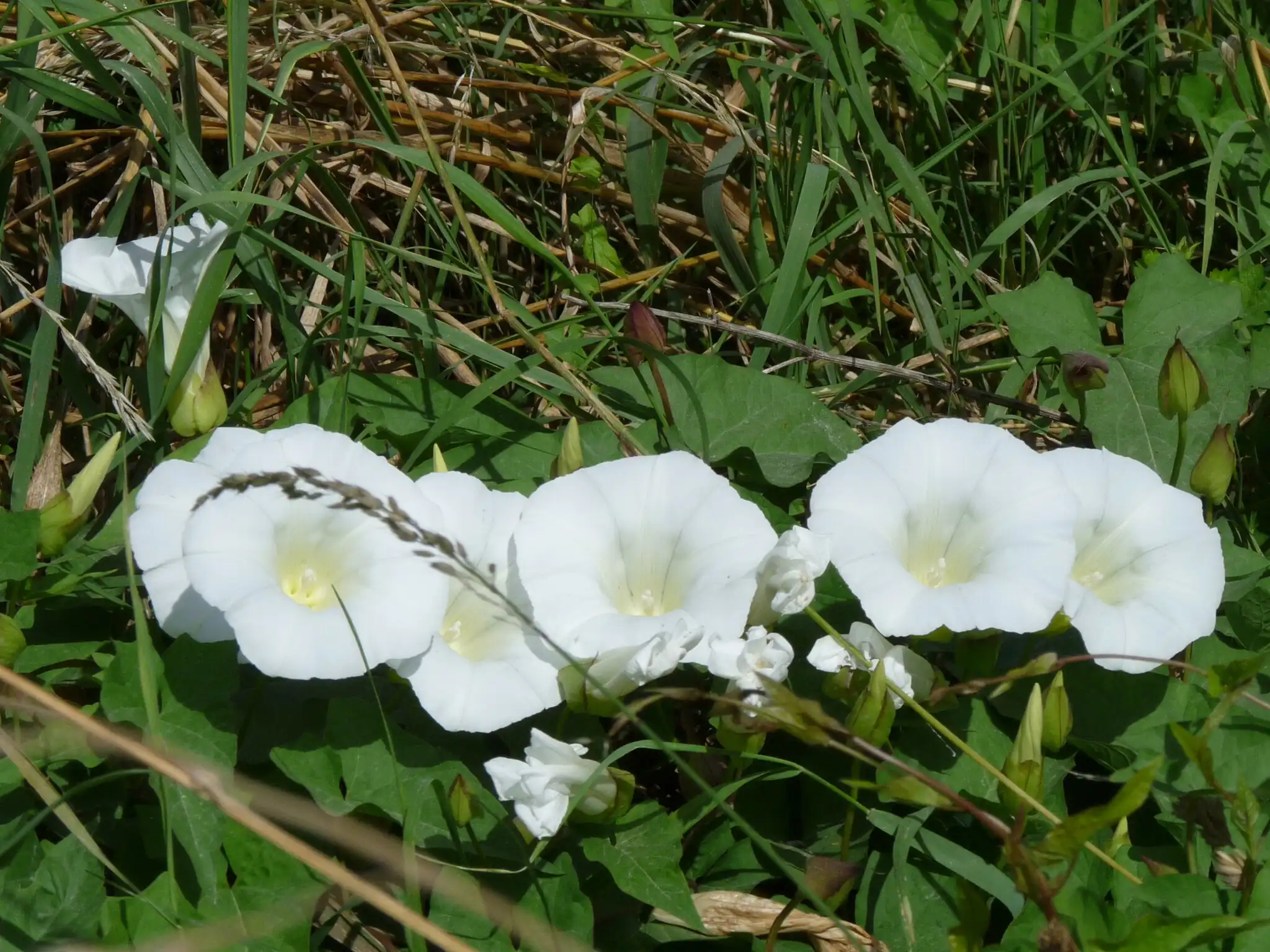
This species is distinguished by its large, white, trumpet-shaped flowers that are completely enclosed at the base by two broad, inflated, overlapping bracteoles. The alternate, hairless leaves are arrowhead-shaped with deeply notched bases and grow up to six inches long.
Uses & Benefits:
Essentials
At a Glance
Plant Type
Vine
Height
197"
Width
120"
Light
Full Sun, Partial Sun
Zones
4, 5, 6, 7, 8, 9
Water
Low to moderate
Humidity
Moderate
Lifespan
Perennial
Native To
Southern Europe, Asia, Africa
Toxicity
Skin Irritant
Bloom period
Summer – Fall
In flower about 6 months of the year
Planting
How to Grow
- Select a site in full sun to partial shade with loam, clay, or sandy soil.
- Install physical root barriers deep into the soil if attempting to contain the spreading rhizome network.
- Provide a sturdy trellis or support for the twining stems to climb.
- Monitor the surrounding area constantly to intercept and dig out escaping underground shoots.
Pro Tip
Pulling or cutting the top growth fails to control this plant because the brittle underground rhizomes easily snap and regenerate entirely from any fragments left behind in the soil.
Keep It Thriving
Care Guide
Do
- Dig deep to extract the entire root system when attempting eradication.
- Wear gloves when handling the plant to avoid skin irritation from the milky sap.
- Use physical root barriers to prevent the rhizomes from invading adjacent garden beds.
Don't
- Do not leave snapped root fragments in the soil, as they will rapidly resprout.
- Do not plant this species near delicate ornamentals that can be easily smothered by its vigorous growth.
- Do not compost the pulled stems or roots, which can survive and establish elsewhere.
Seasonal Care Calendar
| Task | Jan | Feb | Mar | Apr | May | Jun | Jul | Aug | Sep | Oct | Nov | Dec |
|---|---|---|---|---|---|---|---|---|---|---|---|---|
| Pest Check | ||||||||||||
| Propagate | ||||||||||||
| Prune | ||||||||||||
| Winter Prep |
Watch Out For
Pests & Diseases
Common Pests
Common Diseases
In the Garden
Landscape Uses & Companions
Landscape Uses
Companion Plants
Multiply
Propagation Methods
Good to Know
Common Questions
Great Bindweed questions
What zones can Great Bindweed grow in?
Great Bindweed is hardy in USDA Zones 4–9. Inside that range it survives winter in the ground; outside it, grow it as an annual or a container plant you protect.
Is Great Bindweed deer resistant?
Not reliably. Deer may browse Great Bindweed, especially tender spring growth — plan on repellents or fencing where pressure is high.
When does Great Bindweed bloom?
Great Bindweed typically blooms in summer through fall. Exact timing shifts a week or two with your zone — Sow's bloom calendar maps it to your garden.
Does Great Bindweed need full sun?
Great Bindweed does best in full sun to part shade. In hot climates, afternoon shade keeps blooms fresher longer.
Is Great Bindweed drought tolerant?
Yes — once established (usually after the first full season), Great Bindweed handles dry spells with minimal watering. Water deeply its first year to build the root system that makes that possible.
More Calystegia to compare
Keep exploring
Explore the genus
Grow Great Bindweed with confidence
See it in a design of your actual yard, get zone-matched care reminders, and track it season by season in your garden journal.