The Story
Plant Bio
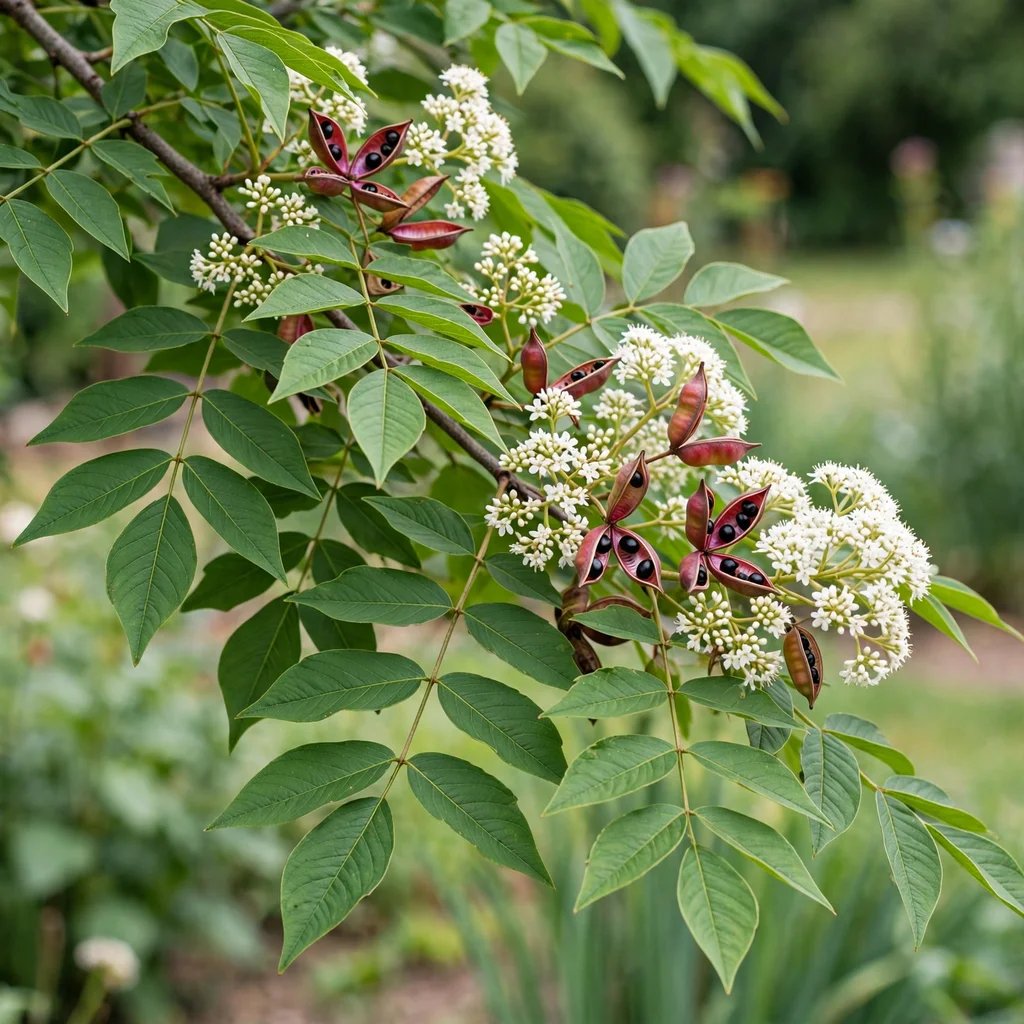
Tetradium daniellii, formerly classified as Euodia hupehensis, is a deciduous small tree forming a broad, rounded, umbrella-shaped canopy with smooth gray bark resembling that of a beech. The opposite, pinnately compound leaves emit a pungent, sharp odor when crushed and emerge with fine, downy hairs along the veins on their undersides.
In mid-to-late summer, the branches bear large, flat-topped clusters of small, highly fragrant white flowers that serve as a critical nectar source for bees. These blooms mature into decorative, reddish-purple seed pods that split open to reveal glossy black seeds favored by local birds.
Uses & Benefits:
Essentials
At a Glance
Plant Type
Tree
Height
354"
Width
472"
Light
Full Sun, Partial Sun
Zones
5, 6, 7, 8, 9
Water
Moderate
Humidity
Adaptable
Lifespan
Moderate
Native To
China, Korea
Toxicity
Non-toxic
Bloom period
Summer
In flower about 3 months of the year
Planting
How to Grow
- Select a planting site in full sun or very light shade with moist, fertile, and well-drained soil.
- Dig a hole twice as wide as the root ball but equal in depth to prevent the trunk flare from sinking.
- Install physical tree guards around the trunk of young specimens to prevent deer and rabbit damage.
- Water deeply and regularly during the first two growing seasons to establish a deep, resilient root system.
Pro Tip
Avoid applying high-nitrogen fertilizers to young trees; rapid, forced juvenile growth produces weak, brittle wood that is highly susceptible to early winter frost damage.
Keep It Thriving
Care Guide
Do
- Prune strictly during late winter when the tree is fully dormant to shape the canopy.
- Mulch the root zone to conserve moisture and protect young roots from temperature extremes.
- Provide structural support or staking for young trees in windy sites due to their rapid early growth.
Don't
- Do not apply high-nitrogen fertilizers, which stimulate weak, brittle wood prone to frost damage.
- Do not prune aggressively into old, leafless wood that lacks active, visible buds.
- Do not plant in heavy, poorly drained clay or low-lying areas prone to standing water.
Seasonal Care Calendar
| Task | Jan | Feb | Mar | Apr | May | Jun | Jul | Aug | Sep | Oct | Nov | Dec |
|---|---|---|---|---|---|---|---|---|---|---|---|---|
| Mulch | ||||||||||||
| Pest Check | ||||||||||||
| Propagate | ||||||||||||
| Prune |
Watch Out For
Pests & Diseases
Common Pests
Common Diseases
In the Garden
Landscape Uses & Companions
Landscape Uses
Companion Plants
Multiply
Propagation Methods
Good to Know
Common Questions
Bee-Bee Tree questions
What zones can Bee-Bee Tree grow in?
Bee-Bee Tree is hardy in USDA Zones 5–9. Inside that range it survives winter in the ground; outside it, grow it as an annual or a container plant you protect.
Is Bee-Bee Tree deer resistant?
Not reliably. Deer may browse Bee-Bee Tree, especially tender spring growth — plan on repellents or fencing where pressure is high.
When does Bee-Bee Tree bloom?
Bee-Bee Tree typically blooms in summer through summer. Exact timing shifts a week or two with your zone — Sow's bloom calendar maps it to your garden.
Does Bee-Bee Tree need full sun?
Bee-Bee Tree does best in full sun to part shade. In hot climates, afternoon shade keeps blooms fresher longer.
Is Bee-Bee Tree drought tolerant?
Yes — once established (usually after the first full season), Bee-Bee Tree handles dry spells with minimal watering. Water deeply its first year to build the root system that makes that possible.
Keep exploring
Explore the genus
Hardy in your zone?
Grow Bee-Bee Tree with confidence
See it in a design of your actual yard, get zone-matched care reminders, and track it season by season in your garden journal.