The Story
Plant Bio
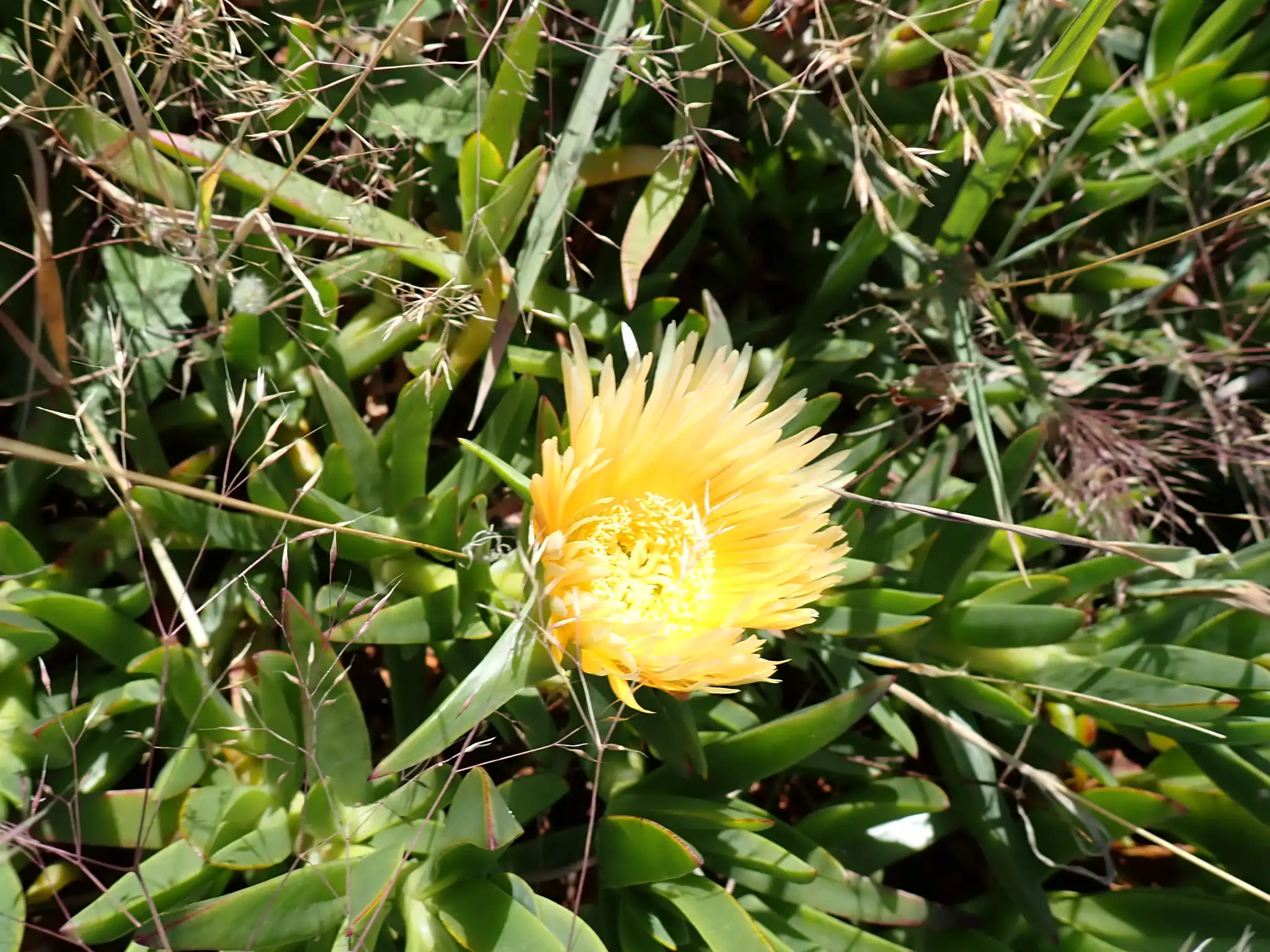
Carpobrotus edulis is a robust, mat-forming succulent perennial native to coastal South Africa, characterized by trailing stems that root at the nodes to bind loose soil. The thick, fleshy leaves are sharply three-angled in cross-section and curve slightly upward, forming a dense, ground-hugging cover.
This species is distinguished by its large, daisy-like flowers that open only in the afternoon, transitioning from bright yellow or pale pink to a dusky bronze-orange as they age. In North America, it has escaped cultivation to become a highly aggressive, ecosystem-altering weed along the California coast.
Uses & Benefits:
Essentials
At a Glance
Plant Type
Cactus Succulent
Height
12"
Width
80"
Light
Full Sun
Zones
8, 9, 10
Water
Low
Humidity
Low to Moderate
Lifespan
Perennial
Native To
South Africa
Toxicity
Non-toxic
Bloom period
Spring – Summer
In flower about 6 months of the year
Planting
How to Grow
- Select a planting site in full sun with sandy, rocky, or highly porous soil.
- Dig a shallow hole just deep enough to accommodate the root system or stem node.
- Water sparingly immediately after planting to settle the soil around the roots.
- Establish a strict dry cycle, allowing the soil to dry out completely between waterings.
Pro Tip
Ensure the soil is exceptionally lean and fast-draining; planting this succulent in rich, moisture-retentive loam inevitably triggers root rot.
Keep It Thriving
Care Guide
Do
- Grow in poor, sandy soils to maintain a compact, manageable habit.
- Clear away dead, rotting thatch from underneath the mats to prevent fungal issues.
- Confine plantings to containers or dry inland areas to prevent escape into wild coastal dunes.
Don't
- Do not overwater or plant in heavy, poorly drained clay soils.
- Do not cut back into old, woody, leafless stems, as they will fail to regenerate.
- Do not leave discarded stem fragments on bare soil, as they root easily and spread.
Seasonal Care Calendar
| Task | Jan | Feb | Mar | Apr | May | Jun | Jul | Aug | Sep | Oct | Nov | Dec |
|---|---|---|---|---|---|---|---|---|---|---|---|---|
| Pest Check | ||||||||||||
| Propagate | ||||||||||||
| Prune | ||||||||||||
| Spring Cleanup |
Watch Out For
Pests & Diseases
Common Pests
Common Diseases
In the Garden
Landscape Uses & Companions
Landscape Uses
Companion Plants
Multiply
Propagation Methods
Good to Know
Common Questions
Hottentot Fig questions
What zones can Hottentot Fig grow in?
Hottentot Fig is hardy in USDA Zones 8–10. Inside that range it survives winter in the ground; outside it, grow it as an annual or a container plant you protect.
When does Hottentot Fig bloom?
Hottentot Fig typically blooms in spring through summer. Exact timing shifts a week or two with your zone — Sow's bloom calendar maps it to your garden.
Does Hottentot Fig need full sun?
Hottentot Fig does best in full sun (6+ hours).
Is Hottentot Fig drought tolerant?
Yes — once established (usually after the first full season), Hottentot Fig handles dry spells with minimal watering. Water deeply its first year to build the root system that makes that possible.
More Carpobrotus to compare
Keep exploring
Explore the genus
Hardy in your zone?
Grow Hottentot Fig with confidence
See it in a design of your actual yard, get zone-matched care reminders, and track it season by season in your garden journal.