The Story
Plant Bio
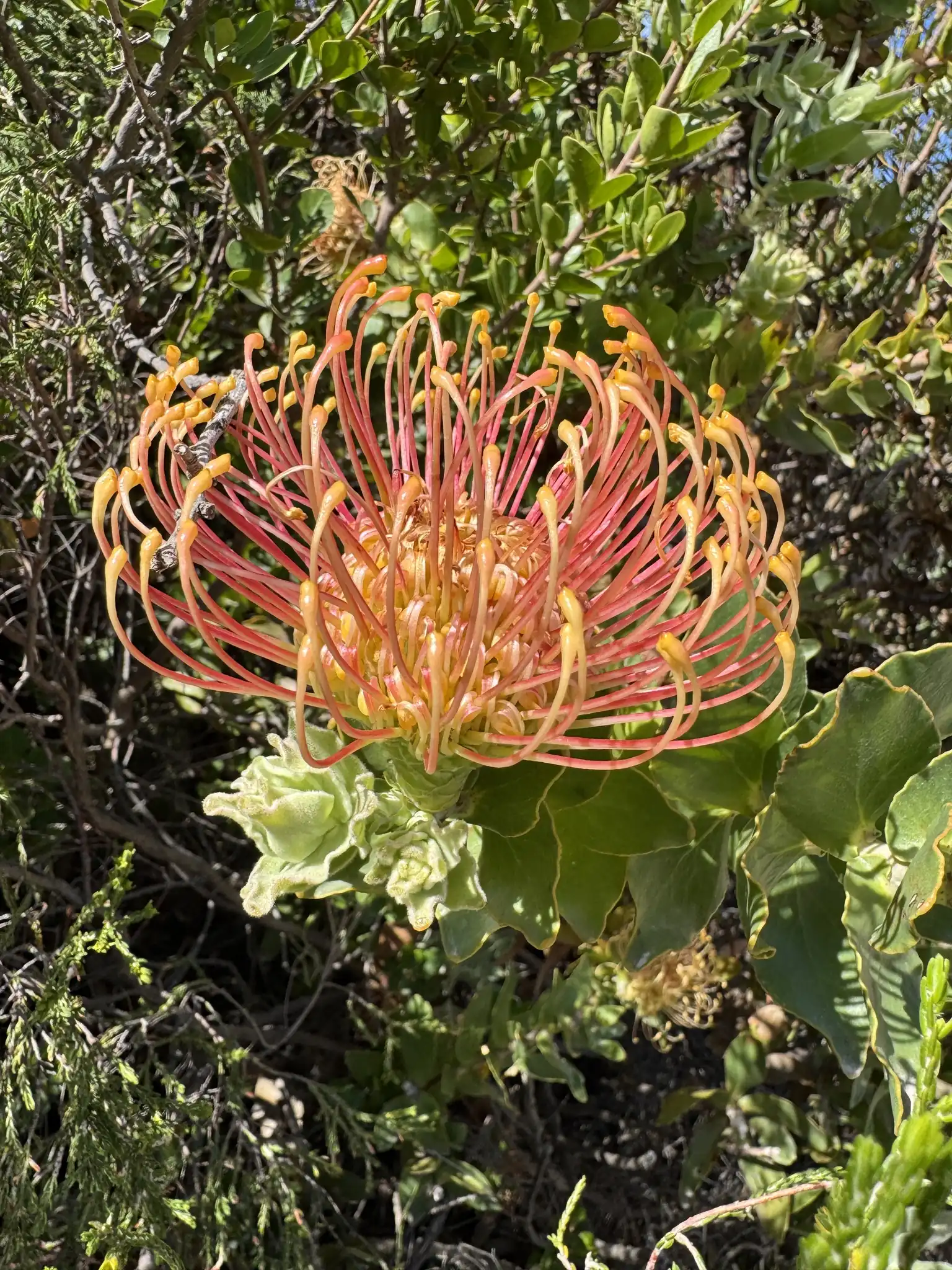
Leucospermum cordifolium, the pincushion protea, is a spreading, mounded evergreen shrub native to the acidic, nutrient-poor fynbos soils of South Africa's southwest Cape. Its stiff, leathery, gray-green leaves crowd the stems, which terminate in large, dome-shaped flower heads packed with long, upward-curving styles that transition from yellow to deep orange and crimson.
This species is distinguished by its dense, symmetrical growth habit and highly prominent, tactile inflorescences that persist for weeks. New foliage emerges with a distinct light green or reddish tint, providing subtle color contrast before the winter bloom cycle begins.
Uses & Benefits:
Essentials
At a Glance
Plant Type
Shrub
Height
80"
Width
90"
Light
Full Sun
Zones
9, 10
Water
Low
Humidity
Low to Moderate
Lifespan
Perennial Shrub
Native To
South Africa
Toxicity
Non-toxic
Bloom period
Late winter – Late spring
In flower about 4 months of the year
Planting
How to Grow
- Select a planting site in full sun with coarse, sandy, highly acidic soil and exceptional drainage.
- Dig a hole twice as wide as the root ball but no deeper, ensuring the crown sits slightly above the surrounding soil level to prevent water pooling.
- Water deeply but infrequently during the first summer to establish the root system, allowing the soil to dry out completely between waterings.
- Prune the plant annually immediately after flowering, cutting spent stems back by four to eight inches into active, leafy wood.
Pro Tip
Never cut back into old, woody stems that lack leaves; these branches do not have dormant buds and will fail to resprout.
Keep It Thriving
Care Guide
Do
- Plant in raised beds or mounds if your native soil contains clay or retains moisture.
- Use only zero- or extremely low-phosphorus fertilizers, as standard phosphorus applications cause fatal toxicity.
- Ensure excellent air circulation around the canopy to minimize the risk of fungal leaf diseases.
Don't
- Do not overwater or allow the roots to sit in soggy, slow-draining soil.
- Do not prune into bare, hard wood that lacks green leaves.
- Do not apply organic mulches like manure or rich compost that raise soil nutrients and phosphorus levels.
Seasonal Care Calendar
| Task | Jan | Feb | Mar | Apr | May | Jun | Jul | Aug | Sep | Oct | Nov | Dec |
|---|---|---|---|---|---|---|---|---|---|---|---|---|
| Fertilize | ||||||||||||
| Pest Check | ||||||||||||
| Prune | ||||||||||||
| Winter Prep |
Watch Out For
Pests & Diseases
Common Pests
Common Diseases
In the Garden
Landscape Uses & Companions
Landscape Uses
Companion Plants
Multiply
Propagation Methods
Good to Know
Common Questions
Pincushion Protea questions
What zones can Pincushion Protea grow in?
Pincushion Protea is hardy in USDA Zones 9–10. Inside that range it survives winter in the ground; outside it, grow it as an annual or a container plant you protect.
Is Pincushion Protea deer resistant?
Yes — Pincushion Protea is rated deer-resistant. Deer typically pass it over, though extreme hunger can override any plant's defenses.
When does Pincushion Protea bloom?
Pincushion Protea typically blooms in late winter through late spring. Exact timing shifts a week or two with your zone — Sow's bloom calendar maps it to your garden.
Does Pincushion Protea need full sun?
Pincushion Protea does best in full sun (6+ hours).
Is Pincushion Protea drought tolerant?
Yes — once established (usually after the first full season), Pincushion Protea handles dry spells with minimal watering. Water deeply its first year to build the root system that makes that possible.
Keep exploring
Explore the genus
Hardy in your zone?
Grow Pincushion Protea with confidence
See it in a design of your actual yard, get zone-matched care reminders, and track it season by season in your garden journal.