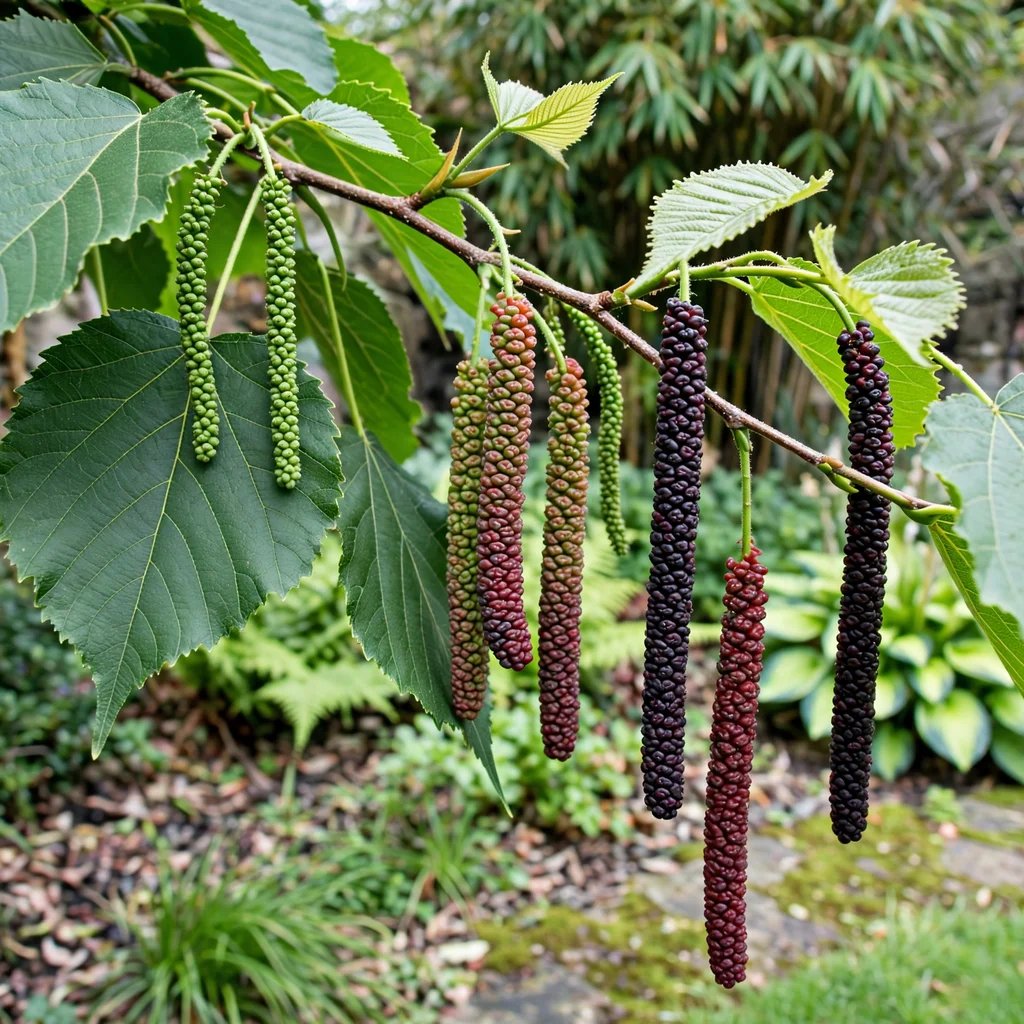
The Story
Plant Bio
Morus macroura, native to the Himalayas and parts of Southeast Asia, is a deciduous tree characterized by a spreading canopy and large, heart-shaped green leaves with serrated margins. The species produces inconspicuous, wind-pollinated catkins in spring that develop into exceptionally long, sweet mulberries.
'Red Shahtoot' is an informal trade designation applied to highly productive selections that yield elongated, deep red fruits. This cultivar is prized in home orchards for its sweet, low-acid berries and its adaptability to warm-temperate and subtropical climates.
Uses & Benefits:
Essentials
At a Glance
Plant Type
Tree
Height
358"
Width
299"
Light
Full Sun
Zones
7, 8, 9, 10
Water
Medium
Humidity
Moderate
Native To
Himalayas, Tibet, southern China, northern India, Pakistan, Southeast Asia
Toxicity
Mildly toxic (unripe fruit and sap)
Bloom period
Spring
In flower about 3 months of the year
Planting
How to Grow
- Select a planting site in full sun with fertile, well-drained loamy or sandy soil.
- Dig a hole twice as wide as the root ball and plant at the same depth as the nursery container.
- Water deeply at planting and maintain consistent soil moisture during the first two to three years to establish a deep root system.
- Apply a balanced organic fruit-tree fertilizer in early spring as new growth begins.
- Protect young trees from deer and rabbits using physical wire cages or fencing.
Pro Tip
Prune only during deep winter dormancy and avoid cutting back heavily into old, leafless structural wood, as these branches lack latent buds and recover poorly.
Keep It Thriving
Care Guide
Do
- Clean up dropped, overripe fruit promptly to prevent staining and minimize pest attraction.
- Provide regular irrigation during fruit development to prevent premature fruit drop.
- Prune annually in mid-winter to shape the canopy and remove dead or crossing branches.
Don't
- Do not plant in heavy, poorly drained clay or boggy subsoils where water pools.
- Do not prune heavily into old, bare wood that lacks visible buds.
- Do not plant near coastal areas exposed to salty maritime winds and direct sea spray.
Seasonal Care Calendar
| Task | Jan | Feb | Mar | Apr | May | Jun | Jul | Aug | Sep | Oct | Nov | Dec |
|---|---|---|---|---|---|---|---|---|---|---|---|---|
| Fertilize | ||||||||||||
| Harvest | ||||||||||||
| Pest Check | ||||||||||||
| Prune |
Watch Out For
Pests & Diseases
Common Pests
Common Diseases
In the Garden
Landscape Uses & Companions
Landscape Uses
Companion Plants
Multiply
Propagation Methods
Good to Know
Common Questions
Red Shahtoot questions
What zones can Red Shahtoot grow in?
Red Shahtoot is hardy in USDA Zones 7–10. Inside that range it survives winter in the ground; outside it, grow it as an annual or a container plant you protect.
Is Red Shahtoot deer resistant?
Not reliably. Deer may browse Red Shahtoot, especially tender spring growth — plan on repellents or fencing where pressure is high.
When does Red Shahtoot bloom?
Red Shahtoot typically blooms in spring through spring. Exact timing shifts a week or two with your zone — Sow's bloom calendar maps it to your garden.
Does Red Shahtoot need full sun?
Red Shahtoot does best in full sun (6+ hours).
Is Red Shahtoot drought tolerant?
Yes — once established (usually after the first full season), Red Shahtoot handles dry spells with minimal watering. Water deeply its first year to build the root system that makes that possible.
More Morus to compare
Keep exploring
Explore the genus
Hardy in your zone?
Grow Red Shahtoot with confidence
See it in a design of your actual yard, get zone-matched care reminders, and track it season by season in your garden journal.