The Story
Plant Bio
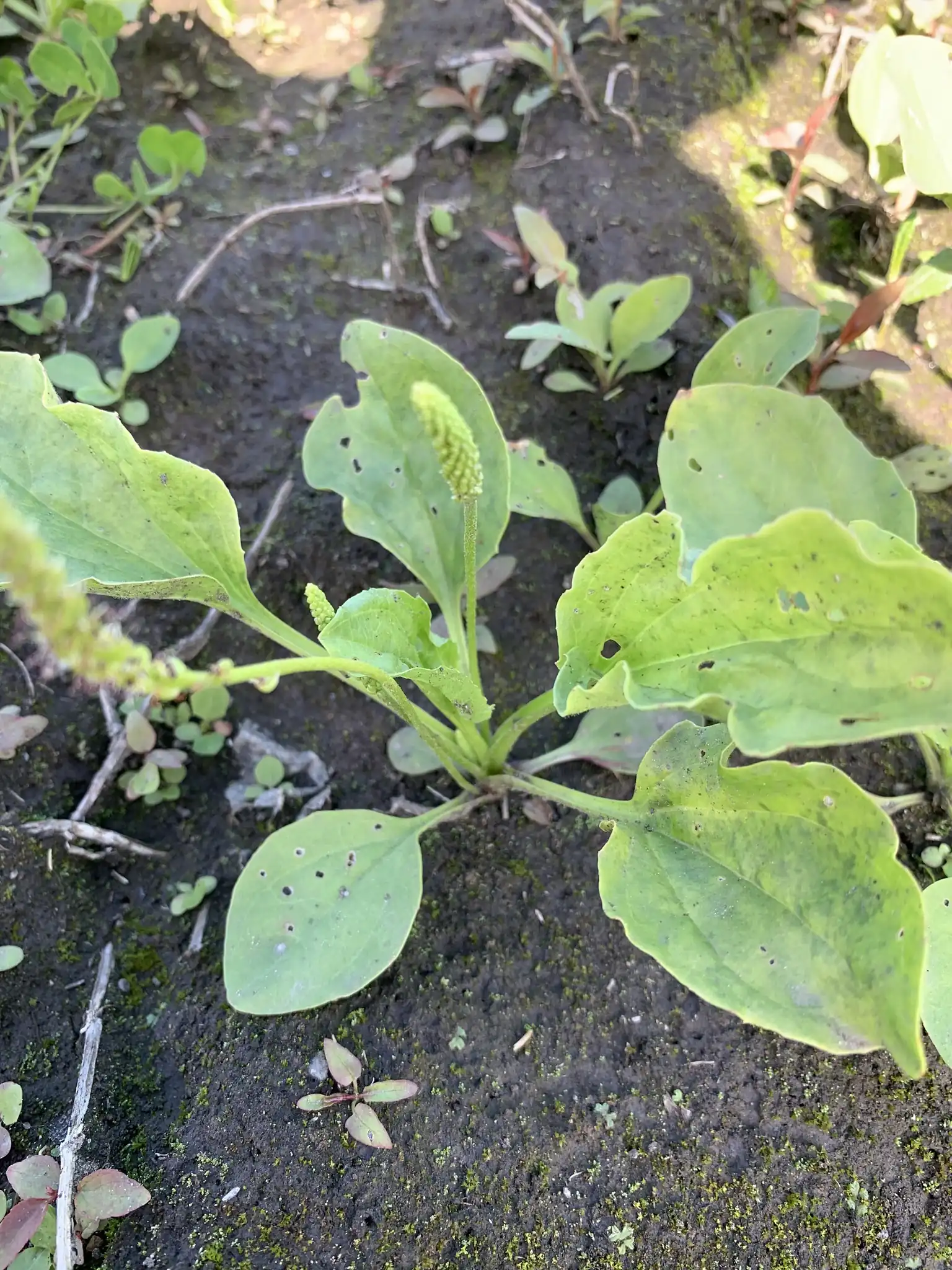
Plantago major, broadleaf plantain, is a low rosette-forming perennial from Eurasia, now naturalised across almost every temperate region on earth. Broad oval ribbed leaves lie flat against the ground on short channelled stalks, and leafless flowering stems under a foot tall carry slim greenish spikes of tiny flowers through summer.
It is the lawn weed nearly everyone recognises, and it thrives precisely where grass fails — compacted, trodden ground — so a spreading patch is usually telling you the soil needs aerating rather than that the plant needs killing. The young leaves are edible cooked like spinach, and it is a genuine wildlife plant: birds strip the oil-rich seed.
Uses & Benefits:
Essentials
At a Glance
Plant Type
Perennial
Height
8"
Width
12"
Light
Full Sun, Partial Sun
Zones
4, 5, 6, 7, 8, 9, 10
Water
Moderate
Humidity
Moderate
Lifespan
Perennial
Native To
Europe and central Asia
Toxicity
Non-toxic; young leaves are edible
Bloom period
Summer – Mid-summer
In flower about 2 months of the year
Planting
How to Grow
- Expect it wherever soil is compacted or trodden.
- Aerate compacted ground rather than only pulling tops.
- Dig out the whole taproot if you want it gone.
- Harvest young leaves before the plant flowers.
- Leave a patch for seed-eating birds if you can.
- Cut flowering spikes early to limit self-seeding.
Pro Tip
A plantain patch is a soil report, not a plant problem — it colonises compaction, so aerating fixes the cause the weeding never will.
Keep It Thriving
Care Guide
Do
- Read it as a sign of compacted soil 🧭
- Aerate the ground to discourage it 🍴
- Harvest young leaves for the kitchen 🥬
- Leave seed heads for birds 🐦
Don't
- Pull the tops and expect it gone ❌
- Ignore what the compaction is telling you ❌
- Let it seed through a fine lawn ❌
Seasonal Care Calendar
| Task | Jan | Feb | Mar | Apr | May | Jun | Jul | Aug | Sep | Oct | Nov | Dec |
|---|---|---|---|---|---|---|---|---|---|---|---|---|
| Control | ||||||||||||
| Harvest |
Watch Out For
Pests & Diseases
Common Pests
Common Diseases
In the Garden
Landscape Uses & Companions
Landscape Uses
Multiply
Propagation Methods
Good to Know
Common Questions
Purple-leaved Plantain questions
What zones can Purple-leaved Plantain grow in?
Purple-leaved Plantain is hardy in USDA Zones 4–10. Inside that range it survives winter in the ground; outside it, grow it as an annual or a container plant you protect.
Is Purple-leaved Plantain deer resistant?
Yes — Purple-leaved Plantain is rated deer-resistant. Deer typically pass it over, though extreme hunger can override any plant's defenses.
When does Purple-leaved Plantain bloom?
Purple-leaved Plantain typically blooms in summer through mid-summer. Exact timing shifts a week or two with your zone — Sow's bloom calendar maps it to your garden.
Does Purple-leaved Plantain need full sun?
Purple-leaved Plantain does best in full sun to part shade. In hot climates, afternoon shade keeps blooms fresher longer.
Is Purple-leaved Plantain drought tolerant?
Yes — once established (usually after the first full season), Purple-leaved Plantain handles dry spells with minimal watering. Water deeply its first year to build the root system that makes that possible.
More Plantago to compare
Keep exploring
Explore the genus
Grow Purple-leaved Plantain with confidence
See it in a design of your actual yard, get zone-matched care reminders, and track it season by season in your garden journal.